Hindu religious sentiments insulted as Christian man posted derogatory remarks targeting Hindu deities on WhatsApp status
 Meerut, Uttar Pradesh, India
  7 August, 2026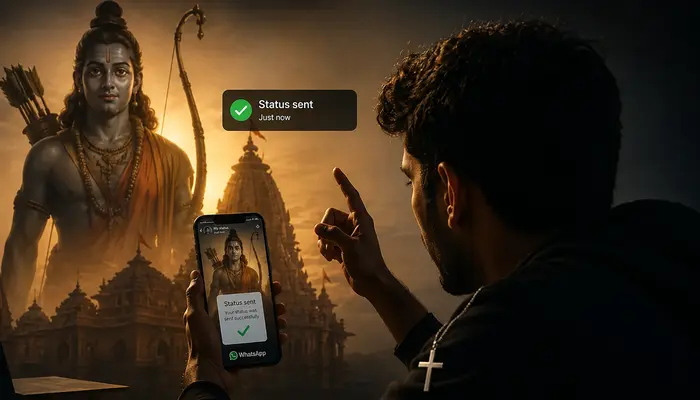
Case Summary
Hindu religious sentiments were outraged after a Christian man named Gyanesh alias Jesus posted derogatory remarks targeting Hindu deities on his WhatsApp status. The accused, Gyanesh alias Jesus, a Canada-based engineer residing in Jagriti Vihar Sector 7, Meerut, Uttar Pradesh, who was present in India at the time of the incident, had shared objectionable content that insulted revered Hindu gods and goddesses, causing outrage among members of the Hindu community. The matter came to light after officials of the Narsingh Hindu Vahini approached the Medical Police Station and demanded action against Gyanesh. The organisation’s L. Block President Naveen Tyagi, General Secretary Ravi Chauhan, and other members reached the police station, where Ravi Chauhan submitted a complaint along with screenshots of the objectionable WhatsApp statuses. The complainant stated that the accused had posted similar offensive content on multiple occasions. Following the complaint, the police registered a First Information Report (FIR) and initiated action against Gyanesh. City Superintendent of Police Vinayak Gopal Bhosale confirmed that the accused had posted the objectionable statuses and had been arrested in connection with the case. The incident constituted an act of hate speech targeting the Hindu community as the accused deliberately used a public social media platform to publish derogatory remarks against Hindu religious figures and objects of worship. The dissemination of such content through WhatsApp status demonstrated an intent to publicly insult and provoke sentiments associated with the religious beliefs of Hindus. By targeting revered deities, the accused’s actions directly attacked symbols that hold deep spiritual significance for the Hindu community.
Why it is Hate Crime ?
The first primary category for this case is: Hate speech against Hindus. The subcategory for this case is: Anti-Hindu slurs and mocking faith. Anti-Hindu slurs and the deliberate mocking of the Hindu faith owing to religious animosity involve the usage of derogatory terms, stereotypes, or offensive references to religious practices, symbols, or figures. One of the common anti-Hindu slurs used against Hindus is “cow-worshipper” and “cow piss drinker”. The intention of using this term is to demean and mock Hindus as a group and their religious beliefs since Hindus consider the cow holy. Additionally, some symbols and the slurs attached to them have a historical context that exacerbates the insult, hate, stereotyping, dehumanisation and oppression against Hindus. Cow worship has been used for centuries to denigrate Hindus, insult their faith and oppress Hindus specifically as a religious group. There has been overwhelming documentation about how cow slaughter has been used to persecute Hindus, with cow meat being thrown in temples and places of worship. There has also been overwhelming documentation where cow meat (beef) has been force-fed to Hindus to either forcefully convert them to Islam or denigrate their faith. Apart from cow worship, the Swastika – which holds deep religious significance for the Hindus – has also been misinterpreted and distorted to use as a slur against Hindus. Similarly, the worship of the Shivling has been used by supremacist ideologies and religions to denigrate Hindus owing to religious animosity. Such slurs and denigration stem from inherent animosity and hate towards Hindus and their faith; therefore, it is categorised as hate speech targeted at Hindus specifically owing to their religious identity. This incident constituted a hate speech case targeting Hindus because the accused deliberately used a public social media platform to publish derogatory remarks against Hindu gods and goddesses, thereby insulting sacred figures central to Hindu religious belief. The accused shared objectionable content through his WhatsApp status, which was accessible to others, demonstrating an act of public denigration rather than a private expression of personal opinion. By targeting revered Hindu deities, the accused’s actions directly attacked symbols of worship that hold deep spiritual and cultural significance for millions of Hindus. The deliberate mocking and insult of Hindu religious figures constitutes anti-Hindu hate speech because Hindu deities are not merely cultural figures but are worshipped as divine entities by devotees. Attacks against such figures are inherently directed at the religious identity of Hindus, as they seek to ridicule and undermine beliefs, traditions, and practices that form an integral part of Hinduism. The accused’s use of derogatory remarks against gods and goddesses was not framed as a theological discussion or criticism of religious ideas but as offensive content intended to demean and provoke sentiments associated with the Hindu faith. The incident reflected a pattern of targeting Hindu religious symbols through abusive language and online dissemination. Social media platforms provide the ability for such content to reach a wider audience, amplifying the impact of derogatory remarks against a religious community. By posting objectionable content as a WhatsApp status, the accused made the remarks available for circulation among his contacts, thereby increasing their potential to offend and hurt the religious sentiments of Hindus. The matter came to attention after members of the Narsingh Hindu Vahini approached the Medical Police Station with screenshots of the objectionable posts and sought legal action. The complainants stated that the accused had repeatedly shared similar offensive content targeting Hindu religious beliefs. Following the complaint, police registered an FIR and arrested Gyanesh alias Jesus in connection with the case. The repeated publication of derogatory remarks against Hindu deities demonstrated a deliberate attempt to insult and ridicule sacred figures revered by the Hindu community. Such acts contribute to the spread of religious hostility by normalising contempt towards Hindu beliefs and practices. Therefore, the incident was categorised as hate speech against Hindus under the subcategory of anti-Hindu slurs and mocking of the Hindu faith, as the accused’s actions specifically targeted Hindu religious figures and sought to demean the faith and sentiments of its followers. Disclaimer: The Hinduphobia Tracker records incidents based on when an event occurred or when the victim's ordeal began. In this case, the media reports did not specify the exact date on which the accused posted the objectionable WhatsApp status. Therefore, for documentation purposes, the date has been recorded based on when the incident was reported in the media, 7 August 2026.


Case Status
Arrested


Perpetrators Details
Perpetrators
Christian Extremists
Perpetrators Range
One Person
Perpetrators Gender
male
 Sources




