Hindu faith targeted; Muslim man posts derogatory remarks about Hindu deities and Hindu saints on social media
 Raipur, Chhattisgarh, India
  4 August, 2026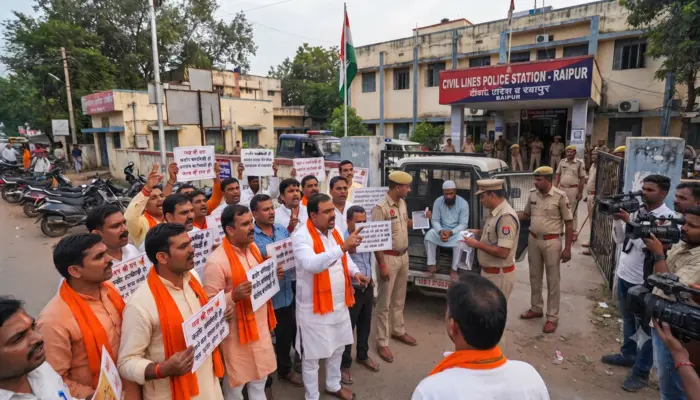
Case Summary
In Raipur, Chhattisgarh, Hindu religious sentiments were hurt after a Muslim man, identified as Wasim Ahmed, posted derogatory remarks about Goddess Sita and Hindu saints on social media. The accused, Wasim Ahmed, a resident of the Raja Talab area of Raipur, shared the objectionable content through an Instagram account identified as "_wasim_ahmed_1." The posts triggered outrage among members of the Hindu community, who demanded strict action against the accused for insulting Hindu religious figures. Following the incident, members of the Bajrang Dal gathered at the Civil Lines Police Station and staged a protest demanding legal action against the accused. The organisation submitted a memorandum stating that if immediate action was not taken, it would launch a larger agitation. Chhattisgarh Bajrang Dal State Co-convenor Vijendra Verma stated that the posts targeted Hinduism and urged the authorities to initiate strict legal proceedings against those responsible. Acting on the complaint, the police registered a FIR and initiated an investigation into the matter. Police officials stated that the Instagram account, the disputed posts, and other digital evidence were being examined to establish the identity of the account holder and determine the relevant offences. Authorities also appealed to the public not to circulate unverified content relating to the case while the investigation continued. As of the date of writing this report, the investigation was ongoing.
Why it is Hate Crime ?
This case is added to the tracker under the primary category- Hate Speech against Hindus. The subcategory selected is- Anti-Hindu slurs, mocking faith. Anti-Hindu slurs and the deliberate mocking of the Hindu faith owing to religious animosity involve the usage of derogatory terms, stereotypes, or offensive references to religious practices, symbols, or figures. One of the common anti-Hindu slurs used against Hindus is “cow-worshipper” and “cow piss drinker”. The intention of using this term is to demean and mock Hindus as a group and their religious beliefs since Hindus consider the cow holy. Additionally, some symbols and the slurs attached to them have a historical context that exacerbates the insult, hate, stereotyping, dehumanisation and oppression against Hindus. Cow worship has been used for centuries to denigrate Hindus, insult their faith and oppress Hindus specifically as a religious group. There has been overwhelming documentation about how cow slaughter has been used to persecute Hindus with cow meat being thrown in temples and places of worship. There has also been overwhelming documentation where cow meat (beef) has been force-fed to Hindus to either forcefully convert them to Islam or denigrate their faith. Apart from cow worship, the Swastika – which holds deep religious significance for the Hindus – has also been misinterpreted and distorted to use as a slur against Hindus. Similarly, the worship of the Shivling has been used by supremacist ideologies and religions to denigrate Hindus owing to religious animosity. Such slurs and denigration stem out of inherent animosity and hate towards Hindus and their faith, therefore, it is categorised as hate speech targeted at Hindus specifically owing to their religious identity. This case has been added to the hate crime database because the Muslim accused published explicit derogatory remarks targeting Goddess Sita and Hindu saints on a public social media platform, thereby deliberately mocking sacred figures revered by the Hindu community. The accused utilised his Instagram handle to circulate content that denigrated central objects of Hindu devotion, demonstrating a clear awareness and effort to hurt religious sentiments and provoke community-wide outrage. The deliberate publication of this content on a widely accessible digital medium transformed the action from a private expression into a targeted manifestation of religious hostility directed at Hindus as a collective group. Hindu deities and revered saints occupy a foundational position within Hinduism, embodying the spiritual identity, devotional practices, and moral framework of millions of practitioners. Directing offensive and mocking commentary at Goddess Sita and religious figures constitutes an assault on the core religious markers of the faith. The selection of these specific spiritual symbols demonstrates that the Hinduism as a religion was explicitly targeted, as the insults were designed to degrade the religious figures of worship that anchor Hindu religious life. The conduct matched the selected category of anti-Hindu slurs and mocking of faith through the intentional distortion and ridicule of revered spiritual figures to demean practitioners as a collective body. The accused weaponised digital platforms to ridicule sacred associations that hold deep meaning for Hindus. This form of expression relies on animosity toward Hindu religious traditions, turning sacred figures into vehicles for public humiliation and religious degradation. The choice of social media as the dissemination channel acted as a force multiplier for this religious hostility, ensuring the inflammatory material reached a broad audience beyond the immediate locality. This digital propagation mirrored historical patterns wherein religious markers of the targeted populations, the Hindu community in this case, are deliberately profaned to inflict collective emotional distress and reinforce social dominance. When derogatory or insulting content targeting Hindu religious beliefs is spread online, it does not just affect one incident or one individual. It contributes to a wider atmosphere where hostility, contempt, and prejudice against Hindus become more normalised. Because the conduct specifically targeted Hindu religious identity, it qualifies as a religiously motivated hate crime. Disclaimer: The exact date on which the derogatory remarks targeting Goddess Sita and Hindu saints were first posted on social media was not specified in the available sources. However, the reports indicated that the objectionable content had surfaced before Hindu organisations lodged a complaint and staged a protest on 5th August 2026. The tracker records incident dates based on when the crime occurred rather than when it was reported or published. In this case, 5th August 2026 has been used as the indicative incident date for documentation purposes only.


Case Status
Complaint registered


Perpetrators Details
Perpetrators
Muslim Extremists
Perpetrators Range
One Person
Perpetrators Gender
male
 Sources




