Anti-Hindu hate speech: Indian airline employee insults Lord Ram and mocks Hindu beliefs on Instagram
 India
India  5 August, 2026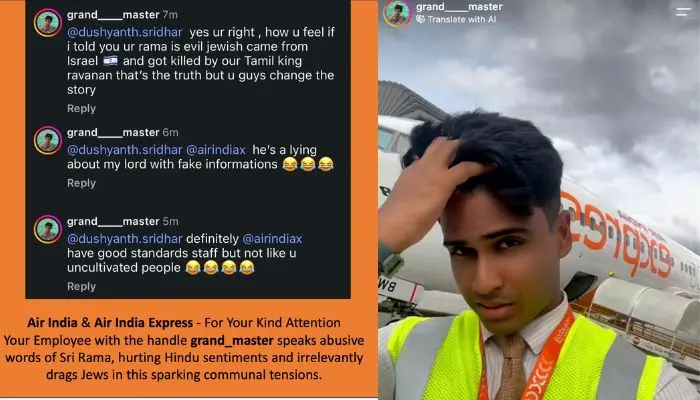
Case Summary
Hindu religious sentiments were outraged after an Air India employee, identified as Veeravel, using the Instagram handle "grand__master", posted abusive comments on Instagram targeting Hinduism and Lord Sri Ram. He mocked Lord Ram by referring to him as an "evil Jewish" figure and wrote, "How you feel if I told you your Rama is evil Jewish came from Israel, and got killed by our Tamil king Ravana, that’s the truth, but u guys change the story." The comments were directed at Vedic speaker Dushyanth Sridhar and other social media accounts that regularly shared Hindu religious content. Veeravel also used abusive language against such accounts and described Dushyanth Sridhar as an "uncultivated" person while portraying himself as an example of the "good standards" maintained by Air India employees. Screenshots of the comments circulated widely on social media, prompting strong condemnation from Hindu devotees and other users, who stated that the remarks insulted Lord Rama, hurt Hindu religious sentiments, and had the potential to create communal tension. Many social media users called upon Air India to take appropriate action against the employee over his conduct.
Why it is Hate Crime ?
The first primary category for this case is: Hate speech against Hindus. The subcategory for this case is: Anti-Hindu slurs and mocking faith. Anti-Hindu slurs and the deliberate mocking of the Hindu faith owing to religious animosity involve the usage of derogatory terms, stereotypes, or offensive references to religious practices, symbols, or figures. One of the common anti-Hindu slurs used against Hindus is “cow-worshipper” and “cow piss drinker”. The intention of using this term is to demean and mock Hindus as a group and their religious beliefs since Hindus consider the cow holy. Additionally, some symbols and the slurs attached to them have a historical context that exacerbates the insult, hate, stereotyping, dehumanisation and oppression against Hindus. Cow worship has been used for centuries to denigrate Hindus, insult their faith and oppress Hindus specifically as a religious group. There has been overwhelming documentation about how cow slaughter has been used to persecute Hindus, with cow meat being thrown in temples and places of worship. There has also been overwhelming documentation where cow meat (beef) has been force-fed to Hindus to either forcefully convert them to Islam or denigrate their faith. Apart from cow worship, the Swastika – which holds deep religious significance for the Hindus – has also been misinterpreted and distorted to use as a slur against Hindus. Similarly, the worship of the Shivling has been used by supremacist ideologies and religions to denigrate Hindus owing to religious animosity. Such slurs and denigration stem from inherent animosity and hate towards Hindus and their faith; therefore, it is categorised as hate speech targeted at Hindus specifically owing to their religious identity. This incident constituted a hate incident because the accused deliberately used social media to insult and ridicule one of the most sacred figures in Hinduism, Lord Sri Ram, through abusive and derogatory remarks, targeting the religious beliefs of millions of Hindus. Rather than expressing disagreement with Hindu theology or engaging in legitimate criticism, the accused referred to Lord Rama as "evil Jewish" and asserted that he "came from Israel" and was "killed by our Tamil king Ravana", further accusing Hindus of having "changed the story". These statements were not presented as historical or academic arguments but were framed in a mocking and contemptuous manner to belittle Lord Rama and undermine the sanctity of the Ramayana, one of Hinduism's most revered scriptures. By portraying a deeply venerated deity as evil and ridiculing the foundational narrative associated with him, the accused attacked a central pillar of Hindu religious belief and identity. For Hindus, Lord Rama is not merely a literary or mythological character but a deity worshipped as the embodiment of righteousness, virtue, justice, and dharma. He is revered across diverse Hindu traditions, and the Ramayana forms an integral part of Hindu religious practice, philosophy, festivals, and cultural life. Consequently, publicly abusing Lord Rama and mocking the beliefs surrounding him amounts to an attack on a sacred religious symbol that is central to the faith of millions of devotees. Such remarks were inherently directed at the religion itself, as they sought to denigrate an object of worship that holds immense spiritual significance for Hindus. The accused also referred to Ravana as "our Tamil king" while contrasting him with Lord Rama in a manner intended to glorify Ravana and demean the Hindu deity. Within the context of the comments, this was not a discussion of alternative cultural traditions or literary interpretations but a deliberate attempt to mock a figure revered by Hindus and provoke devotees by inverting the religious narrative of the Ramayana. Coupled with the accusation that Hindus had "changed the story", the comments sought to portray the religion's sacred traditions as false while insulting its principal deity. The religiously targeted nature of the incident was further reinforced by the fact that the accused directed these remarks towards Vedic speaker Dushyanth Sridhar and social media accounts dedicated to sharing Hindu religious teachings and devotional content. Instead of limiting his comments to disagreement with a speaker's views, the accused used the opportunity to abuse Lord Rama and demean Hindu religious beliefs. This demonstrated that the hostility extended beyond a personal dispute and was directed at Hinduism and those engaged in promoting or practising the faith. The fact that these remarks were posted publicly on Instagram significantly amplified their impact. Social media enables such content to reach a vast audience within a short period, exposing large numbers of Hindu users to abusive statements targeting their faith. The widespread circulation of screenshots and the ensuing outrage reflected the extent to which the comments were perceived as offensive by the Hindu community. Public dissemination of content that mocks revered deities and denigrates the beliefs of an identifiable religious community fosters an atmosphere of hostility towards that community and normalises contempt for its religious identity. For these reasons, the incident constituted a hate incident directed against Hindus, as the abusive comments specifically targeted a revered Hindu deity and sought to ridicule and insult the core religious beliefs of the Hindu community. Disclaimer: The Hinduphobia Tracker records incidents based on when an event occurred or when the victim's ordeal began. It is important to clarify that none of the media sources covering this case has specified the exact date when the accused made those statements. Therefore, for documentation purposes, we have recorded the date based on when the incident was reported in the media, 6 August 2026.


Case Status
Unknown


Perpetrators Details
Perpetrators
Others
Perpetrators Range
One Person
Perpetrators Gender
male
 Sources




