Sacred Kanwar Yatra attacked, devotees assaulted for chanting Jai Shri Ram by Muslim mob in Birbhum, West Bengal
 Birbhum district, West Bengal, India
  31 July, 2026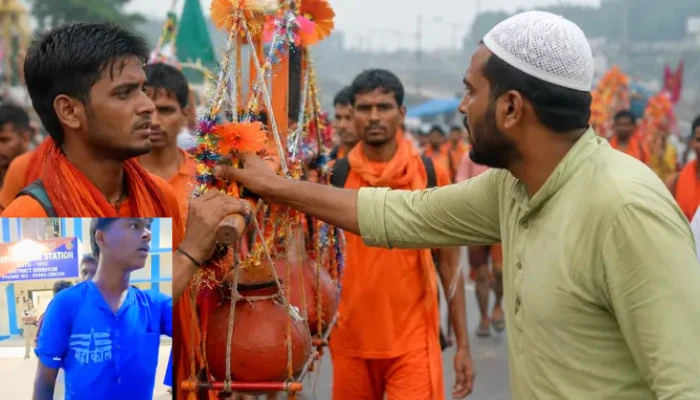
Case Summary
In Labhpur, Birbhum district, West Bengal, Hindu Kanwar pilgrims carrying holy water to offer at a Shiva temple were obstructed and assaulted by Muslim residents. The Kanwariyas were attacked after they chanted ‘Jai Shri Ram’ during their religious procession. The incident triggered protests and a police station gherao by Hindu devotees who demanded the immediate arrest of those responsible. The Hindu Kanwar pilgrims were travelling towards Tarakeswar while carrying Kanwar containing holy water for offering to Lord Shiva. During the religious procession, the pilgrims chanted ‘Jai Shri Ram’. The Muslim residents objected to the chanting and began threatening the pilgrims. When the pilgrims protested against the opposition, two Kanwar pilgrims were assaulted, and their religious journey was obstructed. While Prabhatkhabar report mentions residents, the Hinduvoice handle on X(formerly Twitter) mentions them as Islamists. A video circulated on social media where the Hindus were seen getting beaten by Muslim men for chanting ‘Jai Shri Ram’. Following the assault, a large number of Hindu Kanwariyas gathered outside Labhpur police station during the night and protested against the incident. The protesters raised slogans demanding strict legal action and the immediate arrest of those who had assaulted the Kanwar pilgrims. The protesters also set tyres on fire on the road, blocking traffic for a period of time. Senior police and administrative officials reached the spot and held discussions with the protesters in an attempt to restore calm. The police assured the protesters that the incident would be investigated and that necessary legal action would be taken against those responsible. Additional police personnel were deployed in the area, while the authorities continued to monitor the situation.
Why it is Hate Crime ?
The primary category selected in this case is Attack not resulting in death. The subcategory selected is Attack on a Hindu religious procession. The outward celebration and display of religious symbols is an intrinsic part of Hinduism. Religious processions on various festivals are age-old traditions and a way to manifest faith and form a part of the religious practices of Hindus. On several occasions, such religious processions come under attack by non-Hindu mobs, in a manifestation of their animosity towards Hinduism and its practices. The reasons cited for such violent attacks are many and range from crossing a non-Hindu resident-dominated area to playing loud music, crossing from an area where there is a religious structure of another faith, etc. The violent attacks are triggered by the outward display of religiosity by Hindus. The attacks are mainly a manifestation of religious supremacist doctrine, which believes that idolatry, essentially the Hindu faith, deserves to be annihilated since the very tenets of Hinduism, its practices and traditions are considered a sin in those doctrines. Since these attacks emanate from intrinsic and doctrinal animosity towards Hindus and Hinduism, it is considered a religiously motivated hate crime under this category. The other subcategory selected in this case is: Attack against Hindu devotees. Hindu devotees are a few of the easiest targets of religiously motivated hate crimes because during the festival/procession/puja, etc, for non-Hindus it is easy to profile their victims based on religion. Hindu devotees come under attack on several occasions by individual non-Hindus or mobs of non-Hindus owing to their animosity against Hinduism, its symbols and tradition/practices. There are several instances of Hindu devotees being attacked while they worship in temples or temporary religious structures, during religious processions, doing bhajan/kirtan/puja in their own homes, in the residential society, etc. These attacks are perpetrated by non-Hindus primarily because of their animosity towards Hindus and their faith. In some cases, the trigger for the violence may be non-religious; however, two elements make these hate crimes. First, the Hindus who come under attack are attacked violently while indulging in religious activity. Whether they are in a place of worship or not is immaterial to the crime. When individuals are attacked while indulging in religious practices, the attack in itself is a hindrance to their freedom to practice religion and therefore constitutes a hate crime. Secondly, religious supremacist doctrines and ideologies deem religious practices of Hindus to be offensive ab initio since they are considered “sinful” by these ideologies, worthy to be annihilated by force or coercion. Driven by these religious supremacist ideologies and doctrines, the attacks against Hindu devotees stem from intrinsic animosity towards Hinduism. In some cases, the trigger for the violence may be non-religious; however, it develops into a religiously motivated crime during the course of the violence. Since these attacks stem from animosity towards Hindus and Hinduism, they are considered religiously motivated hate crimes under this category. The other subcategory selected is: Attacked for opposing radicals or trying to save a victim. In several cases, Hindus are attacked for opposing religiously motivated crimes being committed against a fellow Hindu or simply for voicing an opinion opposing radical elements, who either have in the past or continue to persecute Hindus. In such cases, the initial attack against the victim, against which the Hindu was trying to defend the victim, would also need to be classified as a religiously motivated hate crime. Since the initial crime itself was religiously motivated and the subsequent crime of attempting to save the victim or speaking against the radical elements ends up inviting a violent attack, it would also be classified as a religiously motivated hate crime under this category. This case was included in the Hinduphobia Tracker because the violence was triggered by the public expression of Hindu faith during a sacred religious observance. The objection to the chanting of ‘Jai Shri Ram’ established the religious nature of the confrontation. The subsequent threats and physical assault showed that the hostility was directed at Hindu devotees in the course of their religious practice, rather than arising from an unrelated personal or local dispute. The Kanwar Yatra holds deep religious significance for Hindus as a pilgrimage undertaken in devotion to Lord Shiva. Kanwariyas carry holy water as an offering to the deity, making the journey itself an act of worship, devotion and religious observance. The Kanwar is not an ordinary object carried in a public procession but forms a part of a sacred ritual. Likewise, chanting the name of Lord Ram was a form of Hindu religious expression. Together, these practices made the devotees' religious identity and the nature of their activity plainly visible. Consequently, interference with the procession was not merely interference with movement through a public space. It affected the devotees while they were exercising their faith in a recognised religious manner. Hindu religious processions traditionally allowed devotees to take their worship beyond the confines of a temple and express their faith collectively in public. The ability to undertake such observances without intimidation was therefore an important aspect of religious freedom. Violence directed at devotees in this setting had the effect of restricting that freedom. The circumstances also distinguished the incident from an ordinary disagreement over public conduct. The immediate point of contention was a Hindu religious chant, and the confrontation escalated when the devotees resisted the attempt to stop or suppress that expression. The religious element therefore remained present throughout the escalation. It was not merely incidental to the violence; it provided the context in which the hostility arose and the reason why the victims became targets. The conduct also had a wider significance for Hindu devotees. When Hindu devotees were attacked while visibly engaged in religious practice, the impact extended beyond those directly assaulted. Such violence created an atmosphere of intimidation which implied that Hindus could be discouraged from openly participating in religious processions, chanting devotional names or displaying their faith in public. The effect was therefore not limited to causing physical harm but also included restricting the public exercise of Hindu religious identity. Moreover, the victims were identifiable through their participation in a distinctly Hindu religious observance. They were not targeted in circumstances where their religious identity was incidental or unknown. Their participation in the pilgrimage made their religious affiliation apparent, while the objection to their religious chant connected that identity directly with the hostility directed towards them. Furthermore, the response to the devotees’ resistance demonstrated a conscious disregard for their religious rights. Instead of allowing the devotees to continue their observance or resolving the disagreement through lawful means, the situation escalated into threats and physical violence. This showed that the perpetrators treated the religious expression of the devotees as something that could be forcibly suppressed. Such conduct reflected contempt for the equal right of Hindu devotees to practise their religion openly. The intention behind the conduct was consequently to intimidate and discourage the devotees from freely expressing their Hindu faith and to obstruct their religious observance. The escalation from opposition to threats and then physical violence demonstrated that the perpetrators used coercion rather than lawful means to achieve that end. Their conduct sought to make the exercise of Hindu religious expression conditional on the acceptance of those who opposed it. Thus, the conduct demonstrated hostility towards Hindu religious practice and imposed violence as a means of suppressing its public expression. It therefore constituted a religiously motivated hate crime and warranted inclusion in the Hinduphobia Tracker. Date Disclaimer: The Hinduphobia Tracker records incidents based on the date on which the victim's ordeal began. As the exact date on which the assault took place was not available in the source material, 1 August 2026 has been used for documentation purposes, as Hindu pilgrims protested and gheraoed the Labhpur police station on that date in opposition to the attack.
Victim Details
Total Victim
2
Deceased
0
Gender
- Male 2
- Female 0
- Third Gender 0
- Unknown 0
Caste
- SC/ST 0
- OBC 0
- General 0
- Unknown 2
Age Group
- Minor 0
- Adult 2
- Senior Citizen 0
- Unknown 0


Case Status
Unknown


Perpetrators Details
Perpetrators
Muslim Extremists
Perpetrators Range
Unknown
Perpetrators Gender
unknown
 Sources




