Anti-Hindu hate speech: Islamic cleric labels Kanwariyas 'terrorists', mocks Lord Shiva and vilifies sacred Kanwar Yatra
 Delhi, Delhi, India
  6 August, 2026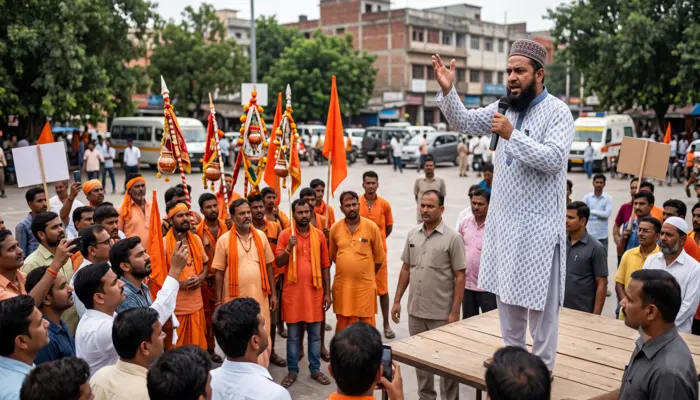
Case Summary
Hindu religious sentiments were hurt after an Islamic cleric, Maulana Sajid Rashidi, President of the All India Imam Association, made derogatory remarks against Kanwariyas (Hindu pilgrims who undertake the sacred Kanwar Yatra) by calling them "terrorists". In the course of his remarks, he also mocked Lord Shiva and vilified the Kanwar Yatra, a sacred Hindu pilgrimage. According to media reports, the accused made these derogatory remarks on 6 August 2026. During his comments, he referred to a few incidents of law and order violations involving some miscreants, as well as an alleged incident of Kanwariyas looting people. However, he did not cite any evidence to substantiate these allegations. Relying on these claims, he questioned whether such individuals could be regarded as devotees of Lord Shiva and stated that they were "not Shiv Bhakts but terrorists". During the same remarks, Rashidi mocked Lord Shiva by asking whether Lord Shiva had taught his devotees to loot people. Rashidi further claimed that although some Kanwariyas peacefully completed the pilgrimage, 70 to 75 per cent of those undertaking the Kanwar Yatra did so only for intoxication and mischief. He contrasted the pilgrimage with earlier controversies surrounding the offering of namaz on public roads, alleging that Kanwariyas similarly caused public inconvenience through dancing, intoxication and disorderly conduct. On this basis, he branded 70 to 75 per cent of Kanwariyas as "terrorists", despite providing no evidence to support such a sweeping characterisation. The remarks sparked widespread criticism from political leaders across party lines. Union Minister Ramdas Athawale stated that even if a few Kanwariyas had committed criminal acts, it was wrong to brand the entire community as terrorists. He said that the actions of a handful of individuals could not be used to defame Hindu devotees participating in the Kanwar Yatra. Several other leaders also condemned Rashidi's statements. Bharatiya Janata Party MP Janardan Singh Sigriwal described the remarks as an attack on Hindu religious faith and said that carrying the Kanwar was a profound expression of devotion to Lord Shiva. Bihar Minister Mithilesh Kumar Tiwari, BJP Bihar Vice-President Pawan Jaiswal, and Rashtriya Janata Dal Chief Spokesperson Shakti Singh Yadav likewise criticised Rashidi, stating that no religion or its followers should be insulted because of the actions of a few individuals. Notably, the Kanwar Yatra is an annual Hindu pilgrimage observed during the sacred month of Shravan by devotees of Lord Shiva, known as Kanwariyas. During the pilgrimage, millions of devotees undertake arduous journeys on foot, travelling to revered Hindu pilgrimage sites such as Haridwar, Gaumukh and Gangotri in Uttarakhand to collect sacred water from the River Ganga. They carry the holy water in decorated bamboo slings known as kanwars and return to their local temples, where it is ceremonially offered to Lord Shiva as an act of devotion, penance and spiritual merit.
Why it is Hate Crime ?
This case has been added to the tracker under the primary category- Hate Speech against Hindus. The subcategory selected is- Anti-Hindu slurs, mocking faith. Anti-Hindu slurs and the deliberate mocking of the Hindu faith owing to religious animosity involve the usage of derogatory terms, stereotypes, or offensive references to religious practices, symbols, or figures. One of the common anti-Hindu slurs used against Hindus is “cow-worshipper” and “cow piss drinker”. The intention of using this term is to demean and mock Hindus as a group and their religious beliefs since Hindus consider the cow holy. Additionally, some symbols and the slurs attached to them have a historical context that exacerbates the insult, hate, stereotyping, dehumanisation and oppression against Hindus. Cow worship has been used for centuries to denigrate Hindus, insult their faith and oppress Hindus specifically as a religious group. There has been overwhelming documentation about how cow slaughter has been used to persecute Hindus with cow meat being thrown in temples and places of worship. There has also been overwhelming documentation where cow meat (beef) has been force-fed to Hindus to either forcefully convert them to Islam or denigrate their faith. Apart from cow worship, the Swastika – which holds deep religious significance for the Hindus – has also been misinterpreted and distorted to use as a slur against Hindus. Similarly, the worship of the Shivling has been used by supremacist ideologies and religions to denigrate Hindus owing to religious animosity. Such slurs and denigration stem out of inherent animosity and hate towards Hindus and their faith, therefore, it is categorised as hate speech targeted at Hindus specifically owing to their religious identity. This case represents a clear example of religiously driven hate speech, as the Muslim perpetrator made derogatory remarks against Kanwariyas, mocked Lord Shiva, and attempted to vilify the sacred Kanwar Yatra, an annual Hindu pilgrimage. Rather than offering a constructive critique regarding public administration or order, the statements targeted a major Hindu religious tradition through extreme generalisations and disparaging remarks. By directing such language at a defining practice of the faith, the rhetoric functioned as an intentional assault on Hindu religious identity, making it a distinct instance of targeted hate speech. The Kanwar Yatra holds immense religious significance for millions of devotees of Lord Shiva, serving as a profound expression of Hindu piety, discipline, and devotion. During this sacred pilgrimage, Kanwariyas undertake gruelling physical penances, travelling long distances on foot to collect holy water from the River Ganga and carry it back to local temples in decorated bamboo slings (kanwars). The arduous journey involves strict personal discipline, abstinence, and intense physical endurance, all performed as acts of spiritual merit and reverence. Attacking a procession defined by such deep-rooted devotional penance strikes directly at the core of Hindu religious practice. Consequently, making derogatory remarks against Kanwariyas, claiming that the overwhelming majority undertake the pilgrimage solely for intoxication and mischief, and branding them "terrorists" reflects deep-seated religious hostility towards Hinduism, one of its most sacred pilgrimages, and the Hindu community at large. In any large-scale public gathering, festival, or religious congregation, isolated individuals may engage in anti-social or unlawful conduct. Such acts are attributable to the individuals responsible, not to the faith or the wider community they belong to. However, the perpetrator did not confine his criticism to those involved in wrongdoing. Instead, he generalised the supposed misconduct of a handful of individuals to an entire religious pilgrimage, portraying the vast majority of Kanwariyas as intoxicated troublemakers and "terrorists". By reducing a sacred act of devotion observed by millions of Hindus to criminality and substance abuse, the remarks sought to vilify Hindu devotees collectively, demean a revered religious tradition, and incite contempt towards the Hindu community on the basis of its religious identity. As such, the remarks amounted to a clear instance of anti-Hindu hate speech rather than a legitimate criticism of isolated acts of misconduct. Under the pretext of criticising anti-social behaviour, the perpetrator further demonstrated explicit religious hostility by mocking Lord Shiva, asking whether the deity had taught his devotees to loot or rob people. Lord Shiva is one of the principal deities in Hinduism and is worshipped by hundreds of millions of Hindus as the embodiment of compassion, asceticism, and righteousness. Criticism of unlawful acts by specific individuals does not require invoking or ridiculing a sacred religious figure. By sarcastically attributing the supposed misconduct of a few individuals to the teachings of Lord Shiva, the remarks shifted the focus from condemning specific acts to disparaging a central figure of the Hindu faith. This rhetorical device portrayed a revered Hindu deity in a derogatory manner and, by extension, demeaned the religious beliefs of His devotees. Such remarks therefore transcended legitimate criticism of public order and reflected clear religious hostility towards Hinduism and its sacred symbols. The perpetrator also drew a direct comparison between the annual Kanwar Yatra and the offering of namaz on public roads, employing a false equivalence specifically designed to vilify a sacred Hindu pilgrimage. The Kanwar Yatra is an annual, centuries-old traditional pilgrimage observed during the holy month of Shravan, conducted along pre-designated routes with required permissions and full coordination from law enforcement and local administration. Conversely, the practice of offering namaz on public roads occurs on a weekly basis, often occupying random public streets without administrative sanction, creating recurring logistical challenges, blocking public access, and causing routine inconvenience to the general public. Equating a regulated, once-a-year religious procession with unsanctioned, weekly road blockades is a completely flawed comparison that shifts focus away from the specific conduct of a few individuals and instead attempts to portray the pilgrimage itself as an inherent source of public disorder. By recasting a revered Hindu tradition through the lens of nuisance and disruption, the rhetoric sought to delegitimise a significant Hindu cultural and religious expression. Drawing such an unwarranted parallel served to sanitise actual, recurring public logistics issues by making false equivalences, disparaging the pilgrimage as a whole, reinforcing derogatory stereotypes about Hindu devotees, and demonstrating deep-seated religious hostility aimed at vilifying Kanwariyas. This incident does not appear in isolation but forms part of a broader pattern of public statements made by Sajid Rashidi concerning Hindu beliefs, symbols, and religious institutions. On previous occasions, Rashidi has courted controversy for remarks opposing the Ram Mandir in Ayodhya, including statements in which he spoke about demolishing the temple after its construction. While those statements related to a separate incident, they provide important context in assessing the present case. When viewed alongside his branding of Kanwariyas as "terrorists", his derogatory characterisation of the Kanwar Yatra, and his mocking references to Lord Shiva, the present remarks appear consistent with a recurring pattern of public expressions directed at revered Hindu deities, sacred traditions, and places of worship. Rather than constituting an isolated or impulsive comment, the incident reflects a continuation of rhetoric that repeatedly targets central symbols of the Hindu faith, reinforcing the inference that the remarks were directed not merely at isolated acts of misconduct but at Hindu religious beliefs and practices themselves. Overall, since this case meets the parameters of a religiously driven offence, it is being added to the hate crime database of the Hinduphobia Tracker.


Case Status
Unknown


Perpetrators Details
Perpetrators
Muslim Extremists
Perpetrators Range
One Person
Perpetrators Gender
male
 Sources




