Hindu temples desecrated; Muslim man dumps meat inside Shiva and Hanuman temples in Madhya Pradesh
 Khandwa, Madhya Pradesh, India
  20 July, 2026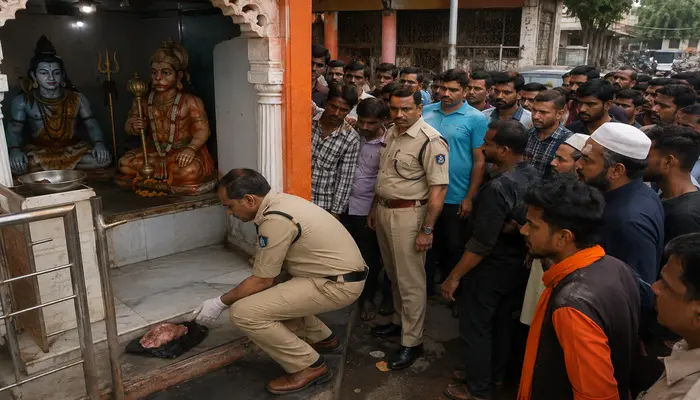
Case Summary
In Khandwa, Madhya Pradesh, the sanctity of two Hindu temples was desecrated by a Muslim man, identified as Razzaq. The accused dumped pieces of meat inside the Shiva Temple and Hanuman Temple in Pandhana town on 21 July 2026. The accused also placed meat directly on top of a Shivalinga inside the Shiva Temple, hurting Hindu religious sentiments. The incident came to light when devotees arrived at the temples for morning worship and discovered pieces of meat inside the premises and on top of the Shivalinga. They informed the police, following which officers reached the spot, removed the meat, registered a case, and launched an investigation. The incident sparked widespread outrage among local Hindu residents and members of Hindu organisations, who gathered at the temple premises demanding strict action against those responsible. In the aftermath of the incident, local residents also installed CCTV cameras around the temples to strengthen security and help identify the perpetrator. A few days later, CCTV footage captured a suspicious individual near the temples. Based on the footage and other evidence collected during the investigation, the police identified and detained Razzaq, son of Ghani Khan. During interrogation, he claimed that he had placed the meat inside the temples after being advised by a tantrik, who had assured him that doing so would make him wealthy and resolve his financial difficulties. The police stated that they were verifying this explanation as part of the ongoing investigation. A video also went viral on social media, showing pieces of meat placed on top of the Shivalinga and the accused Razzaq admitting in the presence of police personnel that he dumped broiler chicken meat in the temple premises. The incident triggered protests by members of several Hindu organisations and local residents, who gathered outside the Pandhana Police Station, surrounded the premises, blocked the road, and submitted a memorandum demanding the immediate arrest of the accused and strict legal action for hurting Hindu religious sentiments. Police officials assured the protesters that appropriate action would be taken, following which the protest concluded. Following the investigation, the police arrested Razzaq. During interrogation, he confessed to dumping the meat inside the Shiva and Hanuman temples. Thereafter, the police took him to the temple premises and recreated the sequence of events, during which he demonstrated how he had committed the act. The police subsequently conducted a public procession of the accused through the locality before producing him before a court, following which he was remanded to judicial custody. The police also attempted to whitewash the crime by claiming that Razzaq's mental condition appeared abnormal during the initial investigation and that he was undergoing a medical examination while the investigation continued.
Why it is Hate Crime ?
In this case, the primary category selected is: Attack on Hindu religious representations. The subcategory selected is: Desecration of Hindu religious symbols. Icons and symbols or a religious representation of a spiritual ideal are widely revered in Hinduism. Iconography is of vital significance in the Hindu milieu. It helps connect people’s spiritual beliefs with the real world. Iconography within the Hindu faith takes several shapes and forms. Murtis are of most significance to Hindus, to which daily rituals, prayers and offerings are done. Besides the murtis, there are several other symbols which have deep significance in the Hindu faith – the Om and Swastika for example. Since these Hindu religious symbols hold paramount importance in Hinduism, any desecration of symbols, icons, murtis, religious representations and manifestations, is driven by animosity towards the faith itself which manifests itself through these murtis, icons and symbols. Therefore, any desecration of these Hindu religious symbols and representations is considered religiously motivated hate crimes under this category. The other subcategory selected is: Defiling religious customs. Sanatan Dharma is not a religion of one book, which is to say that while it has religious scriptures that form the central tenets of the faith, there are several traditions followed through thousands of years, mostly passed from generation to generation orally. There are several such customs and traditions that are followed by various Hindus and Hindu sects. Defiling of these traditions and customs is a breach of an individual or group’s religious practices. Such practices can range from dietary restrictions like not eating non-vegetarian food for a certain period of the year, not eating non-vegetarian food at all, not eating beef since the cow is considered holy in Hinduism, the sanctity of religious customs followed in the house (like many ISCKON devotees), etc. Any malicious action leading to the breach of such traditions or defilement of these traditions owing to animosity towards the faith or for the sake of activism stems not only from the lack of faith in the religion itself but also from disregard for the faith of the devotees who follow the customs/traditions and implicit bias against the faith, the tradition itself. Since these specific traditions are central to the faith of the devotees of that specific sect of Hindus, any non-compliance with these traditional rules would be considered a religiously motivated hate crime. This case constituted a clear example of a religiously motivated hate crime because the Muslim perpetrator deliberately desecrated the sanctity of two Hindu temples by dumping meat inside the Shiva and Hanuman temples and placing it directly on top of the Shivalinga. By specifically targeting sacred Hindu places of worship and one of Hinduism's holiest religious symbols, the act amounted to a deliberate desecration of Hindu temples and religious symbols, causing deep injury to Hindu religious sentiments. In Hinduism, a temple is not merely a physical structure but the abode of the consecrated deity, where devotees worship in an atmosphere of ritual purity and sanctity. Likewise, the Shivalinga is one of the most sacred and widely revered manifestations of Lord Shiva and serves as the focal point of worship for millions of Hindus. Hindu temples observe strict standards of ritual purity, and substances such as meat, alcohol, intoxicants, and activities such as smoking are regarded as incompatible with the sanctity of the temple premises. The purity of both the temple and the Shivalinga forms an essential aspect of Hindu religious practice, making any deliberate contamination of these sacred spaces a direct affront to Hindu faith. The deliberate act of scattering meat across two Hindu temples and placing it directly on top of the Shivalinga demonstrated a conscious desecration of sacred Hindu religious symbols. The perpetrator did not merely discard meat in a public place but specifically selected consecrated Hindu temples and the Shivalinga as the locations where the act would be carried out. The execution of the offence therefore depended upon violating the sanctity of Hindu places of worship and one of Hinduism's most sacred religious representations. This transformed the act from ordinary criminal conduct into one intrinsically directed against Hindu religious symbols and their sacred character. The incident also constituted a deliberate defilement of Hindu religious customs. The preservation of ritual purity is fundamental to Hindu temple worship, and devotees are required to maintain the sanctity of temple premises by ensuring that ritually impure substances are not brought into these sacred spaces. By introducing meat into the temples and placing it upon the Shivalinga despite these well-established religious customs, the perpetrator deliberately violated practices that are central to Hindu worship. The conduct therefore not only desecrated sacred religious symbols but also disrupted the religious customs and devotional practices that Hindus observe while worshipping at their temples. During interrogation, the accused claimed that he had committed the act after being advised by a tantrik who told him it would bring him wealth and resolve his financial difficulties. However, this explanation did not diminish the religious nature of the offence. No recognised Hindu religious tradition or authentic Tantric practice prescribes placing meat on a consecrated Shivalinga or scattering it inside Hindu temples as a means of attaining prosperity. Even if the accused acted under such advice, the act itself still required the deliberate desecration of Hindu temples and sacred religious symbols. Consequently, the stated explanation did not alter the fact that the offence was carried out through the violation of Hindu places of worship and religious customs. It is also important to note that the police also tried to whitewash the crime by claiming that the accused was mentally unstable. In several cases, where Muslims vandalise and desecrate Hindu places of worship, a usual trope to shield the perpetrator is to attribute the crime to the mental health of the accused, claiming that the crime was committed since the perpetrator was ‘mentally ill’ or ‘mentally unstable’. The police, in many such cases, where the crime has been committed against the Hindu faith by a non-Hindu perpetrator, deny that the crime committed was in any way motivated by a religious bias and attribute it to the perpetrator’s mental health. Many a time, the police downplay incidents of low-level communal crime because it is their jurisdiction that comes under question. The police also often say that the crime was committed because the accused was mentally unstable because they wish to ensure that, owing to the crime already committed, there is no further flare-up in the area. Likewise, in this case too, after the Muslim perpetrator had dumped meat inside two Hindu temples and placed it on top of the Shivalinga, the police claimed that his mental condition appeared abnormal and that he was undergoing a medical examination. The repeated use of the "mental instability" narrative in cases involving attacks on Hindu temples and religious symbols raises critical questions. If such acts are genuinely the result of mental instability, why did the perpetrator selectively target Hindu temples for desecration, leaving mosques, churches or gurudwaras untouched? This selective focus suggests that the act was not driven by mental health issues but by religious animosity. The repeated use of this narrative to downplay crimes against Hindus reflects a strategic effort to whitewash religious hatred, obscuring the true motivations and intentions behind the attacks. Overall, since this case meets the parameters of a religiously motivated offence, it is being added to the hate crime database of the Hinduphobia Tracker.


Case Status
Arrested


Perpetrators Details
Perpetrators
Muslim Extremists
Perpetrators Range
One Person
Perpetrators Gender
male
 Sources




