Ancient Hindu temple vandalised, sacred puja materials desecrated in Rajasthan's Jalore
 Jalore, Rajasthan, India
  30 July, 2026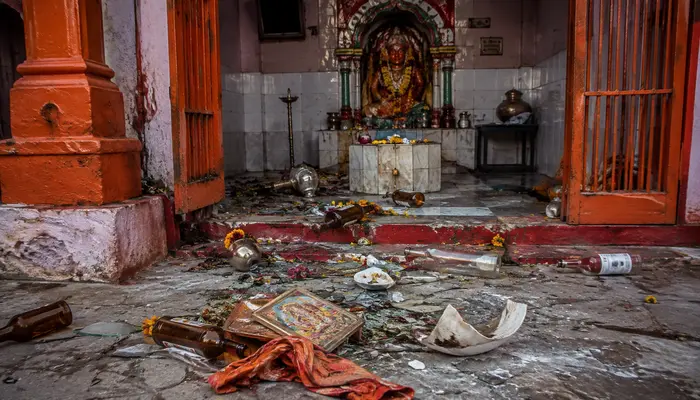
Case Summary
In Dayalpura village near Aam Chauhata, Jalore, Rajasthan, an ancient Hanuman temple was vandalised by a miscreant who damaged the temple premises, broke liquor bottles inside the temple, threw puja materials outside, and damaged the lights installed at the site. The incident took place on the night of 31 July 2026, causing anger among villagers and devotees. The accused entered the temple premises around 9 pm and created a disturbance before vandalising the place of worship. When police reached the spot after receiving information about the incident, the accused had fled from the location around 11 pm. Villagers later informed the police about the incident on the morning of 1 August 2026 and expressed their anger over the desecration of the temple. Initially, they were asked to submit a formal complaint. Following information provided to Jalore Superintendent of Police (SP), Ahor Member of Legislative Assembly (MLA) Chhagan Singh Rajpurohit, and Member of Parliament (MP) Lumbaram Chaudhary, police took further action in the matter. Villagers also highlighted concerns regarding the lack of functional surveillance in the temple area despite Closed-Circuit Television (CCTV) cameras being installed in the village through MLA funds. They stated that the absence of operational cameras near the temple had weakened monitoring of the area. Following a named complaint submitted by villagers, Ahor police, led by Assistant Sub-Inspector (ASI) Mungaram, conducted a search operation and apprehended the accused after two to three hours. The accused was identified as Vikram Singh, son of Mangal Singh Bhomiya Rajput, a resident of Dayalpura. After being taken to Ahor police station, he attempted to escape under the pretext of going to urinate but was recaptured by the police. At the time of writing this report, the investigation was underway. It was also stated that the accused had previously behaved indecently and verbally abused women in the neighbourhood while intoxicated. It was further stated that he was under the influence of alcohol at the time of the temple vandalisation.
Why it is Hate Crime ?
The primary category selected in this case is: Attack on Hindu religious representations, with the subcategory selected as: Desecration of Hindu religious symbols. Icons and symbols or a religious representation of a spiritual ideal are widely revered in Hinduism. Iconography is of vital significance in the Hindu milieu. It helps connect people’s spiritual beliefs with the real world. Iconography within the Hindu faith takes several shapes and forms. Murtis are of most significance to Hindus, to which daily rituals, prayers and offerings are done. Besides the murtis, there are several other symbols which have deep significance in the Hindu faith – the Om and Swastika for example. Since these Hindu religious symbols hold paramount importance in Hinduism, any desecration of symbols, icons, murtis, religious representations and manifestations, is driven by animosity towards the faith itself which manifests itself through these murtis, icons and symbols. Therefore, any desecration of these Hindu religious symbols and representations is considered religiously motivated hate crimes under this category. The other subcategory selected is: Attack on Temples. In Hinduism, a temple is the abode of the Deity. The Deity in the Temple is consecrated, thereby, making it a real, breathing entity. Hindus believe that not just the Deity but the temple premises itself are sacred to Hindus since Hindus hold the faith that the entire Temple space is an amalgamation of the divine energy of the deity. Given the central significance of Temples in Hindu Dharma, any attack against a Hindu Temple or its peripheral premises is an attack on the faith itself and is born out of animosity towards the faith, of which, the Temple is a central tenet. Any manner of attack against a Temple and/or its premises would therefore be considered a religiously motivated hate crime. This case qualifies as a religiously motivated hate crime because the perpetrator deliberately targeted an ancient Hindu place of worship and desecrated its sacred premises. The accused entered the Hanuman Temple in Dayalpura village while intoxicated, created a disturbance inside the temple compound, broke liquor bottles within the premises, damaged temple property, threw puja materials outside the temple, and damaged the lights installed at the site. These acts were not directed towards ordinary property but were carried out inside a functioning Hindu temple, causing damage to a space dedicated to religious worship and devotion. A Hindu temple is not merely a physical structure but a sacred space where devotees perform prayers, rituals, and religious ceremonies. Every element associated with the temple, including puja materials, worship items, and facilities that support religious practices, holds spiritual significance for the Hindu community. Maintaining the sanctity, cleanliness, and preservation of a temple is an essential part of Hindu religious practice, as these spaces represent places of divine presence, devotion, and spiritual connection. Any deliberate act of damaging the temple premises or disrespecting objects used in worship directly violates the religious importance attached to the site by devotees. Therefore, the act of vandalising the temple premises, breaking objects within the compound, throwing sacred puja materials outside, and damaging items associated with the functioning of the temple amounted to more than mere property damage. It constituted the desecration of a sacred Hindu place of worship and the disrespect of religious symbols and objects integral to Hindu religious observance. By intentionally targeting the temple and the materials used for worship, the perpetrator attacked the sanctity of a religious space and undermined the dignity attached to it by Hindu devotees, making the act a religiously motivated offence. The desecration of Hindu temples and sacred religious materials causes harm that extends beyond physical damage. Such acts deeply hurt the religious sentiments of devotees who consider temples and worship materials to be symbols of their faith and spiritual identity. When a place where Hindus gather for prayer and religious practices is deliberately violated, it creates a sense of fear, humiliation, and distress among the wider Hindu community that regards the temple as a sacred institution. The impact of such an act is therefore not limited to the immediate damage caused but affects the collective religious sentiments of those who worship at the site. Some may argue that the perpetrator carried out the act under the influence of alcohol. However, intoxication does not justify the deliberate desecration of a Hindu place of worship or negate the religious dimension of the offence. The perpetrator specifically entered a temple, damaged its premises, broke liquor bottles inside the sacred compound, threw puja materials outside, and violated objects associated with Hindu religious practice. If the act was solely due to intoxication, the perpetrator could have targeted any non-religious property or non-Hindu religious sites such as a mosque, church or gurudwara. The selective targeting of a Hindu temple demonstrates that the act was directed to hurt the religious sentiments of the Hindu community. This overall showcases his inherent hostility towards Hinduism and its adherents. Overall, this case meets the parameters of a religiously motivated hate crime. Therefore, it is being added to the hate crime database of the Hinduphobia Tracker.


Case Status
Complaint filed


Perpetrators Details
Perpetrators
Others
Perpetrators Range
One Person
Perpetrators Gender
male
 Sources




