Sacred Hindu temple vandalised, consecrated idols desecrated and stolen amid land dispute in Etah, Uttar Pradesh
 Etah, Uttar Pradesh, India
  3 August, 2026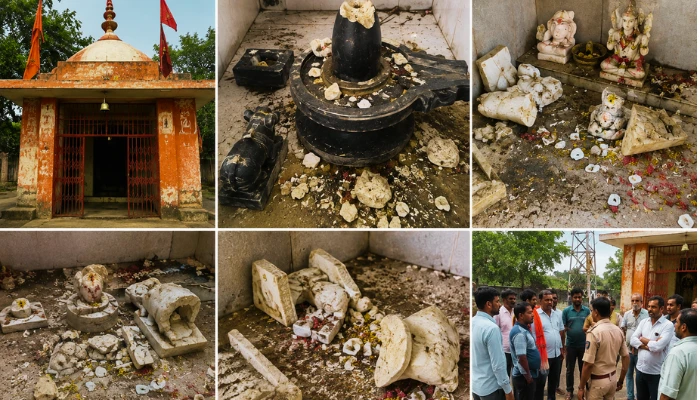
Case Summary
In Etah, Uttar Pradesh, a revered Shiva Temple in Sherganj locality of Jalesar was vandalised by unidentified miscreants, who also stole the sacred idols of the Shiv Parivar from the temple. The incident sparked outrage among local Hindu residents, who staged a protest demanding action against those responsible. According to media reports, the incident took place during the early hours of 4 August 2026 between 4:00 a.m. and 4:30 a.m. The Shiva Temple, situated in Jalesar's Sherganj locality, had been at the centre of a long-standing land dispute. Local resident Harishankar Sharma claimed ownership of the land on the basis of a sale deed, while residents of the locality maintained that an ancient Hindu temple existed at the site. The matter was already pending before a court. It was reported that the idols of the Shiv Parivar were reinstalled at the temple after the commencement of the holy month of Shravan. When devotees arrived at the temple for morning prayers, they discovered that the idols of the Shiv Parivar were stolen and the temple was vandalised. As news of the desecration spread, a large number of local residents gathered at the site and accused those involved in the ongoing land dispute of carrying out the incident. Police officials, including Circle Officer Gyanendra Pratap Singh and personnel from Jalesar Police Station, reached the spot after receiving information about the incident and assured the protesters that appropriate action would be taken. Following the assurance, the protesters ended their brief sit-in protest, and police commenced an investigation into the matter. Police also initiated efforts to identify the perpetrators by examining CCTV footage installed in the town. According to Circle Officer Gyanendra Pratap Singh, the land dispute relating to the temple site remained sub judice, and the investigation into the vandalism and theft of the Hindu idols was underway. At the time of writing this report, no complaint was submitted by either party, and further investigation was continuing.
Why it is Hate Crime ?
This case has been added to the tracker under the primary category: Attack on Hindu religious representations. The sub-category selected is: Desecration of Hindu religious symbols. Icons and symbols or a religious representation of a spiritual ideal are widely revered in Hinduism. Iconography is of vital significance in the Hindu milieu. It helps connect people’s spiritual beliefs with the real world. Iconography within the Hindu faith takes several shapes and forms. Murtis are of most significance to Hindus, to which daily rituals, prayers and offerings are done. Besides the murtis, there are several other symbols which have deep significance in the Hindu faith – the Om and Swastika for example. Since these Hindu religious symbols hold paramount importance in Hinduism, any desecration of symbols, icons, murtis, religious representations and manifestations is driven by animosity towards the faith itself, which manifests itself through these murtis, icons and symbols. Therefore, any desecration of these Hindu religious symbols and representations is considered religiously motivated hate crimes under this category. The second sub-category selected is: Attack on Temples. In Hinduism, a temple is the abode of the Deity. The Deity in the Temple is consecrated, thereby making it a real, breathing entity. Hindus believe that not just the Deity but the temple premises themselves are sacred to Hindus since Hindus hold the faith that the entire Temple space is an amalgamation of the divine energy of the deity. Given the central significance of Temples in Hindu Dharma, any attack against a Hindu Temple or its peripheral premises is an attack on the faith itself and is born out of animosity towards the faith, of which the Temple is a central tenet. Any manner of attack against a Temple and/or its premises would therefore be considered a religiously motivated hate crime. This case was included in the Hinduphobia Tracker because a Hindu temple was targeted and the consecrated idols of Hindu deities installed within it were desecrated and removed. Although the temple land was the subject of an ongoing civil dispute before a court, the incident went far beyond a property disagreement. The destruction inside the temple and the removal of the idols constituted a direct attack on sacred Hindu religious representations, making the offence one against the Hindu faith rather than a mere dispute over land. In Hinduism, a temple is regarded as the abode of the deity, and the consecrated idols installed within it are revered as living manifestations of the Divine after the ritual of *Prana Pratishtha*. Devotees offer daily prayers, rituals, and worship before these deities, making them central to Hindu religious life. Consequently, any act of damaging, removing, or stealing such idols is not simply an act of theft or vandalism but an assault on objects held sacred by the Hindu community and on their freedom to practise and express their faith. Furthermore, the existence of a land dispute did not provide any justification for desecrating the idols or damaging the temple. Even if ownership of the land remained under adjudication, the sanctity of the consecrated deities and the place of worship remained protected. Any lawful dispute over property had to be resolved through judicial process, not by targeting sacred religious symbols. The act of vandalising the temple and removing the idols demonstrated a conscious disregard for the religious significance attached to them and inflicted deep spiritual and emotional harm upon Hindu devotees. The manner in which the offence was carried out further reinforced its religious character. If the dispute genuinely concerned property or ownership, the accused had lawful civil remedies available to them. Instead, they chose to target the temple structure and the consecrated idols worshipped by devotees. This was not an act directed merely at property but at objects held sacred by the Hindu community. By vandalising the deities and the temple, the perpetrators transformed what could have been a civil dispute into an act that violated the sanctity of a Hindu place of worship and directly targeted the religious beliefs and faith of Hindu devotees. At the time of writing this report, the identities and motives of the perpetrators were not conclusively established. Nevertheless, the deliberate desecration of consecrated Hindu idols and the targeting of a Hindu temple demonstrated hostility towards sacred Hindu religious symbols and places of worship. The incident therefore constituted an attack on the religious identity of Hindu devotees and warranted its inclusion in the Hinduphobia Tracker's hate crime database.


Case Status
Unknown


Perpetrators Details
Perpetrators
Unknown
Perpetrators Range
Unknown
Perpetrators Gender
unknown
 Sources




