Hindu religious sentiments hurt after offensive image of Lord Hanuman with objectionable comments shared on social media
 Shahjahanpur, Uttar Pradesh, India
  31 July, 2026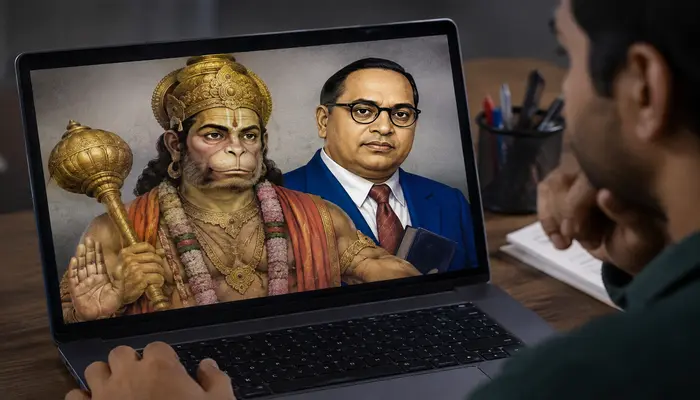
Case Summary
A derogatory edited image of Lord Hanuman (Bajrang Bali) combined with an image of Dr B. R. Ambedkar, along with objectionable comments, was shared on social media by advocate Anoj Kumar Gautam. The accused was a resident of Kunwarpur village in Shahjahanpur district, Uttar Pradesh. The inflammatory post was shared through a Facebook account bearing his name and caused outrage among Hindu community members and organisations, who stated that it was a deliberate insult to Hindu religious sentiments. On 1 August 2026, Avneesh Mishra, a resident of Khutar under Khutar Police Station in Shahjahanpur district and the Uttar Pradesh State President of Hindu Yuva Sangathan, filed a police complaint against Anoj Kumar Gautam. The complaint stated that Gautam had deliberately shared the edited image and accompanying comments to hurt Hindu religious sentiments. It further stated that Gautam had shared similar posts in the past and continued to do so despite being asked to stop. Following the complaint, police registered a case under the relevant legal provisions and initiated an investigation into the matter. Separately, the Tehsil Bar Association, Powayan, initiated disciplinary proceedings against advocate Anoj Kumar Gautam. In a meeting chaired by Association President Ajay Kumar Pandey, the association unanimously decided to suspend Gautam from the association for 15 days. The association also issued a notice seeking an explanation from him within 15 days and stated that failure to provide a satisfactory reply could result in further disciplinary action, including expulsion from the association. In response to the complaint, Anoj Kumar Gautam claimed that the social media post in question had originally been uploaded in 2021 after another person accessed his mobile phone and made the post. He said that police had contacted him at the time, following which he submitted a written apology acknowledging the mistake. He further stated that the present case was registered in connection with the same post and that the investigation would establish the facts.
Why it is Hate Crime ?
The first primary category for this case is: Attack on Hindu religious representations. The subcategory for this case is: Iconoclastic representation of Hindu Gods/Goddesses. An icon is a symbol of someone or something that is revered, or a religious representation of a spiritual ideal. Iconography is of vital significance in the Hindu milieu. It helps connect people’s spiritual beliefs with the real world. Iconography within the Hindu faith takes several shapes and forms. Murtis are of most significance to Hindus, to which daily rituals, prayers and offerings are done. Besides the murtis, there are several other symbols which have deep significance in the Hindu faith – the Om and Swastika for example. Any iconoclastic representation of these symbols, images and murtis is an affront to the religious beliefs and faith of the Hindu community itself since the symbols and icons are deeply religious in nature. In this sub-category of crime, we would record hate crimes and iconoclastic representations, in words, art, or any other form of representations of symbols that hold religious significance for the Hindu community. Since these symbols, icons and murtis are central to the Hindu faith, any iconoclastic representation of these symbols is born out of animosity towards the faith itself, manifesting itself through these symbols and therefore, these representations would be considered religiously motivated hated crimes. The second primary category for this case is: Hate speech against Hindus. The subcategory is: Anti-Hindu slurs, mocking faith. Anti-Hindu slurs and the deliberate mocking of the Hindu faith owing to religious animosity involve the usage of derogatory terms, stereotypes, or offensive references to religious practices, symbols, or figures. One of the common anti-Hindu slurs used against Hindus is “cow-worshipper” and “cow piss drinker”. The intention of using this term is to demean and mock Hindus as a group and their religious beliefs since Hindus consider the cow holy. Additionally, some symbols and the slurs attached to them have a historical context that exacerbates the insult, hate, stereotyping, dehumanisation and oppression against Hindus. Cow worship has been used for centuries to denigrate Hindus, insult their faith and oppress Hindus specifically as a religious group. There has been overwhelming documentation about how cow slaughter has been used to persecute Hindus with cow meat being thrown in temples and places of worship. There has also been overwhelming documentation where cow meat (beef) has been force-fed to Hindus to either forcefully convert them to Islam or denigrate their faith. Apart from cow worship, the Swastika – which holds deep religious significance for the Hindus – has also been misinterpreted and distorted to use as a slur against Hindus. Similarly, the worship of the Shivling has been used by supremacist ideologies and religions to denigrate Hindus owing to religious animosity. Such slurs and denigration stem out of inherent animosity and hate towards Hindus and their faith, therefore, it is categorised as hate speech targeted at Hindus specifically owing to their religious identity. This case has been included in the Hinduphobia Tracker because the conduct involved the deliberate alteration and circulation of a sacred Hindu religious representation. The image of Lord Hanuman (Bajrang Bali), a revered Hindu deity, was morphed with the image of Dr B. R. Ambedkar and circulated on social media along with objectionable comments. The deliberate and derogatory editing of the traditional depiction of Lord Hanuman and its presentation in an objectionable manner amounted to an attack on a sacred representation of Hindu faith rather than a mere alteration of an ordinary image. Hindu deities are represented through specific religious iconography that carries deep spiritual and theological significance for devotees. The forms, attributes, and depictions associated with Hindu gods and goddesses are not merely artistic representations but sacred symbols connected with worship, devotion, and religious identity. Deliberately altering the depiction of a revered deity and combining it with another representation in a derogatory manner amounted to the iconoclasm of Hindu religious imagery, as it distorted and undermined the sacred form through which devotees worship and connect with the deity. The religious nature of the act was further reinforced by the selection of Lord Hanuman’s image as the subject of the alteration. Lord Hanuman is among the most widely worshipped Hindu deities and is revered as a symbol of devotion, strength, courage, humility and righteousness. By manipulating his sacred depiction and presenting it in an objectionable manner, the act directly targeted a figure central to Hindu religious belief and caused offence to devotees who hold his image in reverence. The accompanying objectionable comments further intensified the religious offence caused by the altered image. The remarks were not made in isolation but were attached to the objectionable depiction of Lord Hanuman, thereby using a sacred Hindu symbol as the vehicle for offensive expression. When derogatory remarks are communicated through the image of a revered deity, the expression moves beyond criticism or opinion and becomes a form of mocking and denigrating Hindu religious beliefs and sentiments. The dissemination of the altered image and comments on social media amplified the impact of the act by allowing the content to reach a wider audience. Social media platforms enable such material to be rapidly circulated, increasing the exposure of devotees to content that targets their religious symbols. The public sharing of a distorted representation of Lord Hanuman therefore aggravated the offence by extending the reach of the insult and causing pain to Hindu devotees. Furthermore, the specific nature of the desecration, morphing the image of Lord Hanuman with that of Dr B.R. Ambedkar, points to a calculated ideological motivation routinely observed within Ambedkarite and other anti-Hindu ecosystems. In these circles, Dr Ambedkar’s legacy is frequently weaponised as a tool to mock, demean, and challenge Sanatan Dharma. By visually juxtaposing a revered Hindu deity with a political and social figure in a derogatory context, the perpetrator is not merely making a social statement, but intentionally manufacturing a cultural clash designed to humiliate practising Hindus. This tactic serves a sinister dual purpose: it deeply outrages Hindu religious sentiments while simultaneously attempting to provoke and fracture Hindu society along caste lines. Such deliberate visual mockery, born out of a systemic disdain for Hindu religiosity, elevates the act from a random social media post to a targeted, ideologically driven hate crime. While the accused may act in an individual capacity, his actions perfectly mirror the established modus operandi of radical Ambedkarite organisations like the Bhim Army. While the Bhim Army presents itself as a champion of Dalit rights, its actions and affiliations often contradict this claim. Dalits are very much Hindus, yet this ideological ecosystem frequently targets Hindu symbols, festivals, and practices, including those held sacred by Dalits themselves. This pattern suggests that the underlying agenda is less about genuine Dalit upliftment and more aligned with broader anti-Hindu narratives that seek to divide and weaken Hindu society from within. This becomes particularly apparent when radical Ambedkarite groups align with leftist and Islamist platforms, where identity politics is weaponised against Hindus. In such spaces, the micro-identities of caste, region, and language are secondary; what matters most is religious identity. It is the Hindu identity, regardless of caste, that often becomes the target of animosity. As seen in cases where Dalit families were attacked for displaying Hindu symbols or worshipping deities, the hostility stems not from caste differences, but from a fundamental disdain for Hindu religiosity. For example, on May 19, 2020, reports emerged in which a Dalit family in Bihar’s Kishanganj district accused the local Bhim Army unit of attacking them for their beliefs, desecrating a temple as they objected to their reverence for Hindu deities and saffron flags. Similarly, on June 29, 2021, in Saharanpur, Uttar Pradesh, a Hindu named Saurabh Sharma was attacked by Bhim Army members over political differences. The assailants used swords and rods, causing severe injuries, and threatened to eliminate the Brahmin community from the area. Moreover, leaders within this ecosystem, such as Bhim Army chief Chandrashekhar Azad, have repeatedly made statements and taken positions that reflect this anti-Hindu stance. For instance, he has publicly endorsed conversion as a political weapon, invoking B.R. Ambedkar’s decision to leave Hinduism, and has actively supported movements that call for a rejection of Hindu festivals and practices. In fact, Chandrashekhar Azad's political trajectory has strongly focused on building a "Dalit-Muslim alliance," a strategy that became particularly visible during his active participation in the anti-CAA (Citizenship Amendment Act) protests that culminated in the Delhi anti-Hindu Riots 2020. His brand of politics has contributed to narratives that vilify Hindu traditions and exacerbate targeted attacks against Hindus. Thus, by attacking Hindu symbols and aligning with forces hostile to Hinduism at large, the Bhim Army effectively turns against the cultural and spiritual traditions of the Dalit community itself. In doing so, it reinforces the very forces of division and religious antagonism that marginalise Dalits, not as a caste, but as Hindus. This contradiction reveals that, despite its stated mission, the Bhim Army’s trajectory increasingly serves an anti-Hindu, rather than a pro-Dalit, agenda. Overall, since this case meets the parameters of a religiously driven crime, it is being added to the hate crime database of the Hinduphobia Tracker. Disclaimer: Hinduphobia Tracker records incident dates based on when the crime occurred rather than when it was reported by the media. In the present case, media reports have not specified the exact date on which the incident occurred. As the only available date is 1 August 2026, when a complaint was filed in the matter, the same has been selected as the indicative incident date. This date is being recorded for documentation purposes only.


Case Status
Complaint registered


Perpetrators Details
Perpetrators
Others
Perpetrators Range
One Person
Perpetrators Gender
male
 Sources




