Hindu temple's sanctity violated; cow meat and slaughter waste dumped near ancient Shiva shrine in Tamil Nadu
 Thiruvallur, Tamil Nadu, India
  26 July, 2026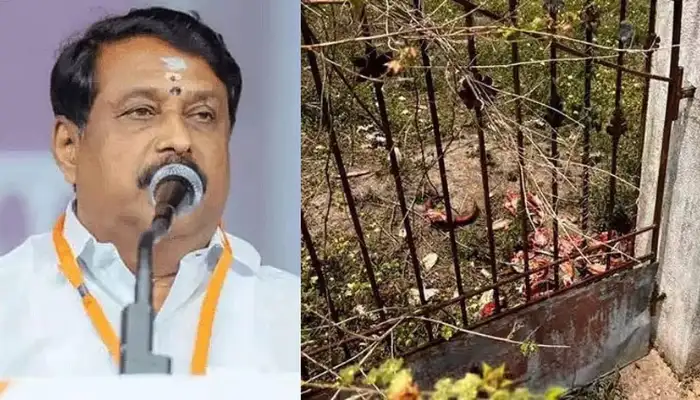
Case Summary
In Tiruvallur, Tamil Nadu, Hindu religious sentiments were hurt after a few miscreants repeatedly dumped slaughter waste, including cow meat (beef) and bone remains, near the outer walls of the ancient Vaacheeswarar Shiva Temple. The repeated dumping affected the sanctity of the sacred Hindu site. It also caused distress among Hindu devotees. The temple, also known as the Thangala Amman Sametha Vaacheeswarar Temple, is approximately 1,800 years old. According to local reports, the rotting slaughter waste emitted a foul stench, posed health hazards, and attracted stray dogs, which dragged bone fragments into the temple premises. Despite the availability of vacant land enclosed by a compound wall in the area, the perpetrators repeatedly dumped the slaughter waste on land belonging to the temple near its outer walls. The repeated dumping disrupted the temple's sacred environment and caused distress among Hindu devotees. Following protests by local devotees, Hindu Munnani functionaries, and members of the Tamil Nadu Bharatiya Janata Party (BJP), a petition was submitted to the Tiruvallur District Collector seeking immediate intervention. Hindu Munnani district president M. Vinodh Khanna and district general secretary Venkatesan were among those who raised the issue. The petition urged the district administration to prevent the recurrence of such incidents and initiate legal action against those responsible. Bharatiya Janata Party state president Nainar Nagendran also condemned the incident and called for prompt action against the perpetrators. Acting on the complaint, the local authorities removed the slaughter waste from the temple land and cleaned the affected area. Hindu Munnani further urged the administration not to permit the operation of slaughterhouses, meat shops, chicken shops, or similar establishments within a 500-metre radius of the temple premises to prevent similar incidents in the future.
Why it is Hate Crime ?
The primary category for this case is: Attack on Hindu religious representations. The first subcategory for this case is: Desecration of Hindu religious symbols. Icons and symbols or a religious representation of a spiritual ideal are widely revered in Hinduism. Iconography is of vital significance in the Hindu milieu. It helps connect people’s spiritual beliefs with the real world. Iconography within the Hindu faith takes several shapes and forms. Murtis are of most significance to Hindus, to which daily rituals, prayers and offerings are done. Besides the murtis, there are several other symbols which have deep significance in the Hindu faith – the Om and Swastika for example. Since these Hindu religious symbols hold paramount importance in Hinduism, any desecration of symbols, icons, murtis, religious representations and manifestations, is driven by animosity towards the faith itself, which manifests itself through these murtis, icons and symbols. Therefore, any desecration of these Hindu religious symbols and representations is considered a religiously motivated hate crime under this category. The other subcategory for this case is: Defiling religious customs. Sanatan Dharma is not a religion of one book, which is to say that while it has religious scriptures that form the central tenets of the faith, there are several traditions followed through thousands of years, mostly passed from generation to generation orally. There are several such customs and traditions that are followed by various Hindus and Hindu sects. Defiling of these traditions and customs is a breach of an individual or group’s religious practices. Such practices can range from dietary restrictions like not eating non-vegetarian food for a certain period of the year, not eating non-vegetarian food at all, not eating beef since the cow is considered holy in Hinduism, the sanctity of religious customs followed in the house (like many ISCKON devotees), etc. Any malicious action leading to the breach of such traditions or defilement of these traditions owing to animosity towards the faith or for the sake of activism stems not only from the lack of faith in the religion itself but also from disregard for the faith of the devotees who follow the customs/traditions and implicit bias against the faith and the tradition itself. Since these specific traditions are central to the faith of the devotees of that specific sect of Hindus, any non-compliance with these traditional rules would be considered a religiously motivated hate crime. This case is a clear example of a religiously motivated crime because the perpetrators desecrated the sanctity of a sacred Hindu temple by repeatedly dumping slaughter waste, including cow meat (beef) and bone remains, near the outer walls of the ancient Vaacheeswarar Shiva Temple. A Hindu temple is not merely a physical structure but a consecrated space where devotees worship, perform rituals, and connect with the divine. It is one of the strongest symbols of Hindu faith, representing centuries-old traditions, beliefs, and spiritual practices. For Hindus, a temple is considered the abode of the deity and a sacred environment that must be preserved with ritual purity and reverence. Deliberately introducing material considered deeply offensive within the Hindu religious context into such a space violated the sanctity of the temple, disrupted its spiritual atmosphere, and caused distress among devotees. The act was not ordinary littering; it constituted the desecration of a place of worship and an affront to Hindu religious sentiments. In Hinduism, the cow is revered as Gau Mata (Mother Cow), a sacred symbol of purity, motherhood, nourishment, and selfless giving. It holds profound religious significance and is associated with divine energies, sacred rituals, and the principle of Ahimsa (non-violence). Deeply connected with Lord Krishna in his form as Gopala, the cow remains an enduring symbol of compassion, harmony, and respect for all life. Across Hindu traditions, cow slaughter is regarded as a grave religious taboo and a violation of Dharma, as it contradicts the values of non-violence and reverence for life. Therefore, dumping cow meat and bone remains near a Hindu temple carried a specific religious significance and was a direct affront to Hindu beliefs regarding the sanctity of the cow and the sacredness of the temple. Hindu religious traditions place great importance on Shuchita (ritual purity) in and around temples. As spaces dedicated to divine worship, temples are expected to maintain a pure environment that enables devotees to perform rituals and practise their faith peacefully. Slaughter waste and animal remains, associated with decay and impurity, are incompatible with this sacred environment. By repeatedly placing such waste near the temple premises, the perpetrators violated religious customs, disrupted the sanctity of the worship space, and interfered with the spiritual practices of Hindu devotees. The choice of location further highlights the religious nature of the act. The Vaacheeswarar Temple, also known as the Thangala Amman Sametha Vaacheeswarar Temple, is an ancient Shiva temple in Thirupachur, Tamil Nadu, dating back over 1,300 years and associated with the Chola period. It is a revered Paadal Petra Sthalam among Shaivite Hindus and is known for its Swayambhu (self-manifested) Lingam bearing the mark of a tool (vasi), its unique Gajaprishta (elephant-back-shaped) sanctum, and a shrine dedicated to 11 Ganesha deities. Targeting a temple of such historical and spiritual importance gave the incident a distinct religious dimension. The impact of this act extended beyond the physical removal of waste, as it affected the religious environment in which Hindu devotees worship and practise their faith. Desecration of sacred spaces undermines the sense of security and reverence devotees associate with their places of worship. When an act specifically targets a site central to a religious community’s identity and practices, it constitutes an attack on the sentiments and beliefs attached to that faith. In this case, although the identity of the perpetrators is unknown, the act was directed at a sacred Hindu site and was rooted in hostility towards Hindu religious beliefs and the Hindu community. Therefore, this incident was documented as a religiously motivated hate crime in the Hinduphobia Tracker. Disclaimer: The Hinduphobia Tracker records the date of an incident based on when the crime occurs rather than the date on which it is reported. In this case, the exact date of the incident was not specified in the available sources. Accordingly, 27 July 2026, the date on which the incident was first reported on social media by the official BJP Tamil Nadu handle, has been recorded as the indicative incident date for documentation purposes.


Case Status
Unknown


Perpetrators Details
Perpetrators
Unknown
Perpetrators Range
Unknown
Perpetrators Gender
unknown
 Sources




