Two Hindu temples targeted, sacred idols of Hindu gods and goddesses desecrated in Sant Kabir Nagar, Uttar Pradesh
 Sant Kabir Nagar, Uttar Pradesh, India
  1 August, 2026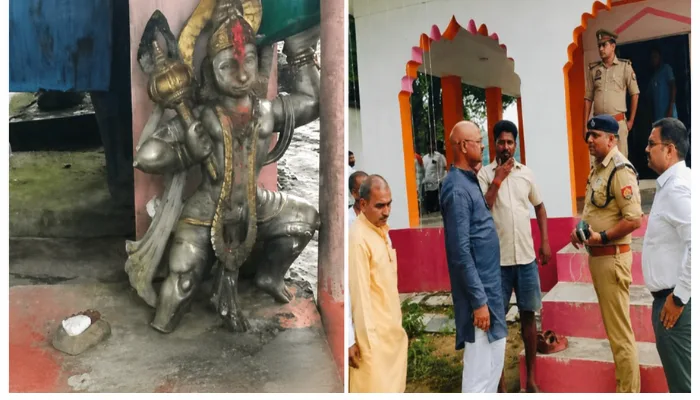
Case Summary
In Sant Kabir Nagar, Uttar Pradesh, Hindu religious sentiments were hurt after a few miscreants desecrated idols of Hindu deities at two Hindu temples during the night of 2 August 2026. At the ancient Shiva temple near Paschim Mansa Pokhra in Dharamsinghwa town, the Shivalinga and the idol of Goddess Parvati were uprooted from the sanctum and thrown into a nearby pond. At the Samaya Mata Temple in Haraiya village (Raidharpar Sivan) under the Baurbyas police outpost, the foot of the idol of Lord Hanuman was damaged. The desecration came to light on the first Monday of the holy month of Sawan (3 August 2026), when Hindu devotees arrived at the Shiva temple to perform Jalabhishek and discovered the missing Shivalinga and Goddess Parvati idol. The incident created tension in the area and caused outrage among devotees, residents, and Hindu organisations after details spread on social media. Following the incident, Rajesh Tiwari submitted a written complaint at the Dharamsinghwa police station seeking legal action against the unidentified perpetrators. Rajesh Tripathi, president of the Sanatan Dharma Prachar Samiti, Dharamsinghwa, along with representatives of the Vishwa Hindu Mahasangh, staged a protest and demanded strict action against those responsible. Former MLA Rakesh Singh Baghel condemned the desecration of the temples, demanded the immediate arrest of the perpetrators, stated that those disrupting law and order should not be spared, and appealed to the public to maintain peace and harmony. Police reached both temple sites after receiving information, recovered the Shivalinga and the idol of Goddess Parvati from the pond, and registered a case. Additional Superintendent of Police Sushil Kumar Singh inspected the sites and assured strict legal action against those responsible. With the assistance of local residents, the recovered idols were restored at the respective temples. Multiple teams comprising the Special Operations Group (SOG), Surveillance Unit, and local police were formed to investigate the incident. CCTV footage was examined, surveillance inputs were analysed, and raids were conducted. During the preliminary investigation, police detected one or two suspicious individuals through CCTV footage and surveillance inputs, while four individuals were taken into custody for questioning. Officials stated that the investigation had reached its final stage and that further details would be disclosed after its completion. Station House Officer Surendra Kumar Singh also assured that strict legal action would be taken against those responsible after the investigation. The desecrated idols at both temples were later reinstalled with Vedic chanting and Hindu religious rituals. Before the reinstallation ceremony, devotees collectively recited the Hanuman Chalisa and offered prayers for peace, prosperity, and social harmony. The ceremony was attended by a large number of devotees, villagers, and public representatives. Residents also demanded the installation of CCTV cameras at temple premises to strengthen the security of Hindu places of worship and prevent similar incidents in the future. Police stated that the search for the perpetrators was continuing and that strict legal action would be taken against those found responsible.
Why it is Hate Crime ?
The primary category for this case is: Attack on Hindu religious representations. The subcategory selected is: Desecration of Hindu religious symbols. Icons and symbols or a religious representation of a spiritual ideal are widely revered in Hinduism. Iconography is of vital significance in the Hindu milieu. It helps connect people’s spiritual beliefs with the real world. Iconography within the Hindu faith takes several shapes and forms. Murtis are of most significance to Hindus, to which daily rituals, prayers and offerings are done. Besides the murtis, there are several other symbols which have deep significance in the Hindu faith – the Om and Swastika for example. Since these Hindu religious symbols hold paramount importance in Hinduism, any desecration of symbols, icons, murtis, religious representations and manifestations, is driven by animosity towards the faith itself, which manifests itself through these murtis, icons and symbols. Therefore, any desecration of these Hindu religious symbols and representations is considered religiously motivated hate crimes under this category. The other subcategory for this case is: Attack on Temples. In Hinduism, a temple is the abode of the Deity. The Deity in the Temple is consecrated, thereby making it a real, breathing entity. Hindus believe that not just the Deity but the temple premises themselves are sacred to Hindus since Hindus hold the faith that the entire Temple space is an amalgamation of the divine energy of the deity. Given the central significance of Temples in Hindu Dharma, any attack against a Hindu Temple or its peripheral premises is an attack on the faith itself and is born out of animosity towards the faith, of which the Temple is a central tenet. Any manner of attack against a Temple and/or its premises would therefore be considered a religiously motivated hate crime. This case is a clear example of a religiously motivated hate crime because the perpetrators targeted two Hindu temples and desecrated idols of Hindu deities at both locations. The deliberate act of damaging sacred symbols of Hindu worship, uprooting the Shivalinga and the idol of Goddess Parvati, and damaging the idol of Lord Hanuman reflects an attack on Hindu religious sentiments and constitutes a case of desecration of Hindu places of worship. To understand the severity of this incident, it is important to understand the religious significance of temples and deity idols in Hinduism. A Hindu temple is not merely a physical structure but a revered religious institution where devotees believe the divine presence of deities resides. Temples serve as sacred spaces where Hindus perform worship, rituals, prayers, and spiritual practices. They represent the centre of religious life for devotees and preserve centuries-old traditions, beliefs, and customs associated with the Hindu faith. Similarly, Hindu murtis (idols) are not viewed as mere objects or representations but as sacred manifestations through which devotees worship and connect with the divine. The consecration of murtis through religious rituals gives them deep spiritual significance, making them an inseparable part of Hindu worship and temple traditions. Therefore, the act of uprooting the Shivalinga and the idol of Goddess Parvati from the sanctum and throwing them into a pond, along with damaging the foot of the idol of Lord Hanuman, amounted to the deliberate desecration of sacred Hindu symbols. Such an act represents a direct violation of the sanctity attached to Hindu deities and places of worship and demonstrates hostility towards Hindu religious beliefs. The desecration of deity idols is not merely damage to physical objects but an attack on symbols that hold profound spiritual and emotional significance for Hindu devotees. Since temple idols are inseparable from the larger temple ecosystem and the religious practices carried out within these sacred spaces, targeting them also constitutes an attack on the sanctity of the temples themselves. The deliberate targeting of Hindu religious symbols with such acts of disrespect makes this a religiously motivated hate crime aimed at hurting the sentiments of the Hindu community. The fact that two separate Hindu temples were targeted within the same night significantly highlights the deliberate and serious nature of the incident. This was not an isolated act of vandalism confined to a single religious site; rather, it involved the repeated targeting of multiple Hindu places of worship and the desecration of their sacred symbols. The coordinated occurrence of such acts at two temples reflects a pattern of hostility towards Hindu religious spaces and demonstrates an attempt to violate the sanctity attached to them. By targeting temples and deities revered by Hindus, such actions create distress among devotees, undermine the sense of security associated with sacred places, and interfere with the peaceful practice of Hindu religious traditions. In this case, although the identity and religious affiliation of the perpetrators remain unknown, this does not diminish the nature or impact of the crime. The deliberate targeting and desecration of Hindu temples and sacred symbols reflect deep-seated hostility towards Hindu religious beliefs and spaces of worship. Therefore, this incident is being documented and added to the hate crime database of the Hinduphobia Tracker.


Case Status
Arrested


Perpetrators Details
Perpetrators
Unknown
Perpetrators Range
From 2 To 5
Perpetrators Gender
unknown
 Sources




