Hindu woman lured, sexually exploited, and forcibly converted to Islam by Muslim man in Mohali, Punjab
 Mohali, Punjab, India
  14 March, 2021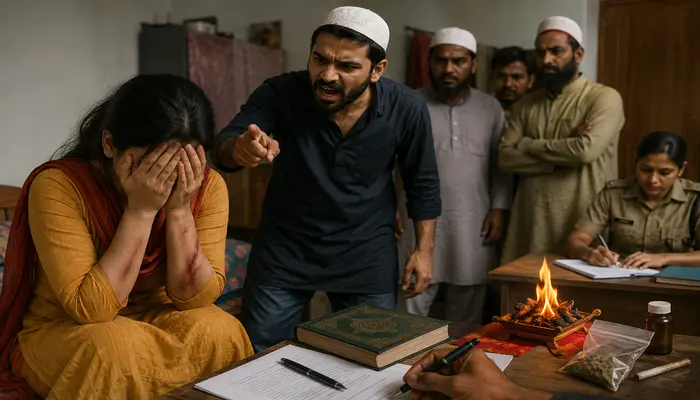
Case Summary
In Zirakpur, Mohali, Punjab, a Hindu woman was lured into a relationship and sexually exploited for five years by a Muslim man on the pretext of marriage. The accused was originally from Dholbazza village under Forbesganj block in Araria district, Bihar, and his father was identified as Abid Hussain. During the relationship, he kept her under constant threat and repeatedly postponed marriage whenever she raised the matter. He subsequently forcibly converted her to Islam before marrying her, and subjected her to prolonged physical and sexual abuse after the marriage. According to media reports, the woman, who lived in the Dhakoli area of Zirakpur, had worked for the accused, who was employed as a construction contractor and had also arranged employment for her sister. During this period, he behaved inappropriately towards the victim by sexually assaulting her and threatened to ruin both her life and her sister’s life if she approached the police. He assured her that he would treat her well and marry her, but continued the relationship for five years while repeatedly delaying the marriage. Unable to tolerate the situation any longer, she approached the women’s police station and lodged a complaint against him. She said that the police did not take legal action on her complaint and instead facilitated a compromise between them. She opposed the compromise and sought legal action against the accused, but was told either to marry him or reach a settlement. She was also warned that she would face consequences if she pursued the complaint. The two subsequently married on 15 March 2026. Before the marriage, the accused had deceptively converted her to Islam without her consent. The woman belonged to a Hindu Rajput family from Bihar and said that she had not understood the documents she was made to sign because she was not well educated. She signed several documents believing that they formed part of the marriage rituals, but later discovered that they related to her religious conversion. After the conversion and marriage, the accused continued bringing similar documents and pressuring her to sign them. From the day after the wedding, the accused began threatening to ruin her life and told her that she had changed her religion and was no longer a Hindu but a Muslim. When she refused to sign further conversion-related documents, he stripped her naked and assaulted her. He smoked marijuana, was addicted to various drugs and frequently returned home intoxicated, during which he subjected her to repeated physical abuse. The accused also burned different parts of her body, including her private parts, with cigarettes on several occasions, leaving visible scars. The woman showed the burn marks on her body. He brought his friends to their room and humiliated and abused her in front of them, although she said that his friends did not physically assault her. After they left, he stripped her naked and assaulted her. She also showed a video in which the accused was lying on the ground in an intoxicated state. The woman named the accused’s uncle and other members of his family in her complaint. She said that after the marriage, they pressured her to bring dowry and subjected her to abuse and death threats when she resisted. They told her that she belonged to another religion and would not be accepted into the family unless she brought dowry. She was subsequently forced to leave the house. After assaulting and abandoning her, the accused vacated their rented accommodation in Zirakpur and returned to his native village in Bihar. Before leaving, he instructed the landlord to make her vacate the house. When she later contacted him by telephone, he refused to live with her. She subsequently submitted a complaint to the office of the Senior Superintendent of Police seeking legal action against her husband and his family. The Assistant Superintendent of Police, Zirakpur, stated that the complaint had not yet reached that office.
Why it is Hate Crime ?
In this case, the primary category selected is: Crimes against women in relationships and other sexual crimes. Within this, the selected subcategory is: Forced conversion before marriage. In such cases, a non-Hindu man is in a relationship with a Hindu woman when the pressure to convert her religion begins to manifest. In such cases, typically, two patterns emerge. First, when the relationship is consensual, and the religious identity of the perpetrator is known to the Hindu woman in the relationship, however, at some point during the relationship, the non-Hindu man starts to force the victim to convert her religion and give up her Hindu religious identity. The second is when the woman gets into a marriage with the man pretending to share her faith. Later, when the truth is revealed, the man starts pressuring the woman to convert her religion and give up her religious identity. In both the situations, the methods used to force the victim to convert her religion often revolve around force-feeding beef, forcing her to wear hijab, forcing her to read the Kalma or even pressurizing the victim to do ‘Nikah’, which is marriage under Islamic law, with a prerequisite being conversion to Islam. Cases where a Hindu woman consensually converts to Islam in a relationship will be left out of the hate crime database, even though it could be argued in several cases that the conversion was a result of religious brainwashing. The other subcategory selected is: Assault or threat upon refusal to convert. When Hindu women are in a relationship with non-Hindu men, there are cases where the woman faces threats or assault after she refuses to convert and change her religious identity owing to pressure/force by the non-Hindu man. Such relationships may be consensual with the religious identity of the non-Hindu man known to the victim. Somewhere along the relationship, the non-Hindu man starts pressurizing the Hindu woman to convert to Islam and upon her refusal, assaults or threatens the victim. Such cases are driven by specific religious motivations and against the religious identity of the victim and are therefore qualified as hate crimes. Cases where the Hindu woman converts to Islam and does not file a complaint about the force or threat, are not considered a part of the hate tracker, even though, it may be argued that the woman was brainwashed or threatened to convert to Islam. This case is a clear example of a religiously motivated hate crime involving a Hindu woman. She was sexually targeted, lured into a relationship, subjected to prolonged sexual exploitation under the pretext of marriage, and subsequently deceptively and forcibly converted to Islam by a Muslim man. When she resisted further attempts to alter her religious identity, she was subjected to severe physical violence, humiliation, threats and torture. The sequence of events demonstrates that the victim’s Hindu identity was not incidental to the abuse but became a central point of coercion. The progression from sexual exploitation and manipulation to forced religious conversion and violence for refusing further conversion-related demands makes the case a clear instance of religiously driven coercion and hostility against a Hindu woman. The predatory nature of the abuse was evident from the very beginning. The perpetrator initially behaved inappropriately towards the victim and subjected her to sexual harassment, and when she objected to his conduct, he drew her into a relationship by promising to marry her. This was not a relationship entered into on equal or transparent terms. The promise of marriage was used to silence her objections and keep her within the perpetrator’s control. For a woman who had already been subjected to inappropriate sexual conduct, entering a relationship on the assurance that the perpetrator would marry her could also provide a means of avoiding the social stigma and consequences associated with openly confronting sexual abuse. The perpetrator exploited that vulnerability and subsequently kept her in the relationship for approximately five years while repeatedly postponing marriage. This prolonged manipulation reveals the deeply predatory character of the conduct from its inception. The subsequent course of events gives the sexual exploitation a clear religious dimension. The victim was not merely deceived into a relationship and subjected to sexual exploitation; she was ultimately subjected to a process in which her Hindu religious identity was targeted for removal through conversion to Islam. The fact that sexual exploitation continued for years under the pretext of marriage, followed by deceptive and forced conversion, demonstrates a continuous pattern of control over the victim’s body, autonomy and religious identity. The later conversion and coercion cannot be viewed as an isolated matrimonial dispute divorced from the preceding abuse. Rather, the entire sequence shows how the victim was progressively deprived of her autonomy, first through sexual exploitation and manipulation and subsequently through attempts to strip her of her Hindu identity. This nexus between her Hindu identity, the coercion imposed upon her and the eventual forced conversion makes the case one of religiously driven sexual and psychological violence. The circumstances surrounding the conversion establish a clear religious motive behind the abuse. The victim was deceptively made to sign documents connected with her conversion before the marriage, without understanding that she was being deceptively converted from Hinduism to Islam. Such a conversion was neither free nor informed. It violated her religious autonomy and her fundamental right to freely practise and identify with her Hindu faith without coercion, deception or fear. The deliberate use of deception to strip a Hindu woman of her religious identity therefore constituted a direct attack on her freedom of religion and demonstrated the religiously driven nature of the crime. The religious coercion continued even after the conversion, with the perpetrator repeatedly pressuring her to sign further conversion-related documents and insisting that she was no longer a Hindu but a Muslim. This demonstrated that the objective was not merely to obtain her signature through deception but to impose and reinforce a religious identity against her will. Her refusal to comply was a refusal to surrender her Hindu identity and religious autonomy. The sustained attempt to compel her to abandon Hinduism, coupled with intimidation and violence when she resisted, establishes a direct nexus between her religious identity and the coercion inflicted upon her, making the case a clear example of a religiously motivated hate crime. The religious hostility became even more explicit when the victim refused to comply with further conversion-related demands. Instead of respecting her refusal, the perpetrator responded with extreme physical violence. He stripped her naked, assaulted her and subjected her to repeated torture, including burning different parts of her body and her private parts with cigarettes, leaving visible scars. The violence was therefore directly connected to her refusal to comply with demands relating to her religious conversion. Her Hindu identity and her refusal to relinquish it became circumstances around which intimidation and violence were exercised. The brutality inflicted upon her demonstrates the extraordinary lengths to which the perpetrator was prepared to go to force compliance and sever her connection with the religious identity she continued to maintain. The nature of the torture further demonstrates the profound dehumanisation involved in the abuse. Burning the victim’s body, including her private parts, with cigarettes, repeatedly assaulting her and humiliating her were not merely acts of domestic cruelty. They formed part of a wider pattern in which her autonomy, dignity and religious identity were systematically attacked. The violence was used when she refused to participate in further conversion-related acts, making her resistance to religious coercion a direct trigger for further abuse. The severity of the torture illustrates the extent of coercive control exercised over her and the level of brutality employed to force her into compliance. When extreme violence is used against a Hindu woman because she refuses to comply with demands aimed at altering her religious identity, the religious dimension of the abuse cannot reasonably be dismissed as incidental. The conduct of the perpetrator’s family further reinforced the religious dimension of the victim’s persecution. The victim was told that she belonged to another religion and that she would not be accepted into the matrimonial household unless she complied with the family’s demands, including bringing dowry. Her treatment was therefore shaped not only by ordinary matrimonial conflict but also by the fact that she was regarded as belonging to a different religion. The combination of religious exclusion, pressure to abandon her Hindu identity, forced conversion and violence created an environment in which her continued identification as a Hindu became a source of hostility and coercion within the marital household. Overall, since this case meets the parameters of a religiously motivated hate crime, it is being added to the Hinduphobia Tracker’s hate crime database. Disclaimer: The Hinduphobia Tracker records the incident date based on the commencement of the underlying offence rather than the date on which the incident was reported or published. The exact date on which the Hindu woman and the Muslim perpetrator first came into contact was not specified in the available sources. However, the victim stated that he remained in a relationship with her for five years on the promise of marriage, and that they married on 15 March 2026. Based on this timeline, Hinduphobia Tracker has recorded 15 March 2021 as the indicative incident date, reflecting the approximate commencement of the relationship and the underlying offences. This date has been recorded for documentation purposes only. In this case, the perpetrator count has been recorded as two, comprising the principal accused and his uncle, as these are the only two family members specifically identified in the available sources. Although other family members were also named as perpetrators in the FIR, their identities were not specified. Therefore, the perpetrator count has been conservatively recorded as two for documentation purposes.
Victim Details
Total Victim
1
Deceased
0
Gender
- Male 0
- Female 1
- Third Gender 0
- Unknown 0
Caste
- SC/ST 0
- OBC 0
- General 0
- Unknown 1
Age Group
- Minor 0
- Adult 1
- Senior Citizen 0
- Unknown 0


Case Status
Complaint filed


Perpetrators Details
Perpetrators
Muslim Extremists
Perpetrators Range
From 2 To 5
Perpetrators Gender
male
 Sources




