Hindu temple targeted, sacred Shivalinga desecrated and discarded by a miscreant in Uttar Pradesh’s Sitapur
 Sitapur, Uttar Pradesh, India
  1 August, 2026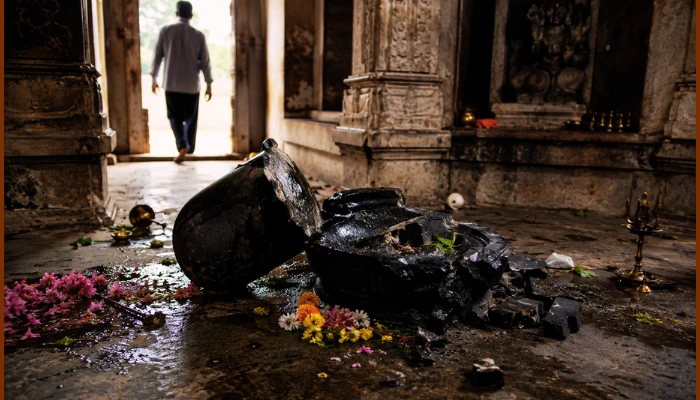
Case Summary
In Baijnath Colony, Sitapur, Uttar Pradesh, a Shivalinga in a Hindu temple was desecrated on 2nd August 2026 by a miscreant named Dilip Kashyap. The accused, a resident of the area, broke it with a chisel and hammer and threw the damaged Shivalinga into a nearby forest. This caused widespread anger among local Hindu devotees. The incident took place around 7 p.m. in the Kotwali area of Sitapur city. According to locals, Dilip Kashyap struck the Shivalinga multiple times with a chisel and hammer before damaging it and discarding it in the forest. After devotees learnt about the desecration, a large number of Shiva devotees gathered at the temple and began protesting. On seeing the crowd gathering, the accused fled the spot. The city police officer, along with Civil Line police post personnel and a large police force, reached the location, brought the situation under control, and detained the accused. The news report stated that Dilip Kashyap was addicted to alcohol and frequently got into arguments and created disturbances after drinking. A search operation was launched in the nearby forest to recover the broken Shivalinga. After an extensive search, including a night search operation, the police recovered the Shivalinga. It was also found that the accused had attempted to cut the sacred Peepal tree located near the temple. The Shivalinga had been installed in the temple in 2003 through the efforts of the then District Magistrate and had served as an important centre of faith for local Hindu devotees for more than two decades. The incident, which occurred just before the first Monday of the holy Sawan Maas (the sacred month in the Hindu calendar dedicated to the worship of Lord Shiva), hurt the religious sentiments of devotees. The police initiated an investigation into the incident and stated that further legal action would be taken based on the findings.
Why it is Hate Crime ?
This case has been added to the tracker under the primary category- Attack on Hindu religious representations. The subcategory selected is- Desecration of Hindu religious symbol. Icons and symbols or a religious representation of a spiritual ideal are widely revered in Hinduism. Iconography is of vital significance in the Hindu milieu. It helps connect people’s spiritual beliefs with the real world. Iconography within the Hindu faith takes several shapes and forms. Murtis are of most significance to Hindus, to which daily rituals, prayers and offerings are done. Besides the murtis, there are several other symbols which have deep significance in the Hindu faith – the Om and Swastika for example. Since these Hindu religious symbols hold paramount importance in Hinduism, any desecration of symbols, icons, murtis, religious representations and manifestations, is driven by animosity towards the faith itself which manifests itself through these murtis, icons and symbols. Therefore, any desecration of these Hindu religious symbols and representations is considered religiously motivated hate crimes under this category. The other subcategory selected is- Attack on Temples. In Hinduism, a temple is the abode of the Deity. The Deity in the Temple is consecrated, thereby, making it a real, breathing entity. Hindus believe that not just the Deity but the temple premises itself are sacred to Hindus since Hindus hold the faith that the entire Temple space is an amalgamation of the divine energy of the deity. Given the central significance of Temples in Hindu Dharma, any attack against a Hindu Temple or its peripheral premises is an attack on the faith itself and is born out of animosity towards the faith, of which, the Temple is a central tenet. Any manner of attack against a Temple and/or its premises would therefore be considered a religiously motivated hate crime. This case is a clear example of a religiously driven hate crime, as the perpetrator targeted a Hindu temple and desecrated the sacred Shivalinga, a central symbol of Hindu worship. The accused not only damaged the Shivalinga using a chisel and hammer and discarded it in a forest, but also attempted to cut the sacred Peepal tree located near the temple. Such actions demonstrate a deliberate targeting of Hindu religious symbols and spaces of worship, amounting to a crime driven by religious hostility towards Hinduism, its sacred traditions, and the beliefs of the Hindu community. Hindu temples are sacred institutions that serve as centres of worship, devotion, spiritual learning, and religious practice for Hindus. They are not merely physical structures but represent a sacred ecosystem where deities, religious symbols, rituals, traditions, and centuries-old spiritual practices are preserved and practised. A temple is considered a space where devotees establish a direct connection with the divine through prayers, offerings, rituals, and acts of devotion. Every element within a Hindu temple, including the sanctum sanctorum, murtis of deities, Shivalingas, sacred trees, and other religious symbols, holds deep spiritual significance and forms an inseparable part of the temple’s religious identity. The Shivalinga holds profound religious significance in Hinduism as a sacred representation of Lord Shiva, one of the principal deities in Hindu tradition. It symbolises the divine presence of Shiva, the eternal nature of consciousness, creation, preservation, and the cosmic principle underlying existence. For devotees of Lord Shiva, the Shivalinga is not merely an object but a revered manifestation of the divine, worshipped through daily prayers, rituals, and offerings. Millions of Hindus across the world offer devotion to Shivalingas in temples and consider their presence a source of spiritual strength, protection, and divine blessings. Therefore, targeting and desecrating a sacred Shivalinga, damaging it with tools, and then discarding it represents an act of hostility towards one of the most revered symbols of Hindu worship. The deliberate destruction of a Shivalinga goes beyond damage to a physical object, as it directly affects an object that carries immense religious, spiritual, and cultural significance for Hindu devotees. Since the desecration took place inside a Hindu temple, the act also amounted to an attack on the temple ecosystem as a whole. Hindu religious symbols, including Shivalingas and murtis of Hindu deities, are inseparable from the larger spiritual environment of a temple, where they serve as focal points of worship and devotion. The deliberate targeting of such a symbol therefore constituted not only the desecration of a sacred Hindu object but also an attack on a Hindu place of worship and the religious sentiments of the community that reveres it. The perpetrator’s further attempt to damage and cut the sacred Peepal tree cannot be viewed in isolation. The Peepal tree holds immense religious significance in Hinduism and has been revered for centuries as a sacred symbol associated with divinity, spiritual energy, and religious traditions. In Hindu practices, the Peepal tree is worshipped, circumambulated, and regarded as a sacred presence connected with spiritual consciousness and religious devotion. All Hindu temples preserve sacred trees within their premises or surrounding areas as part of the broader religious environment of worship. Therefore, an attempt to damage a Peepal tree located near a Hindu temple reflected hostility towards another revered element of Hindu religious tradition. This extended targeting of multiple sacred symbols associated with Hindu worship demonstrated a broader pattern of religious animosity towards Hindu beliefs, practices, and symbols, making it a clear case of a religiously driven hate crime. The fact that this incident occurred just before the first Monday of the holy Sawan Maas, a period considered highly sacred in the Hindu calendar and especially significant for the worship of Lord Shiva, further highlighted the religiously targeted nature of the act. The month of Sawan holds special importance for Shiva devotees, who observe prayers, fasting, and temple visits during this period to seek the blessings of Lord Shiva. The first Monday of Sawan is considered particularly auspicious, with large numbers of devotees engaging in religious observances and worship. The desecration of a Shivalinga dedicated to Lord Shiva immediately before this significant period intensified the religious impact of the act and deeply affected the sentiments of Hindu devotees. The timing of the incident, coinciding with an important period of Hindu worship, further reflected hostility towards Hindu religious beliefs, practices, and the Hindu community, making it a clear case of a religiously driven hate crime. Therefore, this incident is being added to the hate crime database of the Hinduphobia Tracker as a case of religiously motivated hostility involving the desecration of a Hindu religious symbol, targeting of a Hindu place of worship, and an attack on sacred elements associated with Hindu faith and tradition.


Case Status
Arrested


Perpetrators Details
Perpetrators
Others
Perpetrators Range
One Person
Perpetrators Gender
male
 Sources




