Hindu Guru Purnima mahotsav defamed; branded 'anti-national' by Muslim leader in Karnataka
 Bantval, Karnataka, India
  28 July, 2026
Case Summary
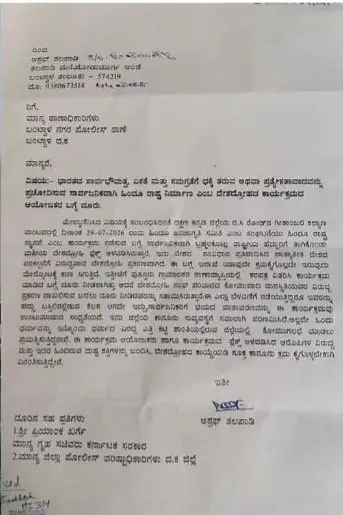
In Bantwal, Karnataka, the radical Islamic organisation Social Democratic Party of India (SDPI) leader Ashraf Talapady defamed the religious festival of Guru Purnima by branding it an ‘anti-national’ event. He filed a police complaint seeking legal action against its organisers and participants. In his complaint submitted to the Inspector of Bantwal (Rural) Police Station, Ashraf claimed that the Guru Purnima programme organised around 29 July 2026 promoted religious extremism, spread hatred against other religions, engaged in anti-constitutional and anti-humanity activities, and threatened communal harmony. According to the complaint, the Hindu Janajagruti Samiti had organised a Guru Purnima Mahotsav in Bantwal taluk as part of its annual religious observance. Ashraf claimed that the event propagated Hinduism in an extremist manner, spread "poison" against other faiths, and amounted to an anti-national activity. Based on these claims, he demanded that the police initiate immediate legal proceedings against the organisers as well as those who had participated in the programme. The complaint sparked widespread outrage among Hindu organisations and devotees, who strongly rejected the false claims as baseless and malicious. They questioned how Guru Purnima, a centuries-old Hindu festival dedicated to expressing gratitude towards gurus, teachers, saints, and the sacred Guru-Shishya tradition, could be portrayed as an anti-national activity. They asserted that branding one of Hinduism's holiest spiritual observances in such terms amounted to a direct insult to the religious beliefs and sentiments of millions of Hindus. In response, supporters of the Hindu Janajagruti Samiti maintained that Guru Purnima was a peaceful religious celebration centred on spiritual learning, respect for teachers, cultural heritage, and moral values. They stated that the event promoted harmony, devotion, and the timeless Hindu teaching, "Guru Brahma, Guru Vishnu, Guru Devo Maheshwara, Guru Sakshat Parabrahma, Tasmai Shri Gurave Namah," which venerates the guru as the embodiment of divine wisdom. They argued that there was no factual basis for portraying such a religious gathering as a threat to the nation or public order. The controversy prompted protests by Hindus from Bantwal and nearby areas, who condemned the complaint and demanded action against those making irresponsible claims against a lawful religious celebration. They urged the authorities to uphold the constitutional right of Hindus to peacefully practise and celebrate their faith and to ensure that criminal law was not misused to target legitimate religious observances. Participants further stated that falsely branding sacred Hindu festivals as anti-national without credible evidence was defamatory, deeply offensive to Hindu devotees, and capable of creating unnecessary communal discord.
Case Images
Why it is Hate Crime ?
This case is being added to the tracker under the primary category: Hate Speech against Hindus. The subcategory selected is: Anti-Hindu slurs, mocking faith. Anti-Hindu slurs and the deliberate mocking of the Hindu faith owing to religious animosity involve the usage of derogatory terms, stereotypes, or offensive references to religious practices, symbols, or figures. One of the common anti-Hindu slurs used against Hindus is “cow-worshipper” and “cow piss drinker”. The intention of using this term is to demean and mock Hindus as a group and their religious beliefs since Hindus consider the cow holy. Additionally, some symbols and the slurs attached to them have a historical context that exacerbates the insult, hate, stereotyping, dehumanisation and oppression against Hindus. Cow worship has been used for centuries to denigrate Hindus, insult their faith and oppress Hindus specifically as a religious group. There has been overwhelming documentation about how cow slaughter has been used to persecute Hindus, with cow meat being thrown in temples and places of worship. There has also been overwhelming documentation where cow meat (beef) has been force-fed to Hindus to either forcefully convert them to Islam or denigrate their faith. Apart from cow worship, the Swastika – which holds deep religious significance for the Hindus – has also been misinterpreted and distorted to use as a slur against Hindus. Similarly, the worship of the Shivling has been used by supremacist ideologies and religions to denigrate Hindus owing to religious animosity. Such slurs and denigration stem from inherent animosity and hate towards Hindus and their faith; therefore, it is categorised as hate speech targeted at Hindus specifically owing to their religious identity. This case was included in the Hate Crime database of the Hinduphobia Tracker because it involved an attempt to stigmatise and criminalise a sacred Hindu religious observance by portraying it as an activity detrimental to the nation. Guru Purnima occupies a revered place in Hinduism as a day dedicated to expressing gratitude towards gurus, saints, and spiritual teachers who guided their disciples on the path of knowledge, righteousness, and dharma. The festival celebrates humility, spiritual learning, and the timeless Guru-Shishya tradition. Branding such a centuries-old religious observance as anti-national directly denigrated a core Hindu religious practice and hurt the religious sentiments of Hindu devotees. Further, publishing damaging claims that portrayed Guru Purnima as an activity promoting extremism, hatred, and anti-humanity defamed a peaceful Hindu religious observance and fundamentally misrepresented its purpose. The festival neither promotes hostility nor encourages division; rather, it honours those who devoted their lives to imparting wisdom, moral values, and spiritual guidance. Falsely associating such a sacred observance with anti-national and hateful activities ridiculed and delegitimised a revered Hindu tradition, thereby fostering prejudice against Hindu religious beliefs and those who publicly practised them. The conduct also reflected prejudice against Hindu religious identity because it sought to invoke criminal law against the organisers and participants of a lawful religious celebration based on sweeping and unsupported claims. By portraying the public observance of Guru Purnima as a threat to the nation and communal harmony, the complaint misrepresented a peaceful Hindu festival in a manner capable of creating suspicion and hostility towards Hindu religious practices. Such false characterisation went beyond criticism of any organisation and instead stigmatised a sacred Hindu tradition itself, contributing to a prejudicial portrayal of Hindus and their faith. Moreover, the complaint assumed added significance because it was filed by a leader of the SDPI, the political wing of the (PFI) Popular Front of India, an extremist and now-banned political organisation. The irony was striking: an individual associated with an organisation linked to extremist activities sought to portray Guru Purnima, a sacred Hindu observance centred on gratitude, spiritual learning, and reverence for gurus, as an event promoting hatred and anti-national activities. Given the antecedents of the organisation and the reasons for the ban imposed on the PFI, the complaint raised serious questions about the locus of such a political formation to characterise a peaceful Hindu religious observance as extremist or hateful. Instead, it reflected an attempt to cast aspersions on a sacred Hindu tradition while portraying a lawful religious celebration in a false and prejudicial light. The background of the complainant is also relevant to understanding the context of the incident. Ashraf Talapady is a leader of the Social Democratic Party of India (SDPI), an organisation that has repeatedly faced allegations of promoting sectarian politics and has frequently been associated with anti-Hindu mobilisation. In March 2025, the Enforcement Directorate (ED) stated that its investigation had uncovered documents and digital evidence showing that the banned Popular Front of India (PFI) funded, guided, and exercised organisational control over SDPI, describing it as the political front of the banned outfit. The investigation further indicated that PFI used SDPI to pursue its ideological objectives through political means. Viewed against this backdrop, the attempt by an SDPI leader to portray a centuries-old Hindu religious festival as "anti-national" was not an isolated act but appeared consistent with a broader pattern of hostility towards Hindu religious institutions and public expressions of the Hindu faith. Taken together, the false claims and the demand for police action demonstrated an intention to delegitimise and discredit a revered Hindu religious observance by falsely portraying it as dangerous, extremist, and contrary to the nation's interests. The complaint targeted the celebration because of its religious character, revealing a conscious disregard for the sanctity of Hindu traditions while seeking to normalise prejudice against the public expression of the Hindu faith. This conduct justified its inclusion in the Hinduphobia Tracker.


Case Status
Complaint filed


Perpetrators Details
Perpetrators
Muslim Extremists
Perpetrators Range
One Person
Perpetrators Gender
male
 Sources




