Dalit Hindu family abused with casteist slurs, their daughter abducted at gunpoint by armed Muslim gang; accused invoked 'Ghazwa-e-Hind'
 Pune, Maharashtra, India
  27 July, 2026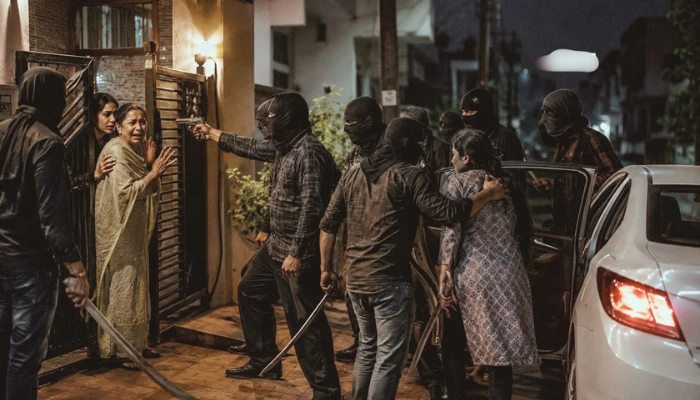
Case Summary
In Pune, Maharashtra, a 26-year-old Dalit Hindu woman was abducted from her home at gunpoint by an armed Muslim gang led by Nadeem Anwar Sheikh and Shafeeq Mulani. During the incident, the accused assaulted and threatened her family, looted cash and gold, abused them with caste-based slurs, and invoked "Ghazwa-e-Hind" while carrying out the abduction. The incident occurred around 1 am on 28 July 2026, when a group of armed men arrived at the victim's residence carrying a pistol, swords, and sickles. According to the FIR, the accused forcibly entered the house, threatened the victim's mother by placing a pistol against her head, abused the family with caste-based slurs, snatched her gold chain, and looted ₹50,000 kept in a cupboard. They then forcibly dragged the 26-year-old woman out of the house and pushed her into a white Hyundai Verna before fleeing the scene. According to the complaint, while leaving the spot, the accused shouted that they were acting for "Ghazwa-e-Hind" and claimed they enjoyed the protection of former Daund Municipal Council President Badshah Sheikh. They also boasted about having committed several crimes in the past. The complainant further stated that the gang attempted to run over police personnel who tried to stop the abduction. Fearing for her daughter's life, the victim's mother did not resist further. Based on the complaint, police registered a First Information Report against eleven accused, including Nadeem Anwar Sheikh, Badshah Adam Sheikh, Shafeeq Mulani, Irfan alias Wasim Anwar Sheikh, Faizal Mehfooz Kazi, Ashpak Sameer Sheikh, Aftab Sameer Sheikh, Arbaaz Anwar Sheikh, and three unidentified persons. The accused were booked under provisions relating to kidnapping, robbery, house trespass, criminal intimidation, outraging the modesty of a woman, the Arms Act, and the Scheduled Castes and Scheduled Tribes (Prevention of Atrocities) Act. The investigation is being conducted by the Daund Sub-Divisional Police Officer. Police records further showed that Badshah Sheikh was named in multiple criminal cases in previous years, including cases involving assault, outraging the modesty of a woman, and assisting an accused in a rape case. At the time of writing this report, no arrests had been made, and the investigation remained ongoing.
Why it is Hate Crime ?
This case was added to the tracker under the primary category: Hate speech against Hindus. The selected subcategory is:, Anti-Hindu slurs, mocking faith. Anti-Hindu slurs and the deliberate mocking of the Hindu faith owing to religious animosity involve the usage of derogatory terms, stereotypes, or offensive references to religious practices, symbols, or figures. One of the common anti-Hindu slurs used against Hindus is “cow-worshipper” and “cow piss drinker”. The intention of using this term is to demean and mock Hindus as a group and their religious beliefs since Hindus consider the cow holy. Additionally, some symbols and the slurs attached to them have a historical context that exacerbates the insult, hate, stereotyping, dehumanisation and oppression against Hindus. Cow worship has been used for centuries to denigrate Hindus, insult their faith and oppress Hindus specifically as a religious group. There has been overwhelming documentation about how cow slaughter has been used to persecute Hindus, with cow meat being thrown in temples and places of worship. There has also been overwhelming documentation where cow meat (beef) has been force-fed to Hindus to either forcefully convert them to Islam or denigrate their faith. Apart from cow worship, the Swastika – which holds deep religious significance for the Hindus – has also been misinterpreted and distorted to use as a slur against Hindus. Similarly, the worship of the Shivling has been used by supremacist ideologies and religions to denigrate Hindus owing to religious animosity. Such slurs and denigration stem from inherent animosity and hate towards Hindus and their faith; therefore, it is categorised as hate speech targeted at Hindus specifically owing to their religious identity. Another category selected is - Violent threats. Violent threats, explicit, implicit or implied, are the most dangerous form of hate speech since it goes beyond discriminatory and prejudicial language to express the intent of causing harm to an individual or a group of people based on their religious identity and faith. There could be several different kinds of threats that are issued to Hindus based on religious animosity. An explicit threat would mean the direct threat of violence towards an individual Hindu, a group of Hindus or Hindus at large. Physical violence, death threats, threats of destruction of property belonging to Hindus and threats of genocide would mean explicit threats against Hindus for their religious identity. Implicit threats may not be a direct threat but implied through the use of symbols of actions – for example – in the Nupur Sharma case, other than explicit threats, there were also implicit threats when Islamists took to the streets to burn and beat her effigies. It implies that they want to do the same to Nupur Sharma – thereby it is considered an implicit threat. Violent threats can be delivered in person, through letters, phone calls, graffiti, or increasingly through social media and other online platforms. It would be important to understand that a threat – explicit or implicit, online or offline – to an individual who happens to be a Hindu does not qualify as a religiously motivated threat. Such a threat, while vile and dangerous, could be owing to non-religious reasons and/or personal animosity. To qualify as a religiously motivated threat, it would need to exhibit an indication that the individual is being targeted for religious reasons and/or owing to his/her religious identity as a Hindu. Here, a Dalit Hindu family was subjected to a coordinated armed attack at their residence, during which their daughter was abducted, and the family was robbed; however, what makes this incident worthy of being added to the Hate Crime Database of the tracker is that the perpetrators accompanied the offence with caste-based abuse and invoked the "Ghazwa-e-Hind" slogan. At first glance, this incident may appear to be an ordinary case of abduction, robbery, and house trespass. However, ordinary criminal offences are generally driven by motives such as financial gain, personal enmity, or other non-religious considerations. In this case, the use of identity-based insults and Islamist rhetoric during the commission of the crime demonstrated that the perpetrators sought not merely to commit violent offences but also to target and intimidate the victims because they were Hindus, bringing the incident within the scope of a religiously motivated hate crime. At the outset, the abuse was not merely offensive language but an attempt to humiliate and degrade the family by targeting both their Hindu and Dalit identity. It can be argued that the caste-specific slur was aimed only at their micro identity as members of the Dalit community rather than their Hindu identity itself. However, in the context of hostility emanating from adherents of Abrahamic faiths, distinctions of caste, region, and language became secondary. It was the victims' broader Hindu identity that attracted the perpetrators' animosity, making the casteist abuse part of a wider identity-based attack rather than an isolated caste insult. Further, the invocation of "Ghazwa-e-Hind" offended an unmistakable religious dimension. The term has long been used by radical Muslims to describe a supposed religious campaign against the Indian subcontinent and, by extension, against Hindus, as they view India as a Hindu collectivity. In fact, the very basis of the partition of India was that the Muslims believed that Islam was a nation unto itself, which could not survive with a Hindu collectivity like India. The ideology associated with Ghazwa-e-Hind advocates the destruction of Hindu temples, the subjugation of Hindus, and their forced conversion or killing upon refusal, to establish Islamic rule. Its use during the attack was therefore not incidental. It amounted to an explicit threat directed at Hindus, intended to intimidate them because of their religious identity. By invoking this term, the accused attempted to convey a message of imposing a belief system that positioned the existing faith of the victims as something to be rejected. This reflected an Islamic supremacist mindset and constituted violent anti-Hindu hate speech. Taken together, the identity-based abuse, the invocation of extremist Islamist rhetoric, and the organised execution of the offence demonstrated that the perpetrators intended not merely to abduct the victim or commit robbery but to intimidate and humiliate a Hindu family because of their religious identity. Their conduct reflected hostility towards Hindus, contempt for their dignity, and an intention to spread fear within the wider Hindu community. For these reasons, this case warranted inclusion in the Hinduphobia Tracker as a religiously motivated hate crime. Disclaimer: In this case, the victim count was recorded as 2 (two) for the Hinduphobia Tracker. While only one Hindu woman was abducted, her mother was also directly subjected to criminal violence when the accused placed a pistol against her head, physically assaulted and intimidated her during the commission of the offence. Since she was an immediate victim of the armed attack and not merely a witness, both women were counted as victims in this incident.
Victim Details
Total Victim
2
Deceased
0
Gender
- Male 0
- Female 2
- Third Gender 0
- Unknown 0
Caste
- SC/ST 2
- OBC 0
- General 0
- Unknown 0
Age Group
- Minor 0
- Adult 2
- Senior Citizen 0
- Unknown 0


Case Status
Complaint filed


Perpetrators Details
Perpetrators
Muslim Extremists
Perpetrators Range
From 10 to 100
Perpetrators Gender
male
 Sources




