Hindu families in Natore terrorised with death threats and extortion demands amidst rising attacks on Bangladesh's Hindu minority
 Natore District, Bangladesh
  31 July, 2026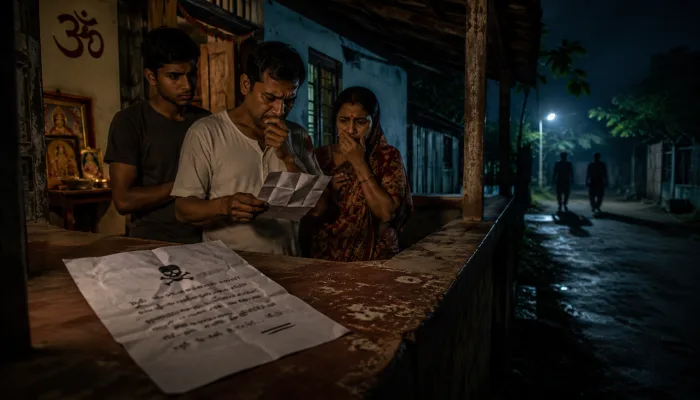
Case Summary
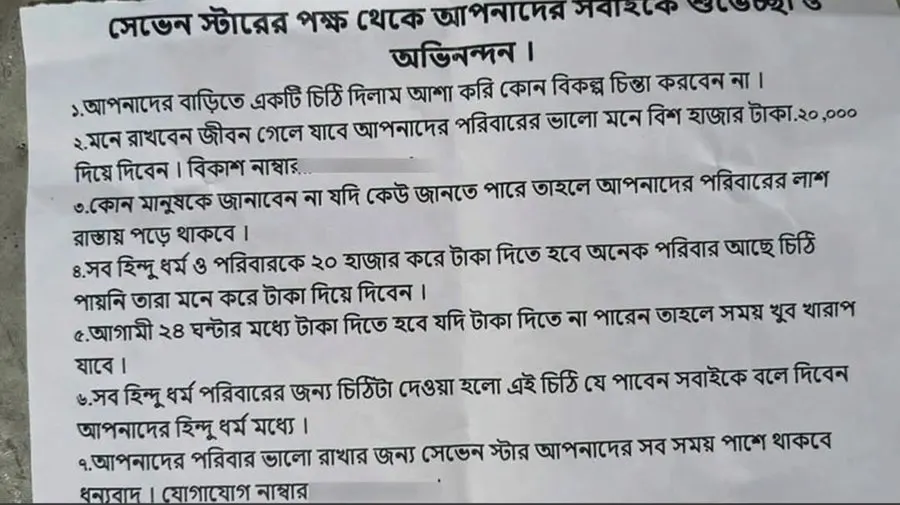
In Palpara of Baknai village under Lalpur Upazila in Natore District, Bangladesh, five Hindu families were terrorised with death threats after receiving computer-typed extortion letters demanding Bangladesh Taka 20,000 each. The unidentified perpetrators threatened to kill their family members if the money was not transferred via bKash within 24 hours. The letters were left under the cover of darkness at the homes of Narayan Kumar Pal, Ajamil Pal, Subrata Pal, Adhir Pal, and Shasthi Pal, all members of the Hindu community residing in a locality comprising around 55 Hindu families. The letters indicated that similar threats were also given to other Hindu families in the locality. The first letter was discovered at around 11:00 pm on 1 August 2026 by Arun Kumar Pal on the veranda of his father, Narayan Kumar Pal's, house. Narayan Kumar Pal, the son of Baidyanath Pal and a gold jewellery merchant operating in Lalpur Bazar, informed his family members and local residents, following which identical letters were found at the other four Hindu households. Signed in the name of "Seven Star" or "Seven Star Authority", the letters instructed each recipient to transfer Bangladesh Taka 20,000 through a specified bKash number within 24 hours. The letters warned that if the money was not paid, family members would be killed, stating that "the dead bodies of your family members will be lying on the street." They further instructed recipients not to disclose the matter to anyone. The letters also stated that they had been issued for all Hindu families and directed recipients to spread the message among other followers of the Hindu religion. Narayan Kumar Pal stated that the computer-typed letter had been left on the veranda of his house during the night and that, after his son discovered it, the family informed local residents and the police. He stated that police reached the village at around 11:00 pm, seized the letter, and that his family had remained deeply concerned about their safety since the incident. He further stated that he intended to file a General Diary at Lalpur Police Station. Rezaul Karim, Acting Chairman of Lalpur Union Parishad, stated that Narayan Kumar Pal had informed him about the extortion letter the following morning, after which he advised the family to file a General Diary at the police station. He also stated that no such incident had previously occurred in Lalpur Union. Following the incident, fear spread among the Hindu families of Palpara, and residents sought immediate action against those responsible. Dipendranath Saha, President of the Lalpur Upazila Puja Udjapan Parishad, informed the Upazila Nirbahi Officer and the Officer-in-Charge of Lalpur Police Station about the incident and stated that he had spoken with the affected Hindu families. He called for a swift investigation to identify those responsible and stated that the fear among the Hindu community would not subside until action was taken. Police visited the village on the night the letters were discovered, seized the documents, and launched an investigation. Officer-in-Charge Shafiqul Islam of Lalpur Police Station stated that the incident was being treated with the highest priority, that the origin of the letters was under investigation, and that security had been strengthened in the area. He further stated that the bKash-linked mobile number mentioned in the letters was registered in the Sylhet region and was switched off when police attempted to trace it. Attempts to contact the number at around 4:45 pm on 2 August 2026 were unsuccessful, and the phone remained switched off. This incident is part of an ongoing pattern of violence against Hindus in Bangladesh, where the community has repeatedly faced persecution and disruptions to their religious festivals and gatherings. Such attacks on Hindu minorities have become increasingly frequent and intensified since August 2024. This escalation of violence against Hindus in Bangladesh has unfolded in three distinct phases: first, following the ouster of Sheikh Hasina’s government in August 2024; second, after the death of Sharif Osman Bin Hadi in December 2025; and third, in the immediate aftermath of the 13th National Parliamentary Election 2026. Following the ouster of Sheikh Hasina, multiple reports documented attacks on Hindu homes, temples, and religious institutions, alongside intimidation campaigns, arson, and mob assaults targeting minority neighbourhoods. The Hinduphobia tracker has recorded 336 such incidents against the Hindu minority, underscoring the scale and persistence of anti-Hindu violence during this period. A further escalation occurred following the death of Sharif Osman Bin Hadi, a Muslim political activist and student leader known for his anti-Hindu and anti-India rhetoric. Hadi had been involved in political unrest after the fall of the Hasina government and was killed in Dhaka on 18 December 2025 during clashes. In the aftermath of his death, Hindu communities were blamed and subsequently targeted in retaliatory violence. Hindu homes were selectively set ablaze in multiple localities, forcing families to flee and leaving many displaced. The attacks appeared patterned rather than sporadic, with Muslim mobs focusing on Hindu neighbourhoods, properties, and religious symbols. Among the victims was Dipu Chandra Das, who was lynched to death and his body was set ablaze by a Muslim mob over false blasphemy allegations. The Hinduphobia tracker documented 51 incidents of anti-Hindu violence in the period following Hadi’s death alone. Such incidents underscore the vulnerability of the Hindu minority amid rising communal hostility and the weaponisation of religious accusations. Reports further indicated that posters and written materials calling for the extermination of Hindus were displayed in public spaces, signalling an alarming normalisation of genocidal rhetoric. When combined with acts of arson, vandalism, assault, and targeted intimidation, these developments suggest a coordinated environment of hostility aimed at terrorising the Hindu community and reinforcing majoritarian dominance. The third phase of violence was unleashed after the 13th National Parliamentary Election 2026. Within days of the announcement of results, Hindu families in districts such as Noakhali, Rangpur, Nilphamari, Sylhet, Thakurgaon, and Dinajpur reported coordinated attacks involving arson, looting, assault, and vandalism of temples and homes. In several instances, Hindu homes were selectively targeted, looted, and families were threatened with displacement.
Case Images
Why it is Hate Crime ?
The primary category for this case is: Hate speech against Hindus. The subcategory for this case is: Violent threats. Violent threats, explicit, implicit or implied, are the most dangerous form of hate speech since it goes beyond discriminatory and prejudicial language to express the intent of causing harm to an individual or a group of people based on their religious identity and faith. There could be several different kinds of threats that are issued to Hindus based on religious animosity. An explicit threat would mean the direct threat of violence towards an individual Hindu, a group of Hindus or Hindus at large. Physical violence, death threats, threats of destruction of property belonging to Hindus and threats of genocide would mean explicit threats against Hindus for their religious identity. Implicit threats may not be a direct threat but implied through the use of symbols of actions – for example – in the Nupur Sharma case, other than explicit threats, there were also implicit threats when Islamists took to the streets to burn and beat her effigies. It implies that they want to do the same to Nupur Sharma – thereby it is considered an implicit threat. Violent threats can be delivered in person, through letters, phone calls, graffiti, or increasingly through social media and other online platforms. It would be important to understand that a threat – explicit or implicit, online or offline – to an individual who happens to be a Hindu does not qualify as a religiously motivated threat. Such a threat, while vile and dangerous, could be owing to non-religious reasons and/or personal animosity. To qualify as a religiously motivated threat, it would need to exhibit an indication that the individual is being targeted for religious reasons and/or owing to his/her religious identity as a Hindu. In this case, the victims were targeted not as isolated individuals but because they belonged to the Hindu community. The extortion letters explicitly stated that they had been issued for "all Hindu families" and instructed recipients to circulate the message among other followers of the Hindu religion. This made it clear that the perpetrators intended to single out Hindus as a religious community rather than merely extort money from a few unrelated households. The coordinated delivery of identical letters to multiple Hindu homes further underscored that the threats were directed at the community as a whole. The letters combined extortion demands with explicit threats of murder, warning that family members would be killed and their bodies left on the street if the demanded sum was not paid within 24 hours. Such threats were designed not only to coerce the immediate recipients into compliance but also to instil fear throughout the wider Hindu population. By instructing recipients to spread the message among other Hindu families, the perpetrators sought to maximise panic and create an atmosphere of terror extending well beyond the five affected Hindu households. The deliberate invocation of the victims' religious identity transformed the incident from a routine act of extortion into one of targeted communal intimidation. Rather than randomly selecting victims, the perpetrators identified Hindus as the intended target group and used threats of extreme violence to undermine their sense of security and intimidate them collectively. The coordinated nature of the letters, the repeated references to Hindus as a distinct community, and the attempt to spread fear across all Hindu families demonstrate that the objective extended beyond financial gain and included the intimidation of a religious minority. Viewed against the broader backdrop of escalating violence and persecution of Hindus in Bangladesh since Sheikh Hasina's exile in August 2024, this incident cannot be seen in isolation. The systematic targeting of Hindu families through threats explicitly linked to their religious identity is consistent with a wider pattern of hostility faced by the Hindu minority. Within the context of the ongoing ethnic cleansing of Hindus in Bangladesh, crimes targeting members of the community are assessed in light of this prevailing environment of religious persecution. Accordingly, this case is being added to the hate crime database of the Hinduphobia Tracker. Disclaimer: Although multiple Hindu families were subjected to intimidation through the threatening letters, the total number of individual victims has not been specified in the available reports. The reports identify only five Hindu victims by name: Narayan Kumar Pal, Ajamil Pal, Subrata Pal, Adhir Pal, and Shasthi Pal. Therefore, for documentation purposes, the Hinduphobia Tracker has conservatively recorded five victims, while acknowledging that the actual number of affected individuals was likely higher.
Victim Details
Total Victim
5
Deceased
0
Gender
- Male 4
- Female 1
- Third Gender 0
- Unknown 0
Caste
- SC/ST 0
- OBC 0
- General 0
- Unknown 5
Age Group
- Minor 0
- Adult 5
- Senior Citizen 0
- Unknown 0


Case Status
Complaint filed


Perpetrators Details
Perpetrators
Unknown
Perpetrators Range
Unknown
Perpetrators Gender
unknown
 Sources




