Hindu Kanwar yatra attacked in Muslim-majority locality over dispute related to DJ music and religious flags in Sunsari, Nepal
 Kosi Zone, Nepal
  25 July, 2026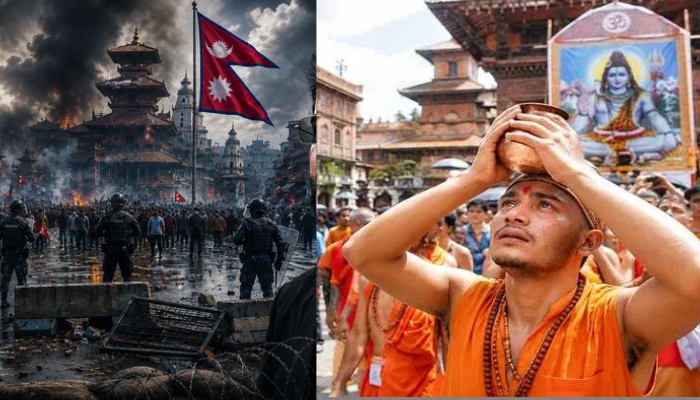
Case Summary
In Dewanganj, Sunsari district of Nepal, a Hindu Kanwar Yatra was attacked by a Muslim mob while it was passing through a Muslim-majority locality. The Kanwar yatra was attacked over a dispute related to DJ music and religious flags, triggering communal clashes resulting in death of three Hindus and around two dozen people being injured. The violence began on 26 July 2026, when saffron-clad Kanwariyas were carrying out their religious procession through Kaptainganj in Dewanganj Rural Municipality-3. According to reports, as the procession entered a Muslim-dominated area, a dispute erupted over the DJ music and religious flags. The dispute escalated into violent clashes during which members of the Muslim community pelted stones at the Hindu devotees, triggering widespread unrest resulting in injuries to over two dozen people. Police and the Armed Police Force fired rounds to disperse the crowd as the violence escalated. The firing resulted in the deaths of three people, identified as Om Prakash Mehta, Jay Prakash Mehta, and 15-year-old Ganesh Yadav. Om Prakash Mehta died at the scene, while Jay Prakash Mehta and Ganesh Yadav later succumbed to their injuries during treatment. The unrest soon spread beyond Sunsari to several districts of Madhesh Province, including Dhanusha and Siraha, where incidents of arson, vandalism, stone-pelting, and clashes with security forces were reported. Several shops, vehicles, homes, and other private properties were damaged. In response, authorities imposed indefinite curfews across several districts, including Sunsari, Dhanusha, and Siraha, and deployed additional police, Armed Police Force personnel, and the Nepal Army to restore order In the aftermath of the killings, Hindu organisations staged large protests in Janakpurdham demanding justice for the victims. Following the violence, the Nepal Government constituted an investigation committee and announced compensation for the victims' families and those injured. Devanganj Rural Municipality declared Om Prakash Mehta and Jay Prakash Mehta as local martyrs, resolved to recommend official martyr status to the Nepal Government, and approved financial assistance for the bereaved families. Former Nepalese King Gyanendra Shah also expressed concern over the communal violence and appealed for the restoration of peace and communal harmony. The Nepali Prime Minister Balen Shah announced that the Ministry of Home Affairs of Nepal formed an investigation committee to probe the incidents of violence and prosecute the culprits. He also promised compensation to the victims of the violence. According to Assistant Chief District Officer of Sunsari, Poshan Lamichhane, a compensation of Nepali Rupees (NRs) 2,00,000 was promised to the kin of the persons killed in violence in Sunsari, while NRs 50,000 was promised to be provided to the injured for treatment expenses. The government reached out to the families of the deceased and agreed on a seven-point resolution, assuring action against the culprits.
Why it is Hate Crime ?
The primary category selected in this case is Attack not resulting in death. The subcategory selected is Attack on a Hindu religious procession. The outward celebration and display of religious symbols is an intrinsic part of Hinduism. Religious processions on various festivals are age-old traditions and a way to manifest faith and form a part of the religious practices of Hindus. On several occasions, such religious processions come under attack by non-Hindu mobs, in a manifestation of their animosity towards Hinduism and its practices. The reasons cited for such violent attacks are many and range from crossing a non-Hindu resident-dominated area to playing loud music, crossing from an area where there is a religious structure of another faith, etc. The violent attacks are triggered by the outward display of religiosity by Hindus. The attacks are mainly a manifestation of religious supremacist doctrine, which believes that idolatry, essentially the Hindu faith, deserves to be annihilated since the very tenets of Hinduism, its practices and traditions are considered a sin in those doctrines. Since these attacks emanate from intrinsic and doctrinal animosity towards Hindus and Hinduism, it is considered a religiously motivated hate crime under this category. The other subcategory selected in this case is: Attack against Hindu devotees. Hindu devotees are a few of the easiest targets of religiously motivated hate crimes because during the festival/procession/puja, etc, for non-Hindus it is easy to profile their victims based on religion. Hindu devotees come under attack on several occasions by individual non-Hindus or mobs of non-Hindus owing to their animosity against Hinduism, its symbols and tradition/practices. There are several instances of Hindu devotees being attacked while they worship in temples or temporary religious structures, during religious processions, doing bhajan/kirtan/puja in their own homes, in the residential society, etc. These attacks are perpetrated by non-Hindus primarily because of their animosity towards Hindus and their faith. In some cases, the trigger for the violence may be non-religious; however, two elements make these hate crimes. First, the Hindus who come under attack are attacked violently while indulging in religious activity. Whether they are in a place of worship or not is immaterial to the crime. When individuals are attacked while indulging in religious practices, the attack in itself is a hindrance to their freedom to practice religion and therefore constitutes a hate crime. Secondly, religious supremacist doctrines and ideologies deem religious practices of Hindus to be offensive ab initio since they are considered “sinful” by these ideologies, worthy to be annihilated by force or coercion. Driven by these religious supremacist ideologies and doctrines, the attacks against Hindu devotees stem from intrinsic animosity towards Hinduism. In some cases, the trigger for the violence may be non-religious; however, it develops into a religiously motivated crime during the course of the violence. Since these attacks stem from animosity towards Hindus and Hinduism, they are considered religiously motivated hate crimes under this category. The other subcategory selected is: Attacked for crossing a 'Muslim area'. One of the reasons that Hindus get attacked unprovoked, specifically by Islamists, is for crossing ‘Muslim areas’. Essentially, Muslim mobs often attack Hindus crossing or present in certain areas which have a majority Muslim population. It has often been cited as one of the reasons to blame Hindus for attacks against themselves, signalling that Hindus displaying religious symbols, taking our religious processions or crossing any area which is dominated by Muslim residents is a provocation in and of itself. These areas are mostly ghettoised areas where mobs mobilise quickly to attack Hindus for a variety of reasons like playing music during a religious procession, crossing a mosque, wearing a tilak or any other religious symbol in a Muslim-dominated area, praying at a local temple in that area, etc. There have been cases where the few local Hindus of that area have been attacked on their way to the Temple for prayers as well, simply because the area is considered a Muslim-dominated area. Several times, it is entirely possible that the immediate trigger for the violence against Hindus was non-religious in nature; however, the violence became religiously motivated in nature because the area was Muslim-dominated and the residents on the whole harboured animosity towards Hindus, evidenced from the actions of the mob, the slogans, and the nature of the attack. Such crimes are motivated by the religious identity of the victims and are therefore classified as hate crimes under this category. The other subcategory selected is Communal Clash/Attack. Communal clash is a form of collective violence that involves clashes between groups belonging to different religious identities. For a communal clash between Hindus and non-Hindus to qualify as a religiously motivated hate crime, the trigger of the violence itself would have to be anti-Hindu in essence. For example, if there is a Hindu religious procession that comes under attack from a non-Hindu mob and after the initial attack, Hindus retaliate in self-defence, leading to a communal clash between the two religious communities. While at a later stage both communities are involved in the clash/violence, the initial trigger of the violence was by the non-Hindu mob against the Hindus, and therefore, it could safely be termed as anti-Hindu violence. Further, the trigger would also have to be religiously motivated. In the cited example, the attack by the non-Hindu mob was against religious processions and therefore can be concluded to be religiously motivated. In some cases, the trigger may be non-religious; however, it develops into religious violence against Hindus at a later stage. In such cases too, the foundational animosity towards Hindus becomes the motivating factor of the crime, and therefore, it would be classified as a religiously motivated hate crime against Hindus under this category. This case was included in the Hinduphobia Tracker because a peaceful Hindu Kanwar Yatra was attacked by a Muslim mob while devotees were publicly practising their faith. The initial act of aggression was directed against a sacred Hindu religious procession, making the religious identity of the victims and the religious nature of the event central to the violence. The Kanwar Yatra is one of the holiest pilgrimages in Hinduism. During the yatra, devotees carry sacred Gangajal to offer to Lord Shiva as an act of worship, penance, and devotion. The procession is not merely a public gathering but an integral religious observance through which Hindus openly express their faith. Attacking a religious procession, especially when it is not entering private property or violating any law, is not a neutral act. It is an attack on the outward manifestation of Hindu religious belief. Such processions are often objected to by those who ideologically oppose the public display of Hindu symbols. This hostility, manifested violently, reflects an intention to silence, disrupt, or punish the religious expression of Hindus. Thus, in this case, the disruption of the religious procession by a Muslim mob was more than just a physical altercation; it was an ideological act rooted in the desire to suppress the outward expression of Hindu religious identity. Furthermore, the violence began after the procession entered a Muslim-majority locality, where objections were raised over the DJ music accompanying the yatra. The unprovoked attack was driven by intrinsic and doctrinal religious animosity, which also stemmed from the fact that the Kanaariyas were probably playing Hindu devotional songs in a Muslim-dominated area. In areas with a majority Muslim population, Hindus often face hostility since the tenets of Islam harbour antagonism towards the Hindu faith and the adherents of Hinduism. Such religious and doctrinal animosity manifests in violence against Hindu individuals when they outwardly display their faith in areas with a Muslim majority. Since the violence was a product of religious animosity, this case is being categorised as a religiously motivated hate crime. The perpetrators reacted violently to the presence of Hindus practising their faith in “their” area. This pattern of attacking Hindus merely for being visibly religious in Muslim-dominated zones shows a territorial religious supremacy, where Hindu presence itself is deemed unacceptable. This transforms the space into one where Hindu faith is not tolerated, and the act of crossing such a space becomes a trigger for communal violence. Such selective intolerance reflected unequal treatment of Hindu religious expression in shared public spaces. Furthermore, if members of Muslim community had genuine concerns regarding the Kanwar yatra, relating to noise or its route, it could have been addressed through lawful dialogue or administrative measures rather than violence against unarmed devotees. The Muslim mob resorted to force against a visibly Hindu religious procession because it publicly manifested Hindu faith. The choice to respond with aggression rather than peaceful resolution demonstrated hostility towards Hindu religious practices rather than a neutral objection to sound or traffic. The perpetrators' conduct revealed a conscious disregard for the religious rights of Hindu devotees by treating a sacred pilgrimage as something that warranted violent disruption. Their actions obstructed the public expression of Hindu faith, endangered devotees, and transformed a peaceful religious observance into widespread communal unrest. The circumstances demonstrated an intention to intimidate Hindus while they were practising their religion publicly and to discourage such expressions of faith. For these reasons, the incident warranted inclusion in the Hinduphobia Tracker as a religiously motivated hate crime. Given that this case meets multiple parameters of a hate crime, it is added to the hate crime database of the Hinduphobia Tracker.


Case Status
Complaint filed


Perpetrators Details
Perpetrators
Muslim Extremists
Perpetrators Range
Unknown
Perpetrators Gender
unknown
 Sources




