Hindu man's Kanwar desecrated, its religious sanctity defiled by Muslim youth during Kanwar Yatra in Ghaziabad, Uttar Pradesh
 Ghaziabad, Uttar Pradesh, India
  23 July, 2026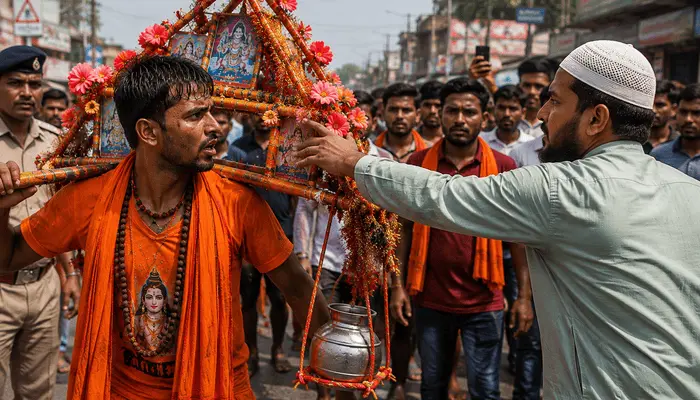
Case Summary
A Hindu man named Sonu Kumar's sacred Kanwar was desecrated by a Muslim youth named Imran Khan during the annual Kanwar Yatra near Guldhar Railway Station in Ghaziabad, Uttar Pradesh. According to the Hindu devotee, the incident invalidated several days of religious penance, during which he had survived only on water while walking from Haridwar in adherence to the Hindu religious customs. Visibly distressed, he said his devotion, fasting, and arduous journey had been rendered meaningless because the Kanwar was deliberately targeted. The incident occurred at around 4:00 PM under the jurisdiction of the Madhuban Bapudham Police Station in Ghaziabad. The complainant, Sonu Kumar, a resident of Bharatpur, Rajasthan, was returning with approximately 15 fellow Kanwariyas after collecting holy Ganga water from Haridwar. Sonu stated that he had begun his Kanwar Yatra at 5:00 AM on 21 July 2026, strictly observing the religious rules of the pilgrimage. He mentioned having rested only three times, consumed only water throughout the journey, and endured intense heat while carrying the sacred Kanwar to his village, where he intended to perform Jalabhishek at the local Shiva temple. According to Sonu and his companions, a local Muslim youth named Imran Khan desecrated the decorated bamboo Kanwar, breaking it with a stick, causing it to lose its ritual purity as per Hindu customs. Sonu asserted that, under his religious beliefs, the sanctity of the Kanwar had been broken, making all his days of devotion and penance futile. The incident led to a heated confrontation between Hindu pilgrims and Muslim locals. As the altercation unfolded, residents gathered at the scene, resulting in heavy congestion and a traffic jam stretching nearly one kilometre on both sides of the road. The disruption reportedly lasted for around 20 minutes before police restored order. Police personnel from the Madhuban Bapudham Police Station, along with foot-patrolling teams, reached the scene, dispersed the crowd, and brought the situation under control. Assistant Commissioner of Police (Kavinagar) Siddharth Gautam confirmed that the individual identified as Imran Khan was taken into custody and that an investigation was initiated into the sequence of events. Police facilitated the performance of traditional religious rituals to restore the Kanwar's sanctity, after which Sonu Kumar and the other Kanwariyas resumed their pilgrimage. Following the incident, Additional Police Commissioner (Law and Order) Rajkaran Naiyar directed all police station in-charges to maintain heightened vigilance during the Kanwar Yatra. Authorities reinforced restrictions on the movement of heavy vehicles along the Kanwar route between the Meerut border and the Delhi border and ordered strict enforcement of traffic diversion plans to ensure the safety of pilgrims and prevent further disturbances.
Why it is Hate Crime ?
The primary category selected in this case is: Attack on Hindu religious representations, with the subcategory selected as: Desecration of Hindu religious symbols Icons and symbols or a religious representation of a spiritual ideal are widely revered in Hinduism. Iconography is of vital significance in the Hindu milieu. It helps connect people’s spiritual beliefs with the real world. Iconography within the Hindu faith takes several shapes and forms. Murtis are of most significance to Hindus, to which daily rituals, prayers and offerings are done. Besides the murtis, there are several other symbols which have deep significance in the Hindu faith – the Om and Swastika for example. Since these Hindu religious symbols hold paramount importance in Hinduism, any desecration of symbols, icons, murtis, religious representations and manifestations, is driven by animosity towards the faith itself, which manifests itself through these murtis, icons and symbols. Therefore, any desecration of these Hindu religious symbols and representations is considered religiously motivated hate crimes under this category. The other sub-category selected here is - Defiling religious customs. Sanatan Dharma is not a religion of one book, which is to say that while it has religious scriptures that form the central tenets of the faith, there are several traditions followed through thousands of years, mostly passed from generation to generation orally. There are several such customs and traditions that are followed by various Hindus and Hindu sects. Defiling of these traditions and customs is a breach of an individual or group’s religious practices. Such practices can range from dietary restrictions like not eating non-vegetarian food for a certain period of the year, not eating non-vegetarian food at all, not eating beef since the cow is considered holy in Hinduism, the sanctity of religious customs followed in the house (like many ISCKON devotees), etc. Any malicious action leading to the breach of such traditions or defilement of these traditions owing to animosity towards the faith or for the sake of activism stems not only from the lack of faith in the religion itself but also from disregard for the faith of the devotees who follow the customs/traditions and implicit bias against the faith, the tradition itself. Since these specific traditions are central to the faith of the devotees of that specific sect of Hindus, any non-compliance with these traditional rules would be considered a religiously motivated hate crime. The Kanwar Yatra is one of the largest and most significant annual pilgrimages in Hinduism, dedicated to Lord Shiva. It takes place during the holy month of Shravan (Sawan), when millions of devotees, known as Kanwariyas, travel to sacred rivers, primarily the River Ganga, to collect holy water. Pilgrims obtain this water from revered sites such as Haridwar, Gangotri, Gaumukh, Sultanganj, and Prayagraj, and then carry it back to their hometowns or villages to offer it to the Shiva Lingam through the ritual of Jalabhishek. The Kanwar itself is the sacred structure used to carry the holy Ganga water during the pilgrimage. Traditionally made from a bamboo pole balanced across the shoulders with water vessels suspended from each end, it is often decorated with saffron cloth, flowers, flags, bells, images of Lord Shiva, and other religious symbols. For many Kanwariyas, the journey is not just a physical walk but a sacred religious observance governed by strict spiritual disciplines. Because of the religious significance, devotees follow customs intended to preserve the Kanwar's ritual sanctity. In this case, the pilgrim stated that he had spent several days walking from Haridwar while consuming only water and following the religious rules of the yatra. He believed that desecration of his Kanwar invalidated his religious observance and rendered his penance futile until purification rituals were performed. For him, his Kanwar represented not only emotional distress but also the disruption of a sacred religious obligation. The Muslim man intentionally targeted the Kanwar and desecrated it because of the pilgrim's Hindu faith or to insult or disrupt his religious practice. This conduct by the Muslim man is a religiously motivated hate crime against Hindus. The harm extends beyond damage to an object, as it interferes with the victim's ability to freely practice his religion and deliberately attacks the sacred Hindu religious practices. The breaking of a Kanwar during the Kanwar Yatra is interference with a sacred religious observance of Hindu religious beliefs. Once a devotee collects holy Ganga water with the intention of offering it to Lord Shiva, the Kanwar becomes part of a consecrated religious act. Throughout the pilgrimage, many Kanwariyas follow strict vows that may include fasting, abstinence, ritual purity, and walking long distances without deviating from prescribed customs. The Kanwar is treated with reverence because it carries water that has been dedicated for worship. Devotees avoid even allowing it to touch the ground except on designated stands, prevent unnecessary contact with it, and believe that if its ritual purity is compromised, purification rites must be performed before the pilgrimage can continue. The act of breaking the Kanwar by the Muslim man is not just an interference with property but an interference with a sacred object that is central to an ongoing act of Hindu worship. If someone deliberately damages the Kanwar to disrupt the pilgrimage or insult the devotee's faith, it is a desecration of a religious symbol because it directly interrupts a consecrated ritual and nullifies the devotee's religious understanding, the spiritual discipline undertaken over several days. In this incident, the pilgrim stated that he had walked from Haridwar while observing strict religious disciplines, surviving only on water and carefully maintaining the sanctity of his Kanwar until he reached his village to perform Jalabhishek. According to him, the desecration of the Kanwar destroyed its ritual purity, prompting police to arrange purification rituals before he could continue. The harm represented the disruption of a sacred covenant he believed he had made with Lord Shiva. Such an intentional act is a sacrilege of Hindu practices because the Kanwar functions as an integral part of an active religious ceremony rather than a symbolic accessory. The Kanwar was deliberately targeted because of the pilgrim's Hindu faith or to insult or obstruct his religious practice. This act is a religiously motivated act of desecration and hatred towards Hinduism.
Victim Details
Total Victim
1
Deceased
0
Gender
- Male 1
- Female 0
- Third Gender 0
- Unknown 0
Caste
- SC/ST 0
- OBC 0
- General 0
- Unknown 1
Age Group
- Minor 0
- Adult 0
- Senior Citizen 0
- Unknown 1


Case Status
Unknown


Perpetrators Details
Perpetrators
Muslim Extremists
Perpetrators Range
One Person
Perpetrators Gender
male
 Sources




