Hindu students barred from wearing tilak, bindi, and kalava by Christian School in Poonch, Jammu and Kashmir
 Punch, Jammu and Kashmir, India
  29 July, 2026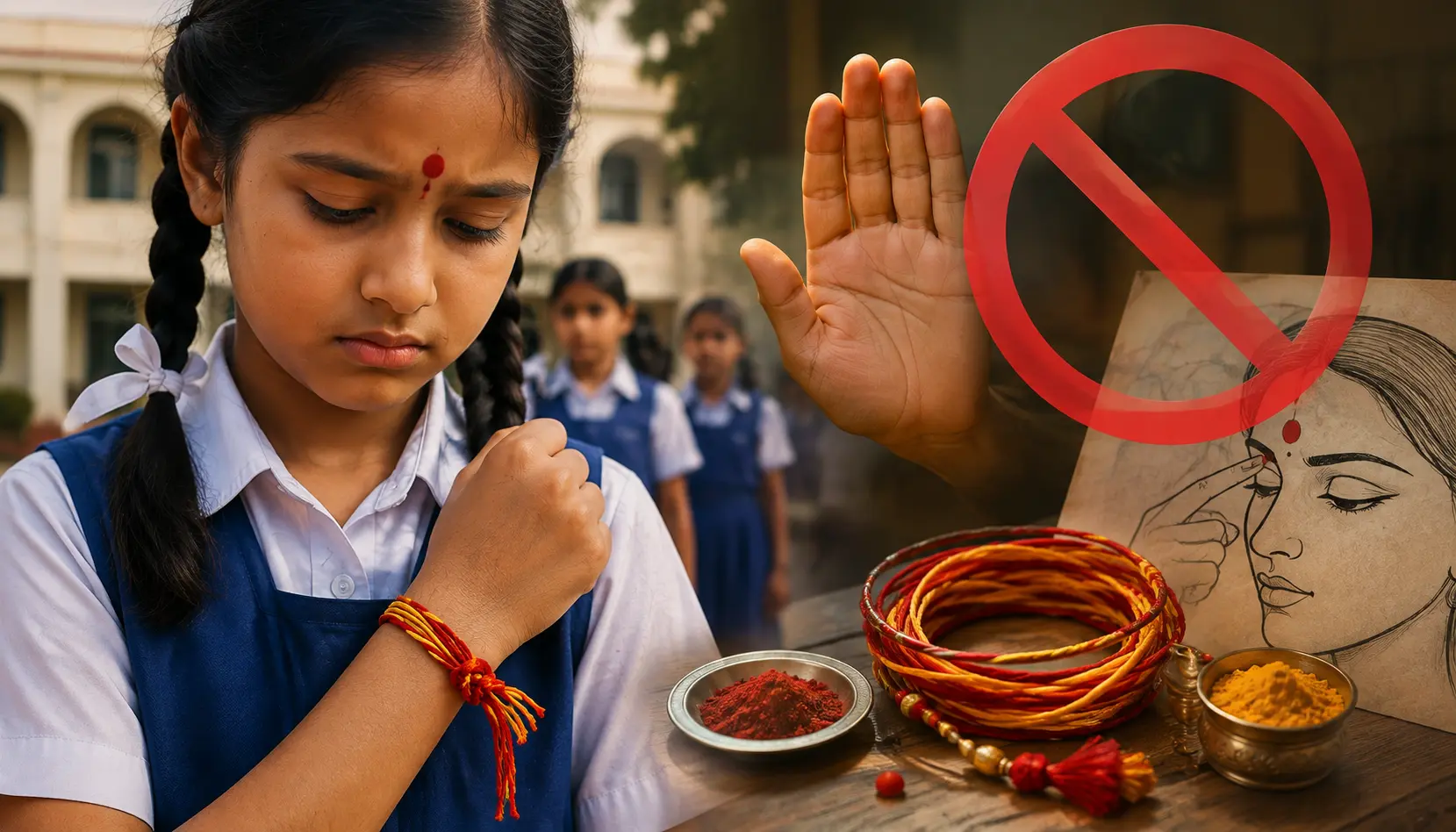
Case Summary
In Poonch district of Jammu and Kashmir, Hindu students were prohibited from wearing tilak, bindi, mehndi, and kalava (moli) by the Christ School in Degwar. The school administration added these instructions in its admission brochure and school diary instructions. The provisions were widely circulated on social media and drew objections from Hindu organisations, including the Sanatan Dharma Sabha, VHP, and Bajrang Dal, which said that the instructions discriminated against Hindu religious practices. Protests were held demanding the removal and arrest of the school's Principal, Fr. Sujith Mathew, and an FIR against him. Chief Education Officer Javid Iqbal Gulshan convened a meeting which involved representatives of the Hindu organisations and the school authorities on the directions of the Deputy Commissioner. During the protest, several demonstrators demanded legal action against the principal and raised concerns about discrimination against Hindu and Sikh students. Some protesters insisted that any settlement be recorded in writing and objected to students being required to address the principal as "Father." One speaker said that the principal could be acting on behalf of an external agency and called for an investigation. The principal apologised for the inclusion of the contentious provisions and announced that the brochure would be withdrawn immediately. The principal claimed that the disputed content had been included due to a copy-and-paste error from brochures used by schools in other states. Police officials assured the protesters that their complaints had been received and that any action required under the law would be examined. Community representatives later stated that they had chosen to pursue legal remedies instead of disruptive protests and appealed for a thorough investigation into the circumstances surrounding the issuance of the disputed instructions.
Why it is Hate Crime ?
The primary category selected in this case is: Restriction/ban on Hindu practices, with the subcategory selected as: Restriction on expression of Hindu identity. An example of the state-affected prejudicial and targeted orders against the Hindu community would be a government denying the right of a Hindu or a group of Hindus to hold a religious procession owing to the animosity of non-Hindu groups. Denial of the religious right of the Hindus to assuage the non-Hindu group which harbours animosity to a point where it could lead to violence against Hindus is not only a failure of law and order but is a prejudicial order against Hindus, denying them their fundamental rights to express their religious identity. An example of a hate crime against Hindus by a non-Hindu would be a non-Hindu institution forcing its Hindu employees to abandon religious symbols that a Hindu would wear as an expression of faith owing to inherent prejudice against the faith professed by the victim or a non-Hindu group of people restricting a Hindu group from constructing a place of worship simply because the demography of the area in which the temple is being built is dominated by non-Hindus. Such actions are driven by religious animosity and/or prejudice against Hindus and their faith and would therefore be categorized as a hate crime. The other primary category selected here is- Predatory Proselytisation. Under this, the sub-category selected is- Proselytisation by grooming, brainwashing, manipulation or subtle indoctrination. Religious brainwashing essentially means the often subtle and forcible indoctrination to induce someone to give up their religious beliefs to accept contrasting regimented ideas. Religious grooming or brainwashing also involves propaganda and manipulation. It involves the systematic effort, driven by religious malice and indoctrination, to persuade “non-believers’ to accept allegiance, command, or doctrine to and of a contrasting faith. Cases of such grooming or brainwashing are far more nuanced than direct threats, coercion, inducement and violence. In such cases, it is often seen that there is repeated, subtle and continual manipulation of the victim to induce disaffection towards their own faith and acceptance of the contrasting faith of the perpetrator. While subtle indoctrination is widely acknowledged as predatory, an element which is often understated in such conversions or the attempts of such conversion is the role of loyalty and trust which might develop between the perpetrator and the victim. Fiduciary relationships are often abused to affect such religious conversion. For example, an educator transmitting religious doctrine of a competing faith to a Hindu student. The Hindu student is likely to accept what the teacher is transmitting owing to existence of the fiduciary relationship. The exploitation of the fiduciary relationship to religiously indoctrinate victims would also be included in this category. Since the underlying animosity towards the victim’s faith forms the basis of predatory proselytization, such cases are considered religiously motivated hate crimes. This case has been added to the Hinduphobia Tracker because Hindu students were subjected to an institutional restriction targeting visible expressions of their religious identity. Christ School in Degwar, Poonch, issued an admission brochure and school diary instructions prohibiting students from wearing Hindu religious symbols and practices, including the tilak, bindi, mehndi, and kalava (sacred thread), on the school premises. These restrictions specifically affected symbols and practices that hold recognised religious significance in Hinduism and therefore directly interfered with the ability of Hindu students to openly practise and express their faith within an educational institution. By prohibiting the display of these Hindu religious symbols, the institution imposed a restriction on the public manifestation of Hindu religious identity, making this a case of religiously motivated institutional discrimination directed against Hindu students. It is more than a disciplinary issue because the instructions specifically mentioned outward expressions of Hindu religious identity such as the tilak, bindi, mehndi, and kalava (moli). These are not just decorative items for Hindus but visible symbols of faith, devotion, family traditions, and religious observance. For Hindus, kalava (moli), tilak, and bindi are important religious and cultural symbols that reflect faith, identity, and tradition. Kalava, the sacred red or red-and-yellow thread tied around the wrist during Hindu rituals, is regarded as a symbol of divine protection, blessings, and commitment to dharma. It is commonly tied by priests during pujas, yajnas, festivals, and other religious ceremonies. The tilak, applied to the forehead using substances such as sandalwood paste, kumkum, vibhuti (sacred ash), or chandan, signifies devotion to a deity, spiritual awareness, and participation in religious worship. Different tilak styles also represent different Hindu traditions and sects. The bindi, traditionally worn on the forehead, holds both cultural and religious significance. While it is widely associated with Hindu women and married life in many communities, it is also regarded as representing the ajna chakra (the "third eye"), symbolising wisdom, inner awareness, and spiritual focus. Collectively, these symbols are visible expressions of the religious identity and are commonly worn during daily life, festivals, temple visits, and family ceremonies. When a school directs students not to wear such symbols, it is singling out their religious identity in a way that restricts the public expression of their beliefs. This shows that Hindu students are expected to suppress aspects of their faith to participate fully in school life. Educational institutions are expected to treat students of all faiths equally and accommodate religious practices wherever reasonably possible. A written prohibition targeting commonly worn Hindu religious symbols appears inconsistent with the principles of religious equality and pluralism. The fact that the restriction was printed in official school material rather than conveyed informally shows that the limitation was institutional rather than accidental. Such an incident also contributes to a broader sense of insecurity regarding the open expression of Hindu identity. Visible religious symbols carry cultural and spiritual significance beyond individual belief, and restricting them is discouraging Hindu students from openly practising or displaying their faith. Religious freedom includes not only the right to hold beliefs but also the right to manifest those beliefs through customary symbols and practices, provided they do not interfere with safety or educational functioning. An administrative rule prohibiting Hindu religious symbols effectively places conditions on participation in school that require Hindu students to set aside aspects of their religious identity during school hours. This is an institutional restriction on religious practice rather than merely a dress code. In this case, it is also important to mention that in 2022, a massive controversy erupted in Karnataka, which took a national form, after Muslim women insisted that they should be allowed to wear burqas and hijabs in their schools and classrooms. At that time, the argument given by several politicians, social commentators, Hindu activists and even the judiciary was that schools have the right to enforce uniform rules, since wearing uniforms brings harmony and equality in the classroom, and therefore, schools not allowing girls to wear hijab in the classroom is not religious discrimination, but merely an enforcement of widely accepted uniform norms. The argument was also that overt religious symbols like the Hijab can be restricted under the school's policy of uniformity. Some pseudo-seculars and anti-Hindu leftists argue that a similar line of reasoning should be applied in this case and that school authorities have the authority to regulate student appearance in order to maintain uniformity and discipline. However, it is important to note that the tilak and kalava are benign Hindu religious symbols that neither disrupt classroom activities nor interfere with the educational environment. For Hindu students, wearing a tilak and kalava is a peaceful expression of faith and religious identity. More importantly, the issue in this case extends far beyond any purported institutional policy. Such actions demonstrate hostility towards Hindu religious practice and the students who adhered to it. The selective targeting of Hindu students for wearing sacred Hindu symbols, coupled with punitive actions and the unequal treatment of religious communities, raises serious concerns about the motivations behind such enforcement. The actions of the school authorities amount to religious discrimination and are consistent with the framework of a religiously motivated hate incident, where Hindu religious symbols were targeted. Disclaimer: The incident date has been taken as 30 July 2026 based on the earliest verified public reports, social media posts, and news coverage that brought the controversy into the public domain. No official document specifying the exact date on which the disputed brochure or diary was first issued has been released; therefore, 31 July 2026 has been used as the incident date for documentation purposes.


Case Status
Unknown


Perpetrators Details
Perpetrators
Christian Extremists
Perpetrators Range
One Person
Perpetrators Gender
male
 Sources




