Two Hindu labourer shot dead in a targeted attack by Islamist terrorist outfit; family confirms victims identified by caste and religion before being killed
 Kulgam, Jammu and Kashmir, India
  30 July, 2026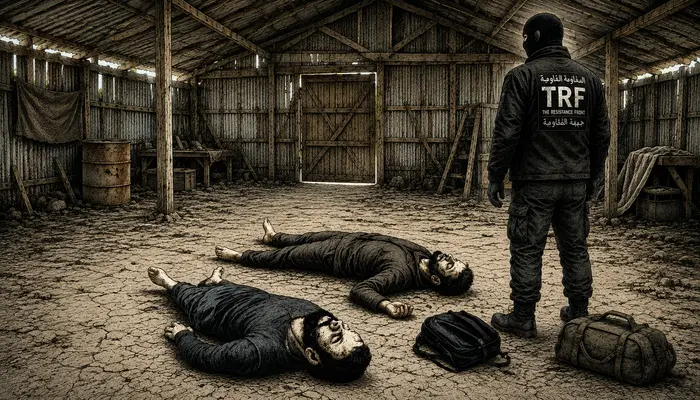
Case Summary
In the Kellam area of Kulgam district in South Kashmir, two Hindu migrant labourers were shot dead by the Islamist terrorist outfit The Resistance Front (TRF), after the attackers identified them based on their religion and caste. On 31 July 2026, Islamist terrorists opened fire on two Hindu migrant labourers, killing 24-year-old Deepak Ratre, a resident of Chhattisgarh, and 28-year-old Bhupendra Bhaina from Sarangarh-Bilaigarh district. The attack took place at around 8:30 pm while the two men were working at a brick kiln in the area. After the attack, Bhopinder was initially taken to a local hospital before being referred to Government Medical College (GMC) Anantnag for specialised treatment due to the severity of his injuries, where he passed away. According to reports, the attackers first asked the victims about their identity, caste, and religion before opening fire. Deepak Ratrey’s family stated that the terrorists asked the labourers their religion before shooting them, demonstrating that the victims were deliberately singled out rather than being caught in indiscriminate violence. Islamists terrorist outfit, The Resistance Front (TRF), an affiliate of the Pakistan-based terrorist organisation Lashkar-e-Taiba (LeT), took responsibility for the attack. Following the shooting, personnel from the Jammu and Kashmir Police and other security agencies reached the spot, cordoned off the area, and launched a large-scale search operation to trace the perpetrators. Lieutenant Governor Manoj Sinha condemned the attack and instructed security forces to intensify counter-terrorism operations to eliminate those responsible. He also directed officials to ensure the injured labourer received the best possible medical treatment. The attack occurred against the backdrop of a series of targeted killings of Hindu and non-local civilians in Jammu and Kashmir. Security agencies stated that such attacks were intended to spread fear among non-local residents, discourage migration into the Valley, and disrupt normalcy in the region.
Why it is Hate Crime ?
This case has been added to the tracker under the primary category of - Attack resulting in death. Within it, the sub-category selected is - Attacked for Hindu identity. In several cases, Hindus are attacked merely for their Hindu identity without any perceived provocation. A classic example of this category of religiously motivated hate crime is a murder in 2016. 7 ISIS terrorists were convicted for shooting a school principal in Kanpur because they got ‘triggered’ seeing the Kalava on his wrist and tilak that he had put. In this, the Hindu victim had offered no provocation except for his Hindu religious identity. The motivation for the murder was purely religious, driven by religious supremacy. Such cases where Hindus are targeted merely for their religious identity would be documented as a hate crime. Under this category, cases where the attack led to the death of the Hindu victim/s would be documented. The other sub-category selected here is - Attacked to induce migration from non-Hindu dominated area. There have been cases where the Hindus living in an area, often with a majority dwelling belonging to non-Hindus or those harboring animosity towards the Hindu faith, the Hindu residents experience threats and violence. The violence is employed with the aim of making the Hindus leave the area and relocate, so the area could be turned into an exclusive ghetto for adherents of the non-Hindu faith or those who harbor animosity towards the Hindu faith. In several cases, the aim of exodus is explicit. However, in several cases, the demand for exodus of Hindu residents is not explicit, however, violence by non-Hindu residents leaves the Hindu residents no option but to leave the area, thereby, turning the area into an exclusive ghetto of non-Hindu residents. In such cases, there are instances of violence against the Hindu residents explicitly. For example, in the Hauz Qazi case of 2019, the Muslim residents claimed that mob violence against the Hindu residents had been triggered by a parking dispute. However, the violence did turn religious with a temple being desecrated, and was directed specifically against the Hindu residents. The Hindu residents of the area were clear that the violence was religiously motivated and one of the motives was to affect an exodus of the Hindu residents. In such cases, even though the perpetrators have not explicitly expressed the aim of affecting exodus, the given circumstances and violence and precedent point to the intention of exodus and therefore would be categorized as a religiously motivated hate crime. Under this category, cases where the attack led to the death of the Hindu victim/s would be documented. This case has been classified as a hate crime because the victims were targeted as Hindu migrant labourers belonging to a community that has repeatedly been singled out by Pakistan-backed Islamist terrorist organisations operating in Jammu and Kashmir. According to security agencies, the attackers specifically identified the victims as non-local labourers before opening fire, demonstrating that they were deliberately selected rather than caught in indiscriminate violence. The victims were Hindu migrant workers from Chhattisgarh who had travelled to Kashmir for employment, making them part of a demographic that has repeatedly faced targeted attacks by Islamist terrorist groups seeking to intimidate Hindus and deter their continued presence in the Valley. The attack was carried out by The Resistance Front (TRF), an Islamist terrorist outfit that functions as an affiliate and proxy of the Pakistan-based terrorist organisation Lashkar-e-Taiba (LeT). Since its emergence in 2019, TRF has been linked to numerous targeted attacks against civilians, security personnel, and religious minorities in Jammu and Kashmir. Indian authorities have designated TRF as a terrorist organisation under the Unlawful Activities (Prevention) Act (UAPA), identifying it as a front organisation created to further the objectives of Pakistan-backed Islamist militancy while masking the direct involvement of Lashkar-e-Taiba. At first glance, this incident may appear to be an attack directed solely against non-local labourers. However, when viewed in the broader context of TRF's pattern of violence, it becomes evident that the attack cannot be reduced to mere regional hostility or xenophobia towards outsiders. The same terrorist organisation has repeatedly targeted Hindu civilians in Jammu and Kashmir, including Kashmiri Pandits, Hindu migrant workers, pilgrims, and tourists. This ideological motive was most explicitly demonstrated during the 2025 Pahalgam Hindu massacre, where TRF terrorists religiously profiled victims by checking their identities, asking about their religion, demanding that they recite Islamic verses, and executing those identified as Hindus. That attack conclusively established that TRF's violence is rooted not merely in opposition to non-local residents but in hostility towards Hindus. The targeting of Hindu migrant labourers in this case is also consistent with the longstanding strategy adopted by Islamist terrorist organisations of creating an atmosphere of fear among Hindu communities in Jammu and Kashmir. By selectively attacking Hindu migrant workers, pilgrims, tourists, these organisations seek to discourage Hindus from travelling to, working in, or settling in the Valley. Such attacks serve not only to terrorise the immediate victims but also to send a broader message that Hindus are unwelcome in the region. The objective extends beyond individual acts of violence and reflects an effort to alter the demographic and social landscape by inducing the migration of Hindus from Muslim-majority areas and deterring the continued presence or arrival of Hindu civilians. The 2025 Pahalgam Hindu massacre by the same outfit, similarly demonstrated this strategy of using targeted violence to intimidate Hindus and reinforce communal fear. This broader pattern must also be understood in the context of The Resistance Front's (TRF) association with the Pakistan-based terrorist organisation Lashkar-e-Taiba (LeT), a group that has long been used as an instrument of Pakistan-backed militancy in Jammu and Kashmir. For decades, Pakistan-sponsored Islamist terrorist groups have sought to challenge India's sovereignty over the region through sustained campaigns of violence directed against security forces as well as civilians, particularly Hindus. It is pertinent to note that Muslim extremists harbour specific animosity towards Hindus and their faith and also view India as a Hindu collectivity. The very basis of the partition of India was that the Muslims believed that Islam was a nation unto itself, which could not survive with a Hindu collectivity like India. The ideological motive underpinning such attacks became particularly evident during the Pahalgam Hindu massacre of April 2025, also carried out by The Resistance Front (TRF). The Pahalgam Hindu massacre demonstrated that TRF's violence extends beyond indiscriminate terrorism and includes the deliberate targeting of Hindus through religious profiling. It also reflected the group's broader strategy of using targeted violence to intimidate Hindus, discourage their continued presence in or travel to Jammu and Kashmir, and reinforce an atmosphere of fear among Hindu communities. Such attacks against Hindu civilians in Jammu and Kashmir cannot be viewed merely as acts of terrorism or violence against civilians. Instead, the repeated selection of Hindu victims by Islamists, including TRF and Muslims, demonstrates a pattern of religiously motivated hostility aimed at intimidating the Hindu community and discouraging its continued presence in the region. The present attack must therefore be understood within this broader context of targeted violence rooted in religious animosity rather than as an isolated security incident. The most devastating manifestation of this campaign was the mass exodus of Kashmiri Pandits in 1990, when widespread killings, targeted assassinations, threats, and intimidation by Islamists forced the overwhelming majority of the Valley's indigenous Hindu population to flee their homes. The present attack follows the same pattern. While the victims were identified as non-local labourers before being shot, they were also Hindu migrant workers belonging to a community that has repeatedly been singled out by Islamist terrorist organisations. Viewed against TRF's established record, the attack demonstrates a continuation of a broader campaign of religiously motivated violence against Hindus rather than a simple act of regional targeting, with the broader effect of discouraging the continued presence and movement of Hindus into the Valley. The present attack also fits into a broader and well-established pattern of Islamist terrorist violence directed against Hindu and non-local civilians in Jammu and Kashmir. Over the past several years, terrorist groups have repeatedly targeted Hindu migrant labourers, Kashmiri Pandits, Hindu teachers, pilgrims, tourists, and other non-local civilians in deliberate attacks intended to spread fear and discourage their presence in the Valley. In October 2021 alone, migrant labourers from Bihar were shot dead in Kulgam, while several other non-local workers and street vendors were similarly murdered in Srinagar and Pulwama, triggering the departure of hundreds of migrant workers from Kashmir. In 2022, Kashmiri Pandit government employee Rahul Bhat was murdered inside his office in Budgam, while teacher Rajni Bala was shot dead in Kulgam. These attacks formed part of a sustained campaign of intimidation directed at Hindu and non-local communities. Accordingly, this incident cannot be viewed as an isolated act of terrorism. It forms part of an established pattern of Islamist extremist violence directed against Hindu at the hands of Muslims. The deliberate targeting of non-local Hindu labourers by an organisation with a documented history of attacking Hindus and other non-local civilians demonstrates an intent to intimidate these communities, discourage their presence in the Valley, and reinforce an atmosphere of religiously motivated fear and exclusion. For these reasons, the incident satisfies the criteria for classification as a religiously motivated hate crime against Hindus.
Victim Details
Total Victim
2
Deceased
2
Gender
- Male 2
- Female 0
- Third Gender 0
- Unknown 0
Caste
- SC/ST 0
- OBC 0
- General 0
- Unknown 2
Age Group
- Minor 0
- Adult 2
- Senior Citizen 0
- Unknown 0


Case Status
Unknown


Perpetrators Details
Perpetrators
Muslim Extremists
Perpetrators Range
Unknown
Perpetrators Gender
unknown
 Sources




