Hindu religious sentiments outraged after Indian politician's parliament skit depicts Hindu priest as thieves
 New Delhi, Delhi, India
  30 July, 2026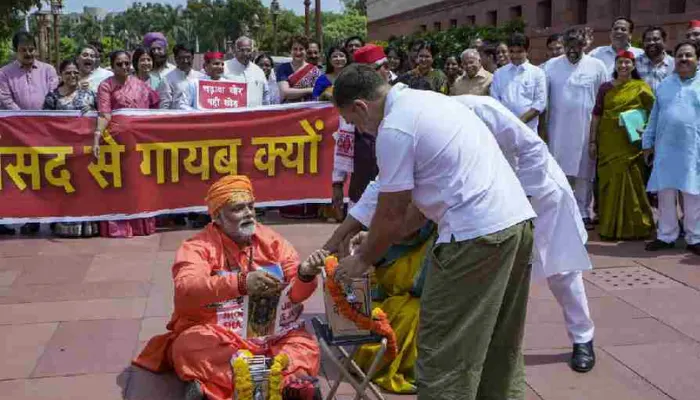
Case Summary
In New Delhi, Hindu religious sentiments were outraged after Hindu religious symbols, Hindu priestly attire, the Shri Ram Janmabhoomi Temple, and the faith of Hindu devotees became the subject of a street-theatre-style skit staged by Purnia MP Pappu Yadav and other politicians outside the Makar Dwar inside the Parliament complex on 31 July 2026. Independent MP Rajesh Ranjan (alias Pappu Yadav) dressed as a Hindu priest in saffron robes, saffron headgear, Rudraksha beads, and a Tripund tilak, sat beside donation boxes with a photograph of Lord Ram. During the skit, Opposition MPs enacted the role of devotees and placed money into the donation boxes, while Pappu Yadav portrayed a Hindu priest by secretly slipping the donated money into his pockets and clothes to depict the theft of donations from the Shri Ram Janmabhoomi Temple. When confronted during the performance, he denied taking the money before theatrically picking up the donation boxes and running away as part of the skit. Rahul Gandhi participated by placing money into one of the donation boxes and, during the performance, also attempted to snatch a donation box before walking away. Mallikarjun Kharge, Priyanka Gandhi Vadra, Awadhesh Prasad, Ruchi Veera, Dharmendra Yadav, K. C. Venugopal, Mahua Maji, Sagarika Ghose, TMC MP Derek O'Brien and other Opposition MPs participated in or were present during the protest. The protest also included slogans such as "Amit Shah Istifa Do," "Amit Shah Sadan Mein Aao," "Chadhawa Chor, Gaddi Chhod," and "Jawab Tumko Dena Hoga." The skit was staged over the investigation into missing donations at the Shri Ram Janmabhoomi Temple in Ayodhya. The Uttar Pradesh Police Special Investigation Team (SIT) stated that the theft took place inside the cash-counting room and that no temple priests or pujaris were involved. The preliminary investigation identified Avinash Shukla, Anukalp Mishra, Lavkush Mishra, Manish Kumar Yadav, Karunesh Pandey, and Ramshankar Mishra, all cash-counting staff engaged through a private State Bank of India (SBI) contractor, and pointed to security lapses including the absence of frisking, failure to enforce pocket-less uniforms, CCTV blind spots, and informal supervision. The performance drew strong objections from Hindu religious organisations and members of the saints' community. The Vishva Hindu Parishad (VHP), Akhil Bharatiya Sant Samiti, and several Ayodhya seers stated that depicting a Hindu priest in saffron attire stealing devotees' offerings hurt Hindu religious sentiments and insulted Hindu priests, saffron robes, and the Sanatan tradition. Swami Jitendranand Saraswati, General Secretary of the Akhil Bharatiya Sant Samiti, stated that while political parties are free to oppose the government, portraying Hindu saints and priests as thieves was an insult to the saintly tradition and saffron robes. He called for a public apology and sought action by the Lok Sabha Speaker if no apology was made, while stating that the saint community would accept the outcome of the legal investigation into the donation theft but would not accept insults to Sanatan traditions and Hindu saints. Following the incident, Lok Sabha Speaker Om Birla cautioned Members of Parliament against wearing costumes inside the Parliament complex. The Opposition stated that the skit was intended to protest the Ram Temple donation theft issue and demand accountability from the Union Government, while continuing to demand a discussion on the issue in Parliament. The Hindu saints' community in Basti, Uttar Pradesh, announced a padayatra (foot march) on 4 August 2026 under the leadership of Govind Das Ji Maharaj (Pada Wale Baba) to protest remarks and portrayals considered disrespectful towards Hindu deities and the Hindu faith. The march was scheduled to culminate in the submission of a memorandum to the administration. According to the organisers, the objective of the protest was to register opposition to derogatory depictions of Hindu deities and to seek action against acts that hurt the religious sentiments of Hindus.
Why it is Hate Crime ?
The first primary category for this case is: Hate speech against Hindus. The subcategory for this case is: Anti-Hindu slurs and mocking faith. Anti-Hindu slurs and the deliberate mocking of the Hindu faith owing to religious animosity involve the usage of derogatory terms, stereotypes, or offensive references to religious practices, symbols, or figures. One of the common anti-Hindu slurs used against Hindus is “cow-worshipper” and “cow piss drinker”. The intention of using this term is to demean and mock Hindus as a group and their religious beliefs since Hindus consider the cow holy. Additionally, some symbols and the slurs attached to them have a historical context that exacerbates the insult, hate, stereotyping, dehumanisation and oppression against Hindus. Cow worship has been used for centuries to denigrate Hindus, insult their faith and oppress Hindus specifically as a religious group. There has been overwhelming documentation about how cow slaughter has been used to persecute Hindus, with cow meat being thrown in temples and places of worship. There has also been overwhelming documentation where cow meat (beef) has been force-fed to Hindus to either forcefully convert them to Islam or denigrate their faith. Apart from cow worship, the Swastika – which holds deep religious significance for the Hindus – has also been misinterpreted and distorted to use as a slur against Hindus. Similarly, the worship of the Shivling has been used by supremacist ideologies and religions to denigrate Hindus owing to religious animosity. Such slurs and denigration stem from inherent animosity and hate towards Hindus and their faith; therefore, it is categorised as hate speech targeted at Hindus specifically owing to their religious identity. The other primary category for this case is: Attack on Hindu religious representations. The subcategory for this case is: Desecration of Hindu religious symbols. Icons and symbols or a religious representation of a spiritual ideal are widely revered in Hinduism. Iconography is of vital significance in the Hindu milieu. It helps connect people’s spiritual beliefs with the real world. Iconography within the Hindu faith takes several shapes and forms. Murtis are of most significance to Hindus, to which daily rituals, prayers and offerings are done. Besides the murtis, there are several other symbols which have deep significance in the Hindu faith – the Om and Swastika for example. Since these Hindu religious symbols hold paramount importance in Hinduism, any desecration of symbols, icons, murtis, religious representations and manifestations is driven by animosity towards the faith itself, which manifests itself through these murtis, icons and symbols. Therefore, any desecration of these Hindu religious symbols and representations is considered a religiously motivated hate crime under this category. The use of revered Hindu religious symbols and institutions as objects of political satire transformed the protest from criticism of an issue into one that directly targeted the religious sentiments of Hindus. Hindu priests, saffron robes, Rudraksha beads, the Tripund tilak, Lord Ram, and the Shri Ram Janmabhoomi Temple are sacred manifestations of the Hindu faith. Depicting these sacred representations for petty politics diminished their religious sanctity and associated objects of worship with criminality. Such conduct directed ridicule towards symbols that millions of Hindus regard as worthy of reverence, making the offence one against the religious identity of the Hindu community rather than merely against an institution. In Hinduism, saffron robes (bhagwa) represent purity, sacred fire, and the renunciation of ego; Rudraksha beads act as sacred tools for Shiva devotion and focused meditation; and the Tripund tilak (three ash lines) signifies overcoming ego, karma, and attachment. Together, these sacred attributes symbolise a practitioner's dedication to spiritual discipline, humility, and the quest for liberation (moksha). In Hinduism, Lord Ram represents Maryada Purushottam, the ideal human embodying ultimate righteousness (dharma), selfless duty, and moral integrity, serving as a timeless spiritual and ethical guide. His birthplace, the Ayodhya Ram Mandir, stands as a monumental symbol of faith, cultural heritage, and historic unity, marking the fulfilment of a centuries-old spiritual legacy for millions of devotees worldwide. The portrayal also blurred the distinction between individuals accused of wrongdoing and the religious tradition itself. The preliminary SIT findings stated that no temple priest or pujari was involved in the donation theft. Despite this, the symbolic representation chosen for the performance projected the image of a Hindu priest as the embodiment of theft. By employing a sacred religious identity to personify criminal conduct, the performance extended criticism beyond any specific investigation and projected it onto a religious institution and its visible representatives. This was why it was an affront to Hindu religious sentiments and to Hinduism itself. In Hinduism, priests and spiritual guardians serve as the essential custodians of ancient knowledge, sacred rituals, and daily devotion. Beyond any social distinctions, they preserve the scriptures, perform essential life-stage ceremonies (Samskaras), and care for temple deities to maintain the spiritual sanctity of holy spaces. As guides on principles of dharma (righteous duty), they form an indispensable bridge connecting devotees to their spiritual heritage, ensuring the continuous transmission of faith across generations. Violating the sanctity of the Ram Mandir, Hinduism, and Brahmins is widely considered wrong because it desecrates sacred spaces revered by millions, mocks an ancient cultural and spiritual heritage, and unfairly vilifies a community that historically guards sacred traditions. Religious institutions like the Ram Mandir represent the abodes of faith and devotion, while sacred attire, rituals, and lineages embody core values of spiritual discipline and dharma. Deliberately targeting, caricaturing, or disrespecting these symbols and communities promotes religious hostility, causes deep spiritual offence, and undermines the principles of mutual respect, pluralism, and peaceful social coexistence. The method adopted for the protest relied upon sacred Hindu religious imagery to communicate a political message. Instead of limiting criticism to the investigation, the temple administration, or the persons identified during the inquiry, the protest appropriated Hindu religious symbols and representations as the primary vehicle of political expression. The deliberate selection of these symbols ensured that the message would be conveyed through imagery deeply connected to Hindu faith, thereby exposing those symbols to ridicule in the course of political theatre. Purnia MP Pappu Yadav not only hurt religious sentiments, but for opposition political motives, chose to demonise Brahmins and sacred Ram Janmabhoomi. By staging a “theft” skit around the Ram Janmabhoomi movement and the Ram Mandir, he deeply offended millions of Hindus who see the site as a holy symbol of their faith. Critics felt the performance unfairly mocked a sacred issue, turning a matter of deep faith and history into cheap political satire. To add to the misery, Rahul Gandhi, a leader with the least knowledge about the faith of Hindus and Hinduism, chose to participate in the skit and tried to run away with the donation box to portray the deep seated hatered not just towards the BJP but also towards Hinduism. This was no ordinary protest; it was a deliberate, calculated political stunt staged inside the Parliament complex, where sacred religious attire and icons were weaponised as cheap props. By transforming symbols deeply revered by Hindus into a comedic portrayal of crime, opposition leaders exposed their underlying animosity toward Hindu traditions. It was clear they simply wanted to revive their political stature through hostile political rhetoric, deliberately amplifying the insult on a national stage and sparking fierce outrage from Hindu leaders and saints. The performance generated strong resentment among Hindu religious organisations, saints, and devotees because it undermined the dignity of symbols central to Hindu worship. The objections were directed not only at the political message but also at the manner in which Hindu religious identity was employed to communicate that message. Calls for a public apology, condemnation by Hindu religious bodies, and the announcement of a padayatra by the saints' community reflected the extent to which it was insulting to Hindu faith and religious traditions. When symbols that embody worship, devotion, and religious identity are publicly associated with criminal conduct, the impact extends beyond political criticism and enters the realm of religious offence. The widespread objections from Hindu religious organisations and saints underscore that the controversy centred not merely on the subject of the protest but on the manner in which Hindu faith and its sacred representations were used to convey that message.


Case Status
Complaint filed


Perpetrators Details
Perpetrators
Others
Perpetrators Range
One Person
Perpetrators Gender
male
 Sources




