Two Hindu temples targeted and vandalised the same night amidst rising anti-Hindu violence in Bangladesh
 Bangladesh
  30 July, 2026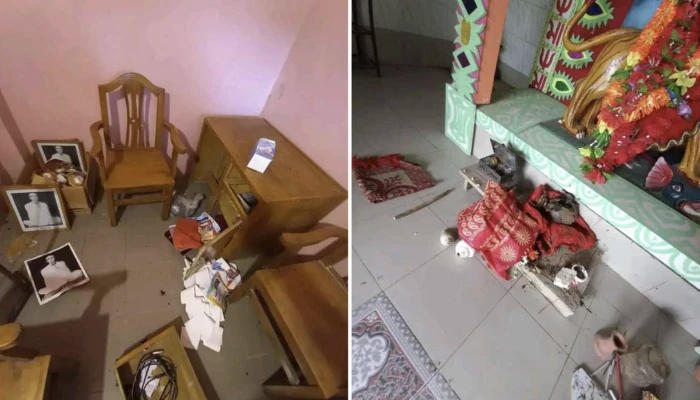
Case Summary
In Habilasdwip village under Patiya Upazila of Chattogram District, Bangladesh, two Hindu temples and the office of a local cooperative society were vandalised and burgled by unidentified miscreants. The accused broke into the temples and the cooperative office after breaking the locks, leaving the premises ransacked. The incident triggered concern among the local Hindu community over the safety and security of their religious institutions. According to media reports, the burglary took place on the night of 31st July 2026. The accused targeted Habilasdwip Sri Sri Jagaddhatri Temple, Sri Sri Ram Thakur Temple, and the office of the Shakti Sarbik Gram Unnayan Cooperative Society. When temple authorities and office bearers arrived the following morning, they found the locks broken and the interiors in disarray. Local residents subsequently gathered at the sites after being informed of the incident. As per reports, an organised gang of burglars had deliberately targeted all three institutions on the same night. At the time of reporting, the exact value of the stolen cash and property was not ascertained, as the affected institutions were still preparing an inventory of the missing items. Following the incident, members of the local Hindu community expressed concern over the recurring vulnerability of Hindu religious institutions and demanded that the authorities swiftly identify and arrest those responsible, recover the stolen property, and ensure exemplary punishment for the perpetrators. The burglary occurred against the backdrop of continuing violence and insecurity faced by the Hindu minority community in Bangladesh. This escalation of violence against Hindus in Bangladesh has unfolded in three distinct phases: first, following the ouster of Sheikh Hasina's government in August 2024; second, after the death of Sharif Osman Bin Hadi in December 2025; and third, in the immediate aftermath of the 13th National Parliamentary Election 2026. Following the ouster of Sheikh Hasina, multiple reports documented attacks on Hindu homes, temples, and religious institutions, alongside intimidation campaigns, arson, and mob assaults targeting minority neighbourhoods. The Hinduphobia Tracker has recorded 336 such incidents against the Hindu minority, underscoring the scale and persistence of anti-Hindu violence during this period. A further escalation occurred following the death of Sharif Osman Bin Hadi, a Muslim political activist and student leader known for his anti-Hindu and anti-India rhetoric. Hadi had been involved in political unrest after the fall of the Hasina government and was killed in Dhaka on 18th December 2025 during clashes. In the aftermath of his death, Hindu communities were blamed and subsequently targeted in retaliatory violence. Hindu homes were selectively set ablaze in multiple localities, forcing families to flee and leaving many displaced. The attacks appeared patterned rather than sporadic, with Muslim mobs focusing on Hindu neighbourhoods, properties, and religious symbols. Among the victims was Dipu Chandra Das, who was lynched to death and his body was set ablaze by a Muslim mob over false blasphemy allegations. The Hinduphobia Tracker documented 51 incidents of anti-Hindu violence in the period following Hadi's death alone. Such incidents underscore the vulnerability of the Hindu minority amid rising communal hostility and the weaponisation of religious accusations. Reports further indicated that posters and written materials calling for the extermination of Hindus were displayed in public spaces, signalling an alarming normalisation of genocidal rhetoric. When combined with acts of arson, vandalism, assault, and targeted intimidation, these developments suggest a coordinated environment of hostility aimed at terrorising the Hindu community and reinforcing majoritarian dominance. The third phase of violence was unleashed after the 13th National Parliamentary Election 2026. Within days of the announcement of results, Hindu families in districts such as Noakhali, Rangpur, Nilphamari, Sylhet, Thakurgaon, and Dinajpur reported coordinated attacks involving arson, looting, assault, and vandalism of temples and homes. In several instances, Hindu homes were selectively targeted, looted, and families were threatened with displacement.
Why it is Hate Crime ?
The primary category for this case is: Attack on Hindu religious representation. The subcategory for this case is: Attack on Temples. In Hinduism, a temple is the abode of the Deity. The Deity in the Temple is consecrated, thereby making it a real, breathing entity. Hindus believe that not just the Deity but the temple premises themselves are sacred to Hindus since Hindus hold the faith that the entire Temple space is an amalgamation of the divine energy of the deity. Given the central significance of Temples in Hindu Dharma, any attack against a Hindu Temple or its peripheral premises is an attack on the faith itself and is born out of animosity towards the faith, of which the Temple is a central tenet. Any manner of attack against a Temple and/or its premises would therefore be considered a religiously motivated hate crime. This case constitutes a clear instance of a religiously motivated hate crime because the perpetrators deliberately targeted two Hindu temples during the same night, violating places held sacred by Hindus and disrupting the religious life of the local Hindu community. The attack was not confined to an ordinary burglary. By forcibly entering the temples after breaking the locks and ransacking the premises, the perpetrators desecrated spaces regarded by devotees as the abode of the divine. The simultaneous targeting of two Hindu temples further indicates that the temples themselves, rather than merely the prospect of theft, were the focus of the attack. Ordinarily, incidents of theft or robbery are treated as conventional criminal offences and would not, by themselves, qualify for inclusion in the Hinduphobia Tracker, since the mere commission of a property crime does not establish a religious motive. However, the present case cannot be assessed in isolation. It occurred in Bangladesh against the backdrop of sustained and well-documented anti-Hindu violence, where Hindu temples, idols, religious institutions, and members of the Hindu minority have repeatedly been singled out for attacks. In such an environment, the deliberate and coordinated targeting of two Hindu temples during the same night cannot reasonably be divorced from the broader pattern of hostility directed against Hindu religious institutions. The choice of temples as targets, particularly when two were attacked in a single operation, elevates the incident beyond an ordinary burglary and reflects an attack on spaces that are central to Hindu religious life. In Hinduism, a temple is not merely a physical structure but the sacred abode of the deity. Following the ritual of Prana Pratishtha, the deity enshrined within the temple is believed to embody a living divine presence, making the entire temple premises sacred. Devotees visit temples not only to offer prayers but also to perform rituals, celebrate festivals, preserve centuries-old religious traditions, and strengthen their spiritual connection with the deity. Consequently, any unlawful intrusion into a temple, accompanied by the breaking of locks, ransacking of the premises, and theft of property dedicated to worship, amounts to a violation of a sacred religious space and interferes with the community's right to practise its faith freely and without fear. The theft itself also carried significance beyond the monetary value of the stolen articles. Although the exact inventory of the stolen property was yet to be finalised, the perpetrators forcibly entered active Hindu places of worship where articles used in daily rituals, offerings made by devotees, and other temple property are ordinarily kept. Such objects are intrinsically connected with the performance of Hindu religious ceremonies and the maintenance of temple worship. Their theft disrupts established religious practices and diminishes the sanctity of the temple, thereby constituting a defilement of Hindu religious customs in addition to an attack on the institution itself. The fact that two Hindu temples located in the same village were targeted during the same night further distinguishes this incident from an isolated act of opportunistic theft. The coordinated nature of the attacks indicates a deliberate selection of Hindu religious institutions. Even though a nearby cooperative society office was also burgled, the simultaneous targeting of two temples in a single operation heightened fear and insecurity among the local Hindu community, reinforcing the perception that their places of worship remained particularly vulnerable. This incident also occurred against the backdrop of continuing anti-Hindu hostility in Bangladesh, where Hindu temples, idols, and other religious institutions have repeatedly been subjected to vandalism, theft, desecration, arson, intimidation, and attacks alongside broader violence against the Hindu minority. Such incidents have created an atmosphere of persistent insecurity in which attacks on Hindu religious institutions cannot be viewed in isolation but must be assessed against the broader pattern of hostility directed towards the Hindu community and its places of worship. At the time of writing this report, the identities and motives of the perpetrators were not established. However, the absence of identified accused does not diminish the religious nature of the offence. The deliberate targeting of two Hindu temples, the violation of their sanctity through forced entry and ransacking, and the theft of property connected with Hindu worship together constitute an attack on Hindu religious institutions and customs. For these reasons, this incident warranted inclusion in the Hinduphobia Tracker as a religiously motivated hate crime.


Case Status
Unknown


Perpetrators Details
Perpetrators
Unknown
Perpetrators Range
Unknown
Perpetrators Gender
unknown
 Sources




