Hindu villagers targeted for conversion by Christian missionaries under guise of 'Bhagwat Katha' in Sitamarhi, Bihar
 Sitamarhi, Bihar, India
  20 July, 2026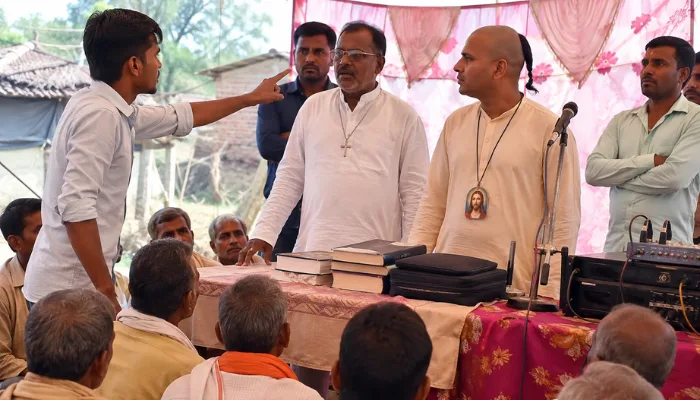
Case Summary
In Sitamarhi district, Bihar, Hindu villagers were targeted for conversion by Christian missionaries under the guise of a "Bhagwat Katha." During this prayer gathering, the perpetrators also attempted to influence Hindu using the Bible. The gathering was confronted by a Hindu youth, who objected that the event was being used to convert Hindu villagers to Christianity under the guise of a Hindu religious discourse. The missionaries were attempting to convert the entire village. According to the video, the programme was organised under a temporary canopy where the Christian missionaries addressed a gathering of villagers seated before a table containing Bibles, religious literature and audio equipment. During the proceedings, the Hindu youth questioned the organisers, stating that they were teaching the Bible while presenting the event as a "Bhagwat Katha." The video also shows one of the individuals associated with the gathering wearing a sacred Hindu *Shikha* (choti) while simultaneously wearing a locket bearing the image of Jesus. The Hindu youth questioned this display during the confrontation and objected to what he described as an attempt to convert local Hindu villagers through deception. The confrontation continued at the venue as the Hindu youth challenged the organisers over the nature of the gathering. The video of the incident subsequently circulated on social media.
Why it is Hate Crime ?
The primary category for this case is: Predatory Proselytisation. The subcategory for this case is: Proselytisation by grooming, brainwashing, manipulation or subtle indoctrination. Religious brainwashing essentially means the often subtle and forcible indoctrination to induce someone to give up their religious beliefs to accept contrasting regimented ideas. Religious grooming or brainwashing also involves propaganda and manipulation. It involves the systematic effort, driven by religious malice and indoctrination, to persuade “non-believers’ to accept allegiance, command, or doctrine to and of a contrasting faith. Cases of such grooming or brainwashing are far more nuanced than direct threats, coercion, inducement and violence. In such cases, it is often seen that there is repeated, subtle and continual manipulation of the victim to induce disaffection towards their own faith and acceptance of the contrasting faith of the perpetrator. While subtle indoctrination is widely acknowledged as predatory, an element which is often understated in such conversions or the attempts of such conversion is the role of loyalty and trust which might develop between the perpetrator and the victim. Fiduciary relationships are often abused to affect such religious conversion. For example, an educator transmitting religious doctrine of a competing faith to a Hindu student. The Hindu student is likely to accept what the teacher is transmitting owing to existence of the fiduciary relationship. The exploitation of the fiduciary relationship to religiously indoctrinate victims would also be included in this category. Since the underlying animosity towards the victim’s faith forms the basis of predatory proselytization, such cases are considered religiously motivated hate crimes. Presenting Biblical teachings under the name of a "Bhagwat Katha" obscures the true religious nature of the gathering and prevents participants from making an informed decision about whether they wish to engage with Christian preaching. A Bhagwat Katha is a recognised Hindu religious discourse associated with Hindu scriptures and devotional traditions. Using that religious identity as the medium for disseminating the teachings of another faith amounts to a form of religious manipulation directed at Hindu participants. Cases involving Christian missionary activities that use manipulation, psychological influence, or other subtle methods to convert Hindu individuals constitute a violation of religious freedom and informed consent. When vulnerable Hindus are targeted through repeated persuasion, exploitation of trust, inducements, or subtle indoctrination rather than through free and informed choice, such actions weaken trust within communities, creating fear among those who are susceptible to such influence, especially individuals from economically and socially vulnerable sections. The law draws a clear distinction between a voluntary change of faith and conversion secured through coercion, fraud, undue influence, manipulation, or exploitation. These elements fall within the category of Predatory Proselytisation, specifically Proselytisation by grooming, brainwashing, manipulation, or subtle indoctrination. The manner in which the gathering was conducted indicates an attempt to create familiarity and trust by employing Hindu religious terminology and symbolism while imparting Christian doctrine. Such an approach reduces the likelihood of immediate resistance from Hindu attendees and enables Christian religious teachings to be introduced within a setting that participants would ordinarily associate with their own faith. The use of Hindu religious identifiers in this context serves to make the proselytisation process more subtle and gradual rather than explicit. The incident also reflects an effort to influence the religious beliefs of Hindu villagers through sustained exposure to the teachings of another religion under the guise of a Hindu religious programme. Rather than openly identifying the gathering as a Christian prayer meeting or Bible study, the use of the term "Bhagwat Katha" had the effect of blurring the distinction between two different religious traditions. Such conduct is capable of creating confusion regarding the source, nature, and purpose of the religious instruction being imparted. Furthermore, the Christian perpetrators were also actively attempting to indoctrinate the Hindu victims by using Christian religious texts and literature. Using the scriptures or literature of one faith to deliberately target and manipulate members of another, with the clear intention of religious conversion, represents a direct attack on the Hindu faith. Such actions are designed to violate and undermine the beliefs of Hindu victims and are clear indicators of religious hostility towards Hindus and their religious identity. Such actions further demonstrate that this was not an isolated incident of evangelism, but rather part of a broader, organised operation to further religious conversions. When Christian religious material is used to exploit trust, sow doubt, and misrepresent the beliefs of Hindus to coerce conversion, particularly in a systematic manner, it constitutes a religiously motivated offence. Taken together, the available material indicates a pattern in which Hindu religious identity, terminology, and symbols were used as the vehicle for communicating Christian religious teachings. The significance of the incident lies not merely in the dissemination of another faith's teachings but in doing so by invoking a Hindu religious platform that carries trust and familiarity among Hindu devotees. It is this use of religious camouflage to introduce Christian doctrine that places the incident within the framework of predatory proselytisation through grooming, manipulation, or subtle indoctrination. Disclaimer: The Hinduphobia Tracker records incidents based on when an event occurred or when the victim's ordeal began. It is important to clarify that none of the media sources covering this case has specified the exact date when the prayer gathering took place. Therefore, for documentation purposes, we have recorded the date based on when the incident was reported in the media, 20 July 2026.


Case Status
Unknown


Perpetrators Details
Perpetrators
Christian Extremists
Perpetrators Range
From 2 To 5
Perpetrators Gender
both
 Sources




