Hindu devotee's sacred Kanwar targeted and desecrated as Muslim boys throw meat at it near a mosque
 Panipat, Haryana, India
  27 July, 2026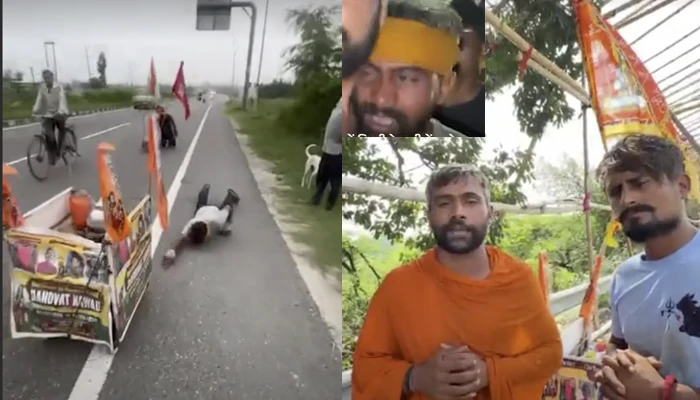
Case Summary
In Kairana, Uttar Pradesh, a Dandvat Kanwar pilgrimage (lying fully prostrated on the ground) of a Hindu devotee was disrupted, and his sacred Kanwar was desecrated after some Muslim boys deliberately threw meat at it near a mosque. The incident triggered outrage among fellow Hindu devotees and prompted the Uttar Pradesh Police to intervene. The victim, Dharmveer alias Nathi alias MD Rawal, a resident of Goyla Khurd village in Haryana's Panipat district, was returning from Haridwar with Gangajal after undertaking the Dandvat Kanwar pilgrimage to celebrate the birth of his daughter when four Muslim boys purposely threw meat at his Kanwar. According to the victim, he undertook the pilgrimage to mark the births of his daughters, Ishaanvi, born in January 2025, and Manvi, born in January 2026. He began his journey to Haridwar on 1 July, collected Gangajal, and was returning to Panipat while completing the pilgrimage through repeated Dandvat (full-body prostrations). The victim stated that at around 11 pm on 28 July, as he passed near a mosque in Kakaur village, Kairana, four Muslim youths sitting outside the mosque threw meat at his Kanwar, desecrating it. He said the incident occurred only a few kilometres from his destination, leaving him devastated after weeks of arduous religious observance. A video of the incident subsequently surfaced online. In the footage, the victim was seen in tears, stating that four Muslim boys had thrown meat at his Kanwar after he passed the mosque. He also pointed to the location where the incident took place, while fellow Kanwariyas gathered around him in protest. The desecration triggered protests among the accompanying Kanwariyas, who refused to continue their journey until those responsible were arrested. Following the protest, police and administrative officials reached the spot to defuse the situation. The Kairana Sub-Divisional Magistrate assured the devotees that efforts would be made to identify and apprehend the accused, after which the Kanwariyas resumed their journey. However, the victim later stated that no action had been taken against the individuals he had named in his complaint. Despite the victim himself narrating a firsthand account and other devotees testifying to the same, Shamli Superintendent of Police N.P. Singh claimed that the preliminary investigation and inspection of the site indicated that an old bone had been buried in the soil along the roadside and may have surfaced because of vehicular movement or other disturbance. He also claimed that the investigation had not found evidence confirming that any person had deliberately thrown meat or a bone at the Kanwar. Officers also questioned the minor boys named in the complaint and said that no evidence of deliberate desecration had emerged during the inquiry.
Why it is Hate Crime ?
The primary category selected in this case is: Attack on Hindu religious representations. The sub-category selected is: Desecration of Hindu religious symbols. Icons and symbols or a religious representation of a spiritual ideal are widely revered in Hinduism. Iconography is of vital significance in the Hindu milieu. It helps connect people’s spiritual beliefs with the real world. Iconography within the Hindu faith takes several shapes and forms. Murtis are of most significance to Hindus, to which daily rituals, prayers and offerings are done. Besides the murtis, there are several other symbols which have deep significance in the Hindu faith – the Om and Swastika for example. Since these Hindu religious symbols hold paramount importance in Hinduism, any desecration of symbols, icons, murtis, religious representations and manifestations is driven by animosity towards the faith itself, which manifests itself through these murtis, icons and symbols. Therefore, any desecration of these Hindu religious symbols and representations is considered religiously motivated hate crimes under this category. The other sub-category selected is Defiling religious customs. Sanatan Dharma is not a religion of one book, which is to say that while it has religious scriptures that form the central tenets of the faith, there are several traditions followed through thousands of years, mostly passed from generation to generation orally. There are several such customs and traditions that are followed by various Hindus and Hindu sects. Defiling of these traditions and customs is a breach of an individual or group’s religious practices. Such practices can range from dietary restrictions like not eating non-vegetarian food for a certain period of the year, not eating non-vegetarian food at all, not eating beef since the cow is considered holy in Hinduism, the sanctity of religious customs followed in the house (like many ISCKON devotees), etc. Any malicious action leading to the breach of such traditions or defilement of these traditions owing to animosity towards the faith or for the sake of activism stems not only from the lack of faith in the religion itself but also from disregard for the faith of the devotees who follow the customs/traditions and implicit bias against the faith, the tradition itself. Since these specific traditions are central to the faith of the devotees of that specific sect of Hindus, any non-compliance with these traditional rules would be considered a religiously motivated hate crime. The other primary category selected is: Attack not resulting in death. The subcategory selected is: Attacked for crossing 'Muslim area'. One of the reasons that Hindus get attacked unprovoked, specifically by Islamists, is for crossing ‘Muslim areas’. Essentially, Muslim mobs often attack Hindus crossing or present in certain areas which have a majority Muslim population. It has often been cited as one of the reasons to blame Hindus for attacks against themselves, signalling that Hindus displaying religious symbols, taking our religious processions or crossing any area which is dominated by Muslim residents is a provocation in and of itself. These areas are mostly ghettoised areas where mobs mobilise quickly to attack Hindus for a variety of reasons like playing music during a religious procession, crossing a mosque, wearing a tilak or any other religious symbol in a Muslim-dominated area, praying at a local temple in that area, etc. There have been cases where the few local Hindus of that area have been attacked on their way to the Temple for prayers as well, simply because the area is considered a Muslim-dominated area. Several times, it is entirely possible that the immediate trigger for the violence against Hindus was non-religious in nature; however, the violence became religiously motivated in nature because the area was Muslim-dominated and the residents on the whole harboured animosity towards Hindus, evidenced from the actions of the mob, the slogans, and the nature of the attack. Such crimes are motivated by the religious identity of the victims and are therefore classified as hate crimes under this category. This case was added to the Hinduphobia Tracker because the act directly targeted a Hindu religious pilgrimage and involved the desecration of a sacred object carried as part of the worship of Lord Shiva. The Kanwar Yatra is not an ordinary journey but a deeply rooted Hindu religious observance in which devotees carry holy Gangajal from the Ganga to offer it to Shiva temples. Desecrating the Kanwar with meat therefore struck at an object that represented his worship, religious observance and devotion to Shiva, making the religious element central to the offence. The act also violated the sanctity of a Hindu custom that was undertaken through intense physical penance and discipline. Dandvat Kanwar involved repeatedly prostrating the entire body on the ground over a long distance, making the pilgrimage itself an expression of religious commitment. Introducing meat into such a sacred observance was therefore not an ordinary interference with a passer-by, but a direct intrusion into a Hindu religious practice and a deliberate affront to the devotee's faith. Moreover, the incident occurred as the devotee passed near a mosque, placing the religiously marked Hindu procession in a setting where he became vulnerable to hostility because of his visible religious identity. His Kanwar identified him as a Hindu pilgrim, and the act targeted him while he was carrying out that religious observance. This made the offence more than a general act of disruption: it discriminated against a Hindu devotee because he was visibly engaged in a Hindu practice and used his passage through the area as the occasion for the attack. The act assumes particular significance because the Kanwar Yatra is one of the largest and most widely recognised annual Hindu pilgrimages in India. Every year, millions of devotees undertake the arduous journey to collect Gangajal from the Ganga and offer it at Shiva temples, making the Kanwar an unmistakable symbol of Hindu faith and devotion. Given the scale and prominence of the pilgrimage, its religious significance is universally recognised. Consequently, if meat is thrown at a Kanwar during the pilgrimage, it is a deliberate and unmistakable act of desecration directed at a sacred object of Hindu worship. Such an act is calculated, done purposely to insult the devotee, and disrupt a deeply revered religious observance. The deliberate use of meat in this context is not incidental; it reflects hostility towards Hindu religious beliefs and practices and an intent to degrade a sacred Hindu ritual. The police in this case denied that meat had been deliberately thrown and attributed the presence of the meat to an accident involving roadside soil and vehicular movement. The police, in many such cases, where the motive behind the crime is obvious but not explicitly mentioned, deny that the crime committed was in any way motivated by a religious bias or say that there was ‘no communal angle’ to the crime. Several factors are generally at play here. Many a time the police downplay incidents of low-level communal crime because it is their jurisdiction that comes under question. The police also often say that there was ‘no communal angle’ to a crime when there was one because they wish to ensure that, owing to the crime already committed, there is no further flare-up in the area. However, a police statement alone cannot be enough to determine whether there is a communal angle to the crime that has been committed. In fact, to determine whether the crime is communal in nature, we need to emphasise the ground realities. In this case, the victim himself gave a firsthand account of the incident and other Kanwariyas gathered at the spot in protest, treating the incident as a deliberate desecration of the Hindu pilgrimage. The police conclusion that the incident had no communal angle therefore did not, by itself, determine the religious character of the act. The nature of the target, the religious setting, the circumstances of the incident and the victim’s account remained relevant to determining whether the Hindu religious practice was deliberately targeted. Going by the same logic, since the victim’s firsthand account and the reaction of the fellow Kanwariyas pointed to a deliberate act against the sacred Kanwar, this case was also included in the hate tracker.
Victim Details
Total Victim
1
Deceased
0
Gender
- Male 1
- Female 0
- Third Gender 0
- Unknown 0
Caste
- SC/ST 0
- OBC 0
- General 0
- Unknown 1
Age Group
- Minor 0
- Adult 1
- Senior Citizen 0
- Unknown 0


Case Status
Unknown


Perpetrators Details
Perpetrators
Muslim Extremists
Perpetrators Range
From 2 To 5
Perpetrators Gender
male
 Sources




