Hindu organisation at the forefront of defending Hindus compared to banned terrorist organisation PFI by senior Congress leader
 Bengaluru, Karnataka, India
  1 May, 2023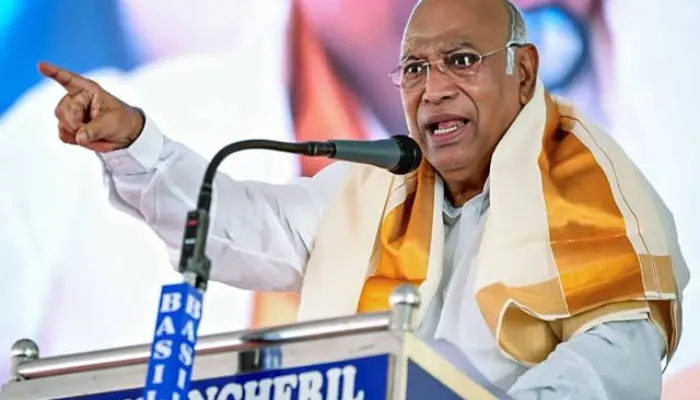
Case Summary
In Sangrur, Punjab, criminal proceedings against Congress President Mallikarjun Kharge continued in connection with remarks made during the 2023 Karnataka Assembly election campaign comparing the Bajrang Dal with the banned Islamist terrorist organisation Popular Front of India (PFI). This comparison was objected to by members of the Hindu organisation as insulting and hurtful to their religious sentiments. On a complaint filed by Hitesh Bhardwaj of Sangrur, associated with the Bajrang Dal (The Bajrang Dal is a Hindu nationalist youth organisation associated with the Vishva Hindu Parishad (VHP) and is known for its activities related to the protection of Hindu religious interests, temples, and cultural traditions), the Sangrur court issued a ₹15,000 bailable warrant against Mallikarjun Kharge and directed him to personally appear on 19 September 2026 to seek bail. The court further stated that failure to appear without sufficient cause could result in the issuance of a non-bailable warrant. The proceedings arise from statements made during the 2023 Karnataka Assembly election campaign, when the Congress manifesto proposed action, including a ban, against organisations such as the Bajrang Dal and compared it with the Popular Front of India (PFI) (The Popular Front of India (PFI) was an Islamist organisation that operated across several Indian states. In September 2022, it was banned by the Government of India under the Unlawful Activities (Prevention) Act (UAPA) for five years, with the government citing its links to unlawful and terrorist activities and its potential to threaten national security and public order), which had been banned by the Central Government under the UAPA. The complaint stated that equating the Bajrang Dal with the banned organisation hurt the religious sentiments of Hindus associated with the organisation, damaged its reputation, and had the potential to create social tension. The matter was initially treated as a civil proceeding but was subsequently taken up as a criminal case. Following the investigation and consideration of the material placed before it, the court proceeded with the criminal proceedings and issued the bailable warrant requiring Kharge's personal appearance. The hearing scheduled for 19 September 2026 will determine the next course of the proceedings, and the court has cautioned that non-appearance may invite a non-bailable warrant. The comparison also drew reactions from Hindu organisations. The Vishva Hindu Parishad (VHP) criticised the comparison between the Bajrang Dal and the banned PFI and called for an apology. The complaint before the court maintained that the comparison defamed the organisation and hurt the sentiments of its members and supporters. The court's order relates to the continuation of criminal proceedings and does not constitute a final determination on the merits of the case.
Why it is Hate Crime ?
The primary category for this case is: Hate speech against Hindus. The subcategory for this case is: Mocking/denigrating Hindu leaders. Hate speech is defined as any speech, gesture, conduct, writing, or display that is prejudicial against a specific individual and/or group of people, which is leading to or may lead to violence, prejudicial action or hate against that individual and/or group. Religious leaders are often seen as representatives of the community, especially the community’s religious faith and beliefs. Mocking or denigrating a religious leader specifically owing to his religious identity and/or the religious rituals he observes can be considered hate speech because the motivating factor of the speech is animosity and/or dislike for what he represents – the religious beliefs and faith of the community. It is important to note that mere insulting words against an individual do not constitute hate speech. Insulting words may be used for an individual; however, the specific speech is not the result of religious hate and/or animosity towards the professed faith of the religious leader, but the individual himself. For the speech to be considered hate speech, the speech itself or the motivating factor behind the speech has to be religious in nature. Such speech, which denigrates Hindu religious leaders specifically owing to animosity towards the faith they profess and the community faith they represent, will be treated as hate speech under this category. Every major religious community has organisations that work to protect the interests of its members, preserve religious traditions, provide legal assistance, and respond to instances of discrimination or persecution. Within the Hindu community, organisations such as the Vishwa Hindu Parishad (VHP) and Bajrang Dal have frequently positioned themselves at the forefront of campaigns relating to temple protection, religious conversions, attacks on Hindu festivals, and assistance to Hindu victims of religiously motivated crimes. In this context, comparing such organisations to the Popular Front of India (PFI), a terrorist organisation that was banned by the Government of India for involvement in unlawful and terrorist activities, goes beyond ordinary political criticism. The comparison places organisations that many Hindus view as defenders of their religious rights in the same category as a banned terrorist outfit. Such remarks have the effect of delegitimising organisations that many Hindus rely upon to raise concerns relating to religious discrimination, attacks on temples, forced conversions, and violence against the community. The comparison also reflects a broader disregard for the grievances of Hindu victims. By equating organisations that advocate for Hindu causes with a banned terrorist organisation, the remark diminishes the legitimacy of the issues these groups seek to highlight and creates the impression that advocacy on behalf of Hindus is itself suspect or extremist. In doing so, it conveys indifference towards the religious persecution, discrimination, and violence that Hindus have reported and for which these organisations often seek legal and public intervention. Viewed in its entirety, the remark was not directed merely at a particular organisation but carried a broader implication for the Hindu community it represents. By portraying organisations that many Hindus regard as their first line of defence in times of religious persecution as equivalent to a banned terroist outfit, the statement displayed disdain for the concerns of Hindu victims and trivialised the role played by such organisations in defending Hindu religious rights. It is this broader hostility towards institutions associated with the protection of Hindu interests that gives the incident its anti-Hindu character and warrants its inclusion in the Hinduphobia Tracker.


Case Status
Case sub-judice


Perpetrators Details
Perpetrators
State and Establishment
Perpetrators Range
One Person
Perpetrators Gender
male
 Sources




