Hindu heritage site Sharda Peeth damaged; Pakistan army demolishes temple boundary walls to build coffee shop
 Pakistan Occupied Kashmir, Pakistan
  27 November, 2023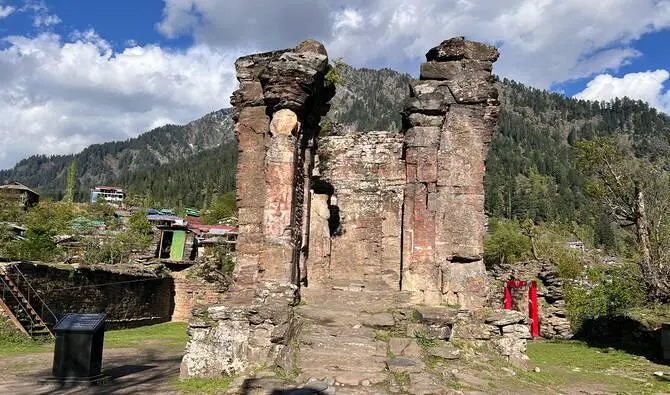
Case Summary
The boundary wall of the ancient Sharda Peeth temple located in the Neelum Valley of Pakistan-occupied Kashmir (PoK) was demolished to facilitate the construction of a coffee house near the site. In November 2023, local activists and the Save Sharda Committee Kashmir flagged visual evidence showing that the boundary wall of the historic complex had been broken down and the stones carted away. The foundation stone of the proposed coffee house was laid by Brigadier Tanveer Ahmad of Pakistan’s 32nd Brigade. The demolition drew criticism from Kashmiri Pandit groups and civil society members in PoK, who said that the action violated a 2018 order of the PoK Supreme Court directing authorities to prevent encroachment and protect the temple premises. Ravindra Pandita, founder of the Save Sharda Committee Kashmir, opposed the demolition, stating that the temple boundary was damaged despite judicial directions protecting the site. He said the community was considering further action, including a march towards the Line of Control (LoC), to highlight concerns about the shrine's preservation. In December 2023, Ravindra Pandita appealed to Prime Minister Narendra Modi to take up the issue of encroachment by the Pakistan Army at the revered Sharda Peeth site located in Pakistan-Occupied Kashmir (PoK) along the Line of Control (LoC). Previously, Mohammad Amir Rashid, president of Dara Shikoh Foundation, also wrote to the United Nations Educational, Scientific and Cultural Organisation (UNESCO) over Pakistan damaging the walls of the cultural heritage site ‘Sharda Peeth’. The Dara Shikoh Foundation on November 27 wrote to the Director General of UNESCO detailing the damage to the walls of Sharda Peeth for the expansion of a coffee house for Pakistani soldiers inside PoK. Sharda Peeth is an ancient Hindu temple dedicated to Goddess Saraswati, located on the banks of the Neelum (Kishanganga) River in the Neelum Valley of PoK along the Line of Control (LoC). Historically, it was one of the most important centres of Sanskrit learning in the Indian subcontinent between the 6th and 12th centuries CE. The site played a significant role in the development of the Sharada script, which derives its name from the temple, and contributed to Kashmir's reputation as “Sharada Desh” — the land of Sharada. For Kashmiri Pandits, Sharda Peeth holds deep religious and cultural significance. Hindus consider it among the Maha Shakti Peethas, believing it represents the sacred site associated with Goddess Sati’s fallen right hand. Along with the Martand Sun Temple and the Amarnath Temple, it is regarded as one of the three most important pilgrimage sites of the Kashmiri Pandit community. Over decades, the temple complex has remained largely in ruins due to neglect and lack of conservation. Reports of damage to the temple’s structures, including the demolition of its boundary wall, have intensified concerns among heritage activists and members of the Kashmiri Pandit community regarding the preservation of Hindu cultural heritage sites in PoK.
Why it is Hate Crime ?
The selected primary category in this case is: Attack on Hindu religious representation, with the subcategory selected as: Attack on Temples. In Hinduism, a temple is the abode of the Deity. The Deity in the Temple is consecrated, thereby, making it a real, breathing entity. Hindus believe that not just the Deity but the temple premises itself are sacred to Hindus since Hindus hold the faith that the entire Temple space is an amalgamation of the divine energy of the deity. Given the central significance of Temples in Hindu Dharma, any attack against a Hindu Temple or its peripheral premises is an attack on the faith itself and is born out of animosity towards the faith, of which the Temple is a central tenet. Any manner of attack against a Temple and/or its premises would therefore be considered a religiously motivated hate crime. This incident is a religiously motivated hate crime since the boundary wall of Sharda Peeth in Pakistan-occupied Kashmir (PoK) was desecrated to accommodate a coffee shop. Sharda Peeth is associated with Goddess Saraswati and is regarded by Kashmiri Pandits as one of their most sacred pilgrimage sites. The removal of part of the temple premises for a non-religious construction project is a disregard for the religious importance of the site and an attempt to diminish a place of Hindu worship and heritage. Damaging the premises of a temple causes not only physical harm to the structure but also emotional and religious harm to devotees who consider the site a representation of their identity and ancestral traditions. When a religious site is neglected, encroached upon, or altered without the community’s consent, it contributes to the erosion of that community’s cultural presence. Such acts reflect a mindset that views Hindu places of worship as legitimate targets for intimidation, humiliation, and the assertion of religious dominance. The deliberate selection of a temple, rather than any other public structure, demonstrates that the objective extends beyond causing ordinary damage. It reveals disdain for Hindus and the beliefs they hold sacred, along with a willingness to violate their places of worship to communicate hostility towards their faith and religious identity. Such conduct reflects an underlying animosity towards Hindu religious practices and institutions. By consciously targeting a sacred Hindu temple, the perpetrators exhibit contempt for the sanctity of Hindu worship and the community's right to practise its religion freely. It is this deliberate targeting of a core institution of Hindu religious life, driven by hostility towards the faith and its adherents, that gives such incidents their distinctly anti-Hindu character and warrants their inclusion in the Hinduphobia Tracker. Disclaimer: The Hinduphobia Tracker records incidents based on when the incident occurred. Here, media reports mention that the demolition happened in November 2023. Since the exact date is not available, the incident date is taken as 28 November 2023, combining the month and year when it occurred with the date when it was reported by the media. This has been used solely for documentation purposes.


Case Status
Unknown


Perpetrators Details
Perpetrators
State and Establishment
Perpetrators Range
Unknown
Perpetrators Gender
unknown
 Sources




