Hindu sentiments outraged; Cockroach Janata Party supporter defends protesters who abused Lord Ram and mocked Hindu customs
 Mumbai, Maharashtra, India
  28 July, 2026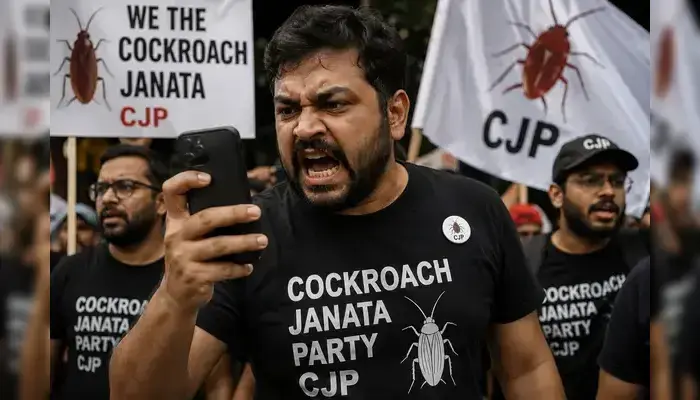
Case Summary
In Mumbai, a Cockroach Janata Party supporter, identified as Piyush Vikas Dwivedi, came out in open support of two Cockroach Janata Party protesters who had used highly abusive and offensive language against the Hindu faith, Lord Ram and Hindu worship rituals. The incident came to light after a video of the accused went viral on social media. In the video, the accused was seen defending two Cockroach Janata Party protesters who had abused Lord Ram during the Cockroach Janata Party protests at Jantar Mantar, Delhi. In the first incident, which had previously been documented by the Hinduphobia Tracker, a female protester, while speaking to the media, denigrated one of Hinduism's holiest temples by stating, "Ram Mandir or whatever the f**k it is... we don't care," while saying that the government's attention should instead have been focused on the education crisis. In another incident, a female protester made derogatory remarks against Lord Ram by stating that "Ram is dead" before going on to mock the Hindu religious practice of performing puja. Dwivedi defended these remarks, asking, "What wrong did the girls say? Even I don't believe in God, Ram or whatever the f**k. What wrong did the girl say?" He further endorsed the protesters' mockery of Hindu worship by questioning why anyone should spend six hours performing puja. He remarked that people did not have time to waste on such religious practices and should instead focus on their work. He was also heard saying, "Ram ke naam pe logon ko ch*tiya banate hai," meaning, "People are made fools in the name of Ram." Following this, the video went viral, triggering outrage among Hindu activists. They identified the accused, reached his residence and confronted him over his remarks. Afterwards, the accused was seen apologising to the Hindu community. In a complete change of stance, he claimed that he was a practising Hindu Brahmin and said that Lord Ram was revered by him as well.
Why it is Hate Crime ?
This case is being added to the tracker under the primary category: Hate Speech against Hindus. The subcategory selected is: Anti-Hindu slurs, mocking faith. Anti-Hindu slurs and the deliberate mocking of the Hindu faith owing to religious animosity involve the usage of derogatory terms, stereotypes, or offensive references to religious practices, symbols, or figures. One of the common anti-Hindu slurs used against Hindus is “cow-worshipper” and “cow piss drinker”. The intention of using this term is to demean and mock Hindus as a group and their religious beliefs since Hindus consider the cow holy. Additionally, some symbols and the slurs attached to them have a historical context that exacerbates the insult, hate, stereotyping, dehumanisation and oppression against Hindus. Cow worship has been used for centuries to denigrate Hindus, insult their faith and oppress Hindus specifically as a religious group. There has been overwhelming documentation about how cow slaughter has been used to persecute Hindus with cow meat being thrown in temples and places of worship. There has also been overwhelming documentation where cow meat (beef) has been force-fed to Hindus to either forcefully convert them to Islam or denigrate their faith. Apart from cow worship, the Swastika – which holds deep religious significance for the Hindus – has also been misinterpreted and distorted to use as a slur against Hindus. Similarly, the worship of the Shivling has been used by supremacist ideologies and religions to denigrate Hindus owing to religious animosity. Such slurs and denigration stem out of inherent animosity and hate towards Hindus and their faith, therefore, it is categorised as hate speech targeted at Hindus specifically owing to their religious identity. The case represents a clear example of religiously driven hate speech because the perpetrator, Piyush Vikas Dwivedi, actively validated and supported two female protesters of the Cockroach Janata Party who hurled abusive remarks against Lord Ram, Hindu temples, and foundational Hindu worship rituals. By publicly endorsing statements that denigrated core symbols of the faith, Dwivedi did not merely express a personal opinion; he amplified and legitimised anti-Hindu speech aimed at Hinduism as a whole and the Hindu community. When individuals intentionally defend attacks on a community's foundational beliefs, it contributes directly to an environment of targeted hostility against that religious group, fulfilling the criteria for a hate crime rooted in religious bias. To understand the severity of this hostility, it is essential to recognise the profound religious and cultural significance of Lord Ram, the Ram Janmabhoomi temple, and daily practices such as performing puja. Lord Ram is revered by hundreds of millions of Hindus as an embodiment of righteousness, while the Ram Mandir stands as a vital symbol of faith and historical devotion. Rituals like performing puja serve as central expressions of spiritual discipline, devotion, and daily religious life. By standing in support of individuals who declared that Ram is dead, dismissed the sacred Ram Mandir with vulgarities, and ridiculed the practice of worship, Dwivedi endorsed the deliberate degradation of these sacred concepts. Expressing support for those who openly mock these central Hindu tenets showcases a deep-seated religious hostility driving the entire incident to promote hatred and ridicule against the Hindu faith and its followers. Beyond endorsing external statements, the perpetrator directly repeated offensive remarks against Lord Ram, stating, "Even I don't believe in God, Ram or whatever the f*ck," while questioning why anyone should spend six hours performing puja instead of focusing on their work. In a mocking and derogatory tone, he further remarked that people are made fools of in the name of Ram, which serves as a direct example of anti-Hindu slurring. This behaviour demonstrates clear religious animosity because the perpetrator deliberately used vulgar and contemptuous language to demean sacred Hindu figures, trivialise essential religious customs, and paint the practice of the Hindu faith as inherently foolish. Overall, this case amounts to a clear example of a hate crime rooted in anti-Hindu hostility. The combination of publicly endorsing abusive attacks on revered religious figures, deriding sacred temples, mocking traditional worship rituals, and issuing direct slurs against the beliefs of the Hindu community demonstrates an intentional pattern of targeting a specific religious group. By seeking to invalidate the faith and demean the identity of its adherents through hostile and abusive speech, the perpetrator's actions cross the threshold into hate-driven conduct aimed at inciting contempt against the Hindu community as a whole. Therefore, this case is being added to the hate crime database of the Hinduphobia Tracker. Disclaimer: The Hinduphobia Tracker records incident dates based on when the crime occurred rather than when it was reported by the media. However, in this case, media reports did not specify the exact date on which the incident occurred. Therefore, 29 July 2026, the date on which the video went viral on social media, has been selected as the indicative incident date. This date has been recorded for documentation purposes only.


Case Status
Unknown


Perpetrators Details
Perpetrators
Others
Perpetrators Range
One Person
Perpetrators Gender
male
 Sources




