Hindu villagers targeted for Christian conversion under guise of prayer meeting in Jharkhand
 Kodarma, Jharkhand, India
  28 July, 2026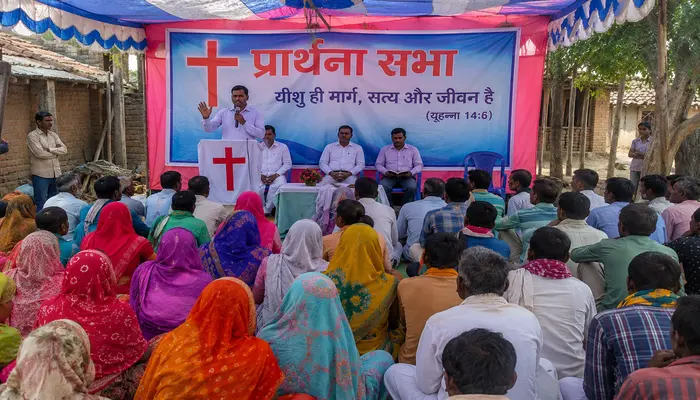
Case Summary
Hindu villagers in Theswa village, under Satgawan police station in Koderma district, Jharkhand, were targeted for Christian conversion through a prayer meeting organised at the residence of Prakash Ravidas. The villagers were conducting their annual puja and Shivacharcha when they learnt that a Christian prayer meeting involving outsiders was being held in the village. Fearing that the gathering was being used to influence Hindus to convert to Christianity, they informed the police on Acting on the information, Station House Officer Bablu Kumar Singh reached the spot with additional police personnel and raided the prayer meeting. Chaos ensued during the police action, during which some people managed to flee. Police detained dozens of men and women present at the gathering for questioning and seized a four-wheeler used by those attending the meeting. The vehicle's documents and other details were taken up for examination. During the raid, police recovered copies of the Bible and other Christian religious literature from the premises. Following the investigation, six individuals, including Mundrika Ravidas, were arrested for organising the gathering and mobilising people to attend it. One of the organisers stated during questioning that he had travelled from Ranchi to attend the prayer meeting. Another woman informed the police that Mundrika Ravidas had been organising similar prayer meetings for several years with people associated with Christian missionary activities. The arrested individuals belonged to different places, including Gaya and Nawada districts of Bihar. Villagers stated that similar prayer meetings had been taking place for a long time in Theswa and several nearby villages, including Gangdih, Vaiddih, Laxmandih, Sihas, Bijhbariya, Ramshala, Kothiyar, Galwati and Balimhari, where economically vulnerable Hindu communities were being influenced through inducements to embrace Christianity. They also raised concerns about the involvement of minor girls. Local representatives of the Vishwa Hindu Parishad and an elected representative reached the village and sought a thorough investigation and strict action. After questioning, many of the detained women were released to their families on personal bonds. Police stated that the investigation into the prayer meeting and the activities surrounding it was ongoing and that further legal action would be taken based on the findings.
Why it is Hate Crime ?
In this case, the primary category selected is: Predatory Proselytisation. The subcategory selected is: Conversion/ attempts to convert by inducement. Predatory Proselytisation is not just limited to threat, harassment, force and violence, but it also has contours of stealth. In several cases, the Hindu victim is exploited to convert, with non-Hindus taking advantage of their poverty. In such cases, the Hindu victim who is suffering financially is offered monetary benefits, including lucrative offers for jobs, health treatment, education, etc, to induce the victim into changing his/her religion. In such cases, the religious identity of the victim and the aim to disenfranchise him from his faith form the heart of the crime. Also, taking advantage of and exploiting an individual’s economic vulnerabilities is widely acknowledged as exploitation, forms of which are often penalised by law. Such cases therefore are considered religiously motivated hate crimes since the victim’s religious identity forms the very heart of the crime itself. The other subcategory selected is: Proselytisation by grooming, brainwashing, manipulation or subtle indoctrination. The tertiary category selected is: Pattern of targeting Hindus. Religious brainwashing essentially means the often subtle and forcible indoctrination to induce someone to give up their religious beliefs to accept contrasting regimented ideas. Religious grooming or brainwashing also involves propaganda and manipulation. It involves the systematic effort, driven by religious malice and indoctrination, to persuade “non-believers’ to accept allegiance, command, or doctrine to and of a contrasting faith. Cases of such grooming or brainwashing are far more nuanced than direct threats, coercion, inducement and violence. In such cases, it is often seen that there is repeated, subtle and continual manipulation of the victim to induce disaffection towards their own faith and acceptance of the contrasting faith of the perpetrator. While subtle indoctrination is widely acknowledged as predatory, an element which is often understated in such conversions or the attempts of such conversion is the role of loyalty and trust which might develop between the perpetrator and the victim. Fiduciary relationships are often abused to affect such religious conversion. For example, an educator transmitting religious doctrine of a competing faith to a Hindu student. The Hindu student is likely to accept what the teacher is transmitting owing to existence of the fiduciary relationship. The exploitation of the fiduciary relationship to religiously indoctrinate victims would also be included in this category. Since the underlying animosity towards the victim’s faith forms the basis of predatory proselytization, such cases are considered religiously motivated hate crimes. This case has been added to the tracker because Hindu villagers were targeted for Christian conversion through a prayer meeting. Firstly, the conversion efforts were directed specifically at Hindu villagers. The purpose was not simply to propagate Christian beliefs but to persuade members of the Hindu community to abandon their existing faith and embrace Christianity. Since the religious identity of the intended targets formed the basis of the conversion efforts, the incident qualified as a religiously motivated act rather than an ordinary religious gathering. Secondly, the prayer meeting served as the means through which the conversion efforts were carried out. Such gatherings provided a familiar and trusted environment where religious influence could be exercised gradually through repeated interaction instead of open coercion. This reflected the nature of predatory proselytisation, where persuasion was carried out through subtle and sustained engagement rather than direct force or intimidation. Thirdly, the recovery of Christian religious literature assumed significance in the context of the conversion efforts. The issue was not the possession of religious texts, but their use as part of organised attempts to persuade members of another faith to renounce their beliefs. When religious literature was employed to influence Hindus to change their religion, it became part of a process of religious indoctrination rather than merely an expression of personal faith. Further, the information available indicated that economically vulnerable Hindu communities had been selected for these conversion efforts through inducements. Targeting individuals because of both their religious identity and their economic vulnerability demonstrated an attempt to exploit hardship in order to secure religious conversion. Such conduct fell within the category of conversion by inducement because the vulnerability of the victims became a means of influencing their religious choices. The information also indicated that similar activities had extended across several neighbouring villages over a prolonged period. This suggested that the incident was not an isolated occurrence but formed part of a wider pattern of sustained efforts directed at Hindu communities. The repeated focus on Hindus as the intended targets reinforced the religious motivation behind the conversion activities and supported its classification as a hate crime under the selected categories.


Case Status
Arrested


Perpetrators Details
Perpetrators
Unknown
Perpetrators Range
From 5 to 10
Perpetrators Gender
unknown
 Sources




