Minor Hindu girls religiously profiled, their names compiled in mosques and madarsas as part of organised conversion network
 Pakistan
  20 December, 2023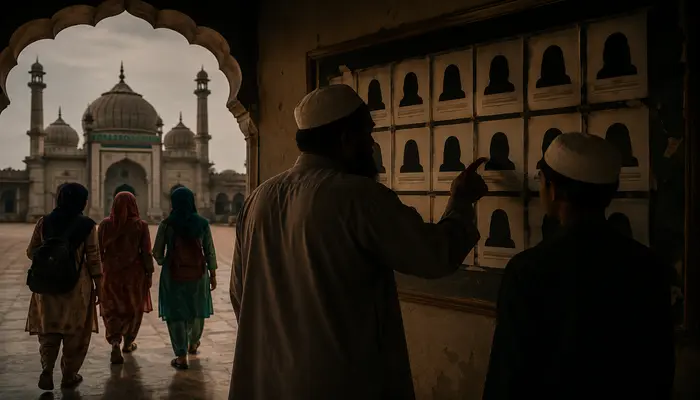
Case Summary
Minor Hindu girls from local neighbourhoods were identified through lists displayed in certain mosques and madarsas for the purpose of religious conversion in Pakistan. During an online discussion with a Pakistani reporter, Indian YouTuber Junaid Khan stated that the names of Hindu girls were written on boards inside these religious institutions and used to encourage Muslim boys to pursue them for conversion to Islam. Khan further stated that he had received photographs from Muslim youths showing boards containing the names and ages of Hindu girls. He said that Maulvis encouraged Muslim boys by telling them they would attain heaven for converting someone to Islam and added that many Muslim boys were willing to participate in this practice. In another video circulated on X, Khan stated that Hindu girls in Pakistan who underwent religious conversion were pushed into prostitution and that some also had their organs removed. The clips were shared by the X account Pakistan Untold, drawing wider attention to the remarks on social media. Pakistan's Hindu minority has long faced religious persecution, with human rights organisations documenting repeated instances of Hindu girls, particularly minors, being abducted, forcibly converted to Islam, and married to their abductors. Against this backdrop, the remarks made by Junaid Khan drew attention to what he described as an organised practice of identifying Hindu girls for religious conversion through lists displayed in mosques and madarsas. This was not the first instance in which concerns were raised regarding the targeting of Hindu girls for religious conversion in Pakistan. The Hinduphobia Tracker had previously documented numerous similar cases. For example, in Mirpur Khas, Sindh, a minor Hindu girl named Maria, daughter of Shamon Bheel of Village Usman Shah Hadi, Tando Allahyar, was abducted, forcibly converted to Islam, and married to her abductor, Naeem Memon Rajput, aged twenty-nine. Her name was changed to Naila Sheikh, and her family stated that the conversion and marriage were carried out without their consent and under coercion. In September 2025, in Umerkot, Sindh, a minor Hindu girl named Shardha Oad was abducted and subjected to forced religious conversion and marriage by a Muslim man named Riaz Ali and his accomplices. The case came to light after her widowed mother, Kamla Oad, approached the Women's Police Station in Umerkot seeking justice. In the same month, in Mirpur Khas, Sindh, another minor Hindu girl, Aneeta Thakur, was abducted and subjected to forced religious conversion and marriage to a Muslim man named Abdul Rehman Mallah. These documented incidents reflected a broader pattern in which Hindu women and girls in Pakistan were disproportionately vulnerable to abduction, forced religious conversion, and coerced marriages. The remarks in the present case, which described Hindu girls being identified and targeted for religious conversion because of their faith, echoed concerns that have repeatedly emerged in documented cases involving Pakistan's Hindu minority. Viewed alongside the wider pattern of religious persecution, including attacks on temples, discrimination, and violence directed at Hindus, the incident reinforced concerns regarding the continued vulnerability of Hindus in Pakistan on account of their religious identity.
Why it is Hate Crime ?
This case has been added to the tracker under the primary category- Predatory Proselytisation. Within this, the subcategory selected is- Harassment, threats, coercion for conversion. Harassment covers a wide range of behaviours of an offensive nature. It is commonly understood as behaviour that demeans, humiliates, and intimidates a person, including threats and coercion. Harassment and threats, in this case, find their root on discriminatory grounds which has the effect of nullifying a person’s rights or infringing upon his freedom to exercise his right specifically owing to the victim’s religious identity. Verbal and physical threats and psychological or physical harassment are often used against Hindu victims because they choose to practice their professed religion. Religious harassment also includes forced and involuntary conversions by harassment, threats or coercion. Coercion includes intimidatory tactics like force-feeding a Hindu victim beef to convert to another religion, forceful circumcision etc. In several cases documented, non-Hindu perpetrators or those who harbour specific animosity towards Hinduism, harass victims simply based on their religious identity. Such cases often also include harassment to ensure the Hindu victim abandons his/her professed religion and adopts the religion of the perpetrator. Such cases where Hindu victims are harassed to convert to the perpetrator’s religion are rooted in animosity towards the victim’s religious identity and are therefore documented as religiously motivated hate crimes. Another subcategory selected is: Proselytisation by grooming, brainwashing, manipulation or subtle indoctrination. Within this, the tertiary categories selected are: Conversion of Minor and Pattern of targeting Hindus. Religious brainwashing essentially means the often subtle and forcible indoctrination to induce someone to give up their religious beliefs to accept contrasting regimented ideas. Religious grooming or brainwashing also involves propaganda and manipulation. It involves the systematic effort, driven by religious malice and indoctrination, to persuade “non-believers’ to accept allegiance, command, or doctrine to and of a contrasting faith. Cases of such grooming or brainwashing are far more nuanced than direct threats, coercion, inducement and violence. In such cases, it is often seen that there is repeated, subtle and continual manipulation of the victim to induce disaffection towards their own faith and acceptance of the contrasting faith of the perpetrator. While subtle indoctrination is widely acknowledged as predatory, an element which is often understated in such conversions or the attempts of such conversion is the role of loyalty and trust which might develop between the perpetrator and the victim. Fiduciary relationships are often abused to affect such religious conversion. For example, an educator transmitting religious doctrine of a competing faith to a Hindu student. The Hindu student is likely to accept what the teacher is transmitting owing to existence of the fiduciary relationship. The exploitation of the fiduciary relationship to religiously indoctrinate victims would also be included in this category. Since the underlying animosity towards the victim’s faith forms the basis of predatory proselytisation, such cases are considered religiously motivated hate crimes. In this case, the religious marker was explicit, as the conduct described was directed specifically at Hindu girls because of their religious identity. The victims were not identified because of any personal dispute, individual relationship, or other distinguishing characteristic. Instead, their Hindu faith itself was presented as the basis on which they were selected, demonstrating that their religious identity formed the foundation of the targeting. The remarks described efforts aimed at persuading members of a specific religious community to abandon their religion and convert to Islam. The remarks further described an organised process involving religious institutions, religious figures, and local Muslim youths, in which Hindu girls were identified and approached for conversion while such acts were portrayed as religiously rewarding. The use of religious messaging to motivate conversion efforts, combined with the identification of Hindu girls through community-based lists, reflected more than isolated instances of religious propagation. Instead, it described a structured process directed specifically at members of the Hindu religious community, with the objective of influencing them to renounce their faith. Such conduct falls within proselytisation because it portrayed religious identity as the basis for selecting potential targets and presented conversion as a religious duty. By portraying Hindu identity itself as the criterion for identifying and approaching victims, the remarks reflected a pattern of religious targeting rather than an individual attempt at conversion. In the context of Pakistan, where coercive conversions of Hindus have been repeatedly documented by human rights organisations, such remarks reinforced concerns regarding the systematic targeting of Hindus because of their faith. This is why the incident has been included in the hate crime database. In this specific case, it is also important to understand the broader dynamics of religious conversions in Pakistan. While religious conversions across the world can be voluntary and stem from an individual's genuine change in faith, Pakistan has a well-documented history of coercive religious conversions targeting its Hindu minority. Human rights organisations have documented repeated instances of Hindu girls, particularly minors, being abducted, forcibly converted to Islam, and married to their abductors. Hindus have also faced widespread religious persecution, including attacks on temples, desecration of religious symbols, and violence on account of their faith. There have also been instances where minors who were forcibly converted after being abducted were handed over to their abductors by Pakistani courts. Against this backdrop, the conduct described in this case reflects concerns that extend beyond isolated acts of religious conversion and aligns with the broader pattern of religious persecution and coercive conversion faced by Hindus in Pakistan. Here, it is also important to examine the ideological dimension underpinning such incidents. Such acts are carried out by Muslim perpetrators due to indoctrination by Islamic theology, which advocates that all non-Muslims (referred to as kafirs) are inferior and subject to subjugation unless they convert to Islam or live under Islamic rule (dhimmitude). These ideas are not mere abstractions; they manifest in actions where non-Muslims, especially Hindus in India, are seen as targets for religious domination, coercion, or humiliation. This theological framework fosters an "us versus them" mindset, in which any assertion of Hindu identity or religious freedom is seen not only as undesirable but as a threat to Islamic supremacy. As a result, perpetrators who are shaped by such teachings feel justified, even morally obligated, to harass, suppress, or violently attack Hindus, particularly when Hindus assert their religious rights or resist conversion. As a result, Muslim perpetrators invoke such doctrines to justify coercive attempts to convert non-Muslims, particularly Hindus, portraying conversion as a means of abandoning Kufr (a state of disbelief in Islam or disbelief in Islam) and attaining salvation. Such acts, therefore, are not isolated but driven by a broader ideological hostility towards Hindus as non-believers and reflect an attempt to impose religious dominance. Since this case was also not a random isolated incident of grooming of a minor but a premeditated attack motivated by bias and hatred against the Hindu community, which is a defining feature of hate crimes, this has been added to the tracker. Disclaimer: The exact date on which the events described in the video occurred, when the practice began, and when the online discussion was recorded could not be verified. Accordingly, this case has been dated 21 December 2023, corresponding to the earliest verifiable public report documenting the incident.


Case Status
Unknown


Perpetrators Details
Perpetrators
Muslim Extremists
Perpetrators Range
Unknown
Perpetrators Gender
unknown
 Sources




