Hindu religious beliefs mocked: CJP protester makes derogatory gau mutra jibe against Hindus
 Central Delhi, Delhi, India
  16 July, 2026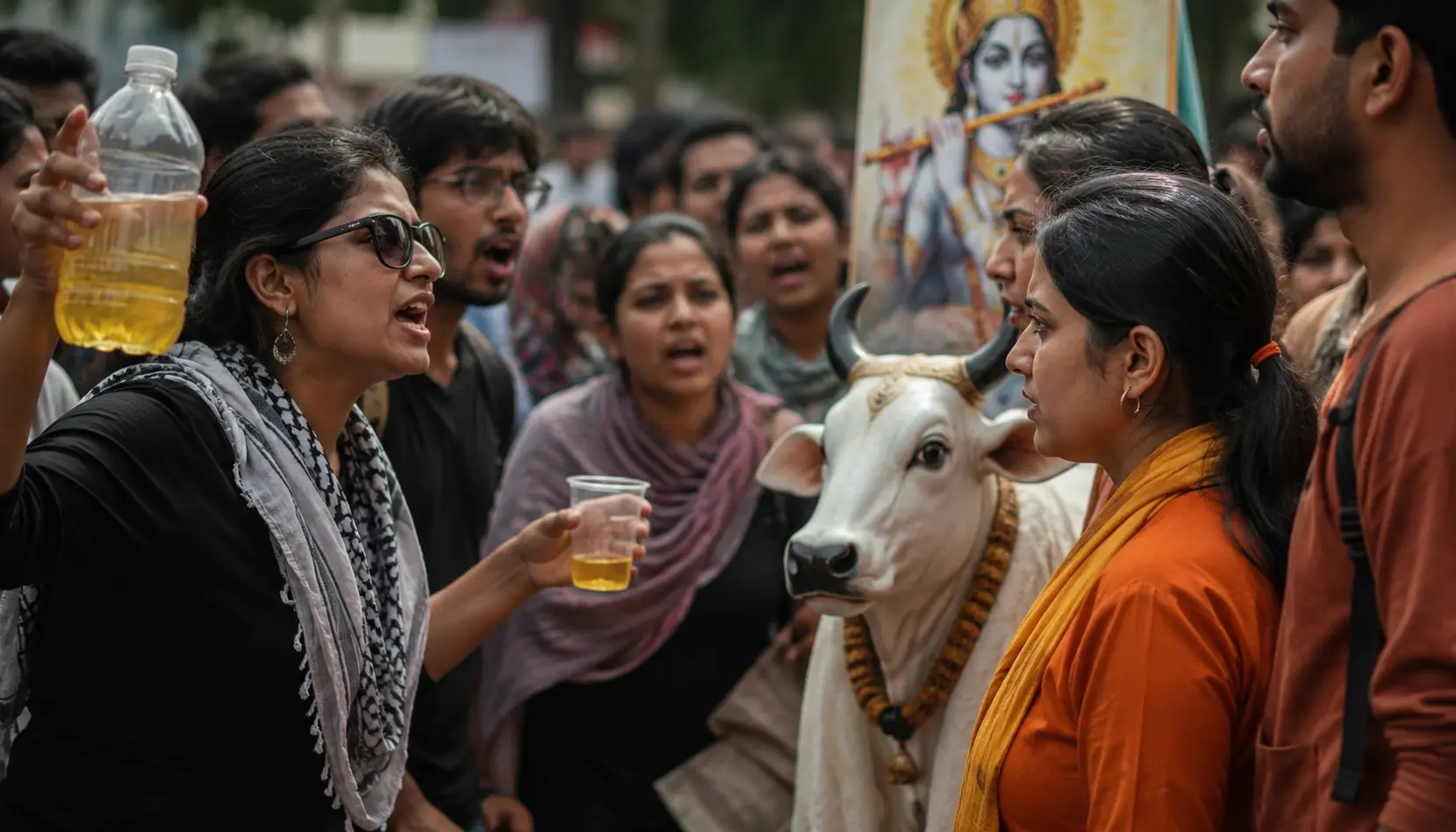
Case Summary
During the protest organised by the Cockroach Janta Party (CJP) at Jantar Mantar in New Delhi, Hindu religious beliefs were targeted when a protester mocked Hindu beliefs by taking a “gau mutra” (cow urine) jibe at Hindus. The protester mockingly said, “Andh Bhakton ka kehna hai gau mutr piyo aur theek ho jaoge” (“Blind devotees say drink cow urine and you will get cured”), portraying Hindus as irrational and superstitious. The video of the derogatory remarks was circulated on social media and was criticised by the Hindu community. The incident occurred on 20 July 2026 when the CJP organised the youth movement with 'Chalo Sansad' (Parliament March) from Jantar Mantar in New Delhi. The incident reflected the broader ideological trajectory of the Cockroach Janata Party (CJP), whose public campaigns increasingly shifted from their stated demands for educational reforms towards conduct perceived by many as hostile towards Hindu religious symbols, traditions, and beliefs. Earlier incidents associated with the movement included participants displaying sacred images of Hindu deities during protests, making derogatory remarks about Hindu deities and religious slogans such as "Jai Shri Ram", abusing the Hindu community, raising overtly pro-Islamic slogans such as "Naam Rahega Allah Ka" and "Naara-e-Taqbeer, Allahu Akbar", and increasingly directing hostility towards Hindu organisations, activists, and the government they described as "Hindutva-led". Notably, the Cockroach Janata Party (CJP) emerged in mid-May 2026 as a satirical, youth-led online movement that rapidly transformed into a mass mobilisation platform for students and unemployed graduates through social media engagement. It was founded by Abhijeet Dipke, a member of the Aam Aadmi Party (AAP), who repurposed a controversial public remark comparing unemployed youth to "cockroaches" as a symbol of collective identity and protest. While Dipke initially portrayed the CJP movement as a genuine, non-partisan, and constitutionally aligned initiative demanding educational reforms, accountability for the National Eligibility cum Entrance Test (NEET) examination paper leak, and the resignation of officials, including the Union Education Minister, the movement soon diverged from its stated objectives. Rather than remaining focused on systemic reforms, it evolved into an ideologically driven campaign characterised by anti-Hindu rhetoric. By the time it culminated in its first major street-level protest at Jantar Mantar on 6 June 2026, the movement had transformed from a purported students' rights campaign into an overtly anti-Hindu platform. Abhijeet Dipke travelled from the United States to lead the protest, which was attended by several AAP-aligned figures. Contrary to the movement's stated objective of seeking educational reforms, its conduct increasingly reflected hostility towards Hindu religious identity, symbols, and beliefs.
Why it is Hate Crime ?
The selected category in this case is: Hate speech against Hindus, with the subcategory selected as: Anti-Hindu slurs, mocking faith. Anti-Hindu slurs and the deliberate mocking of the Hindu faith owing to religious animosity involve the usage of derogatory terms, stereotypes, or offensive references to religious practices, symbols, or figures. One of the common anti-Hindu slurs used against Hindus is “cow-worshipper” and “cow piss drinker”. The intention of using this term is to demean and mock Hindus as a group and their religious beliefs since Hindus consider the cow holy. Additionally, some symbols and the slurs attached to them have a historical context that exacerbates the insult, hate, stereotyping, dehumanisation and oppression against Hindus. Cow worship has been used for centuries to denigrate Hindus, insult their faith and oppress Hindus specifically as a religious group. There has been overwhelming documentation about how cow slaughter has been used to persecute Hindus, with cow meat being thrown in temples and places of worship. There has also been overwhelming documentation where cow meat (beef) has been force-fed to Hindus to either forcefully convert them to Islam or denigrate their faith. Apart from cow worship, the Swastika – which holds deep religious significance for the Hindus – has also been misinterpreted and distorted to use as a slur against Hindus. Similarly, the worship of the Shivling has been used by supremacist ideologies and religions to denigrate Hindus owing to religious animosity. Such slurs and denigration stem from inherent animosity and hate towards Hindus and their faith; therefore, it is categorised as hate speech targeted at Hindus specifically owing to their religious identity. The remarks made during the CJP protest constitute an attack on Hindu faith because they used a religiously significant symbol associated with Hinduism as a means of ridicule and social stereotyping. The reference to “gau mutra” (cow urine) was not made as part of a neutral discussion, academic critique, or respectful debate about a religious practice. Instead, it was used in a mocking manner to portray Hindus who hold reverence towards the cow are irrational, unscientific, or incapable of reasoned thought. By associating a deeply significant religious and cultural symbol with ridicule, the remark targeted not merely an individual belief but the identity and dignity of millions of Hindus who attach spiritual, cultural, and emotional significance to the cow. The cow occupies an important place within Hindu religious traditions and cultural practices, where it is often associated with reverence, purity, nourishment, and the idea of sacredness. Different Hindu traditions, scriptures, and communities have historically expressed respect towards the cow in various forms. By reducing this complex religious and cultural relationship to a mocking phrase such as “drink gau mutra,” the remark created a caricature of Hindu beliefs rather than engaging with them in a meaningful or respectful manner. The issue is not the existence of disagreement or criticism regarding a religious practice; rather, the concern arises when a religious symbol is deliberately invoked as an insult to portray an entire community as foolish, backward, or deserving of contempt. The remark also relied on a broader stereotype frequently directed at Hindus, where aspects of Hindu traditions are selectively highlighted and presented in a derogatory manner to undermine the intelligence, modernity, or credibility of its followers. Such generalisations erase the diversity and complexity within Hinduism by reducing a vast religious tradition, followed by millions of people across the world, to a single mocked reference. When a religious practice is taken out of its cultural and spiritual context and used as a punchline against believers, it transforms political criticism into religious stereotyping. The context in which the statement was made is also significant. The remark was made during a public protest, were political criticism and disagreement with individuals, parties, or government policies could have been expressed without targeting religious beliefs. Criticism of political figures or institutions does not require the use of religious references to demean a community. By invoking a Hindu religious symbol in a derogatory manner, the speaker crossed from political expression into rhetoric that demeaned a religious identity. Similar treatment of sacred symbols belonging to any other religious community would generally be recognised as offensive and discriminatory; therefore, Hindu religious beliefs and symbols should also be accorded the same standard of respect. Such remarks contribute to an environment where negative stereotypes about Hindus become normalised by portraying their religious beliefs as objects of mockery rather than matters of faith and personal identity. Publicly ridiculing sacred practices reinforces prejudice, encourages contempt towards a religious community, and diminishes the dignity associated with its beliefs. The concern is not simply that a religious practice was questioned, but that a religious symbol was used as a tool to insult and stereotype its followers. Therefore, the statement represents anti-Hindu rhetoric involving religious mockery, stereotyping, and the denigration of Hindu beliefs rather than a mere expression of political disagreement. Disclaimer: The Hinduphobia Tracker records incidents based on when an event occurred or when the victim's ordeal began. It is important to clarify that none of the media sources covering this case has specified the exact date when the incident occurred. Therefore, for documentation purposes, we have recorded the date based on when the incident was reported in the media, 17 July 2026.


Case Status
Unknown


Perpetrators Details
Perpetrators
Others
Perpetrators Range
One Person
Perpetrators Gender
male
 Sources




