Sacred images of Hindu deities used in mocking manner during Cockroach Janta Party protest in Delhi
 Delhi, Delhi, India
  22 July, 2026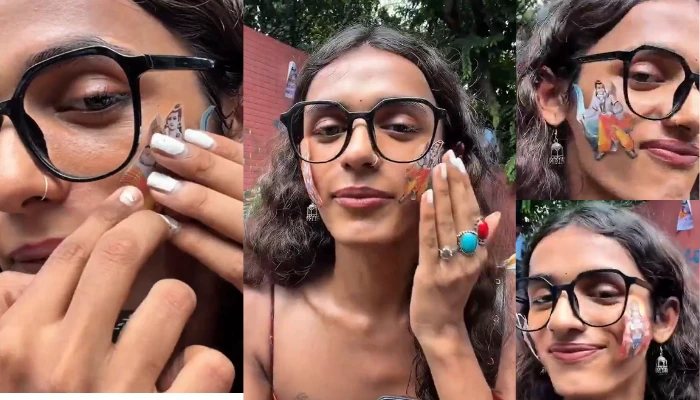
Case Summary
At a protest organised by the Cockroach Janata Party (CJP), the Hindu faith and revered Hindu deities were mocked by displaying cut-outs of Bhagwan Shri Ram and Lord Hanuman on the cheeks of transgender protester Shashwat Srivastava and using them in a derogatory manner during the demonstration. Shashwat Srivastava, who is active on Instagram under the handle "sugar_fudge", pasted the sacred images of the deities on both sides of herface and declared that the deitieswould now save her from police action and lathi charge. She further claimed that if the police touched her they would be hurting Sanatan Dharma. A video of the incident subsequently circulated widely on social media, drawing criticism for using revered Hindu deities in a manner that many Hindus considered insulting and disrespectful. According to the viral video, Shashwat Srivastavapasted cut-outs of Bhagwan Shri Ram and Lord Hanuman on both sides of her cheeks while participating in the protest. Addressing those around her, she said that the deities would now save her from the police and lathi charge. She further remarked that if the police touched her while she wore the images of the deities, they would be accused of hurting Sanatan Dharma. By making these statements, she portrayed revered Hindu deities as shields against police action during a political protest rather than as sacred objects of worship. The manner in which the sacred images of Bhagwan Shri Ram and Lord Hanuman were displayed, and the accompanying remarks, drew criticism from several social media users, who described the act as mocking and trivialising revered Hindu deities for political theatre. They objected to the use of sacred Hindu religious images in such a demeaning manner, stating that it reduced deeply revered deities to instruments of political messaging and demeaned the religious sentiments of millions of Hindu devotees. The visual presentation closely resembled a scene from the Hindi film "PK", in which actor Aamir Khan similarly displayed images of Hindu deities on his cheeks while satirising Hindu religious practices. Although Shashwat Srivastava did not state that she was imitating the film, the resemblance between the two acts was widely noticed because both involved displaying sacred images of Hindu deities on the cheeks in a manner that many Hindus considered disrespectful and derogatory. The incident reflected the broader ideological trajectory of the Cockroach Janata Party (CJP), whose public campaigns increasingly shifted from their stated demands for educational reforms towards conduct perceived by many as hostile towards Hindu religious symbols, traditions, and beliefs. Earlier incidents associated with the movement included participants displaying sacred images of Hindu deities during protests, making derogatory remarks about Hindu deities and religious slogans such as "Jai Shri Ram", abusing the Hindu community, raising overtly pro-Islamic slogans such as "Naam Rahega Allah Ka" and "Naara-e-Taqbeer, Allahu Akbar", and increasingly directing hostility towards Hindu organisations, activists, and the government they described as "Hindutva-led". Notably, the Cockroach Janata Party (CJP) emerged in mid-May 2026 as a satirical, youth-led online movement that rapidly transformed into a mass mobilisation platform for students and unemployed graduates through social media engagement. It was founded by Abhijeet Dipke, a member of the Aam Aadmi Party (AAP), who repurposed a controversial public remark comparing unemployed youth to "cockroaches" as a symbol of collective identity and protest. While Dipke initially portrayed the CJP movement as a genuine, non-partisan, and constitutionally aligned initiative demanding educational reforms, accountability for the National Eligibility cum Entrance Test (NEET) examination paper leak, and the resignation of officials, including the Union Education Minister, the movement soon diverged from its stated objectives. Rather than remaining focused on systemic reforms, it evolved into an ideologically driven campaign characterised by anti-Hindu rhetoric. By the time it culminated in its first major street-level protest at Jantar Mantar on 6 June 2026, the movement had transformed from a purported students' rights campaign into an overtly anti-Hindu platform. Abhijeet Dipke travelled from the United States to lead the protest, which was attended by several AAP-aligned figures. Contrary to the movement's stated objective of seeking educational reforms, its conduct increasingly reflected hostility towards Hindu religious identity, symbols, and beliefs.
Why it is Hate Crime ?
This case has been added to the tracker under the primary category - Hate speech against Hindus. Within this, the subcategory selected for this case is - Anti-Hindu slurs, mocking faith. Anti-Hindu slurs and the deliberate mocking of the Hindu faith owing to religious animosity involve the usage of derogatory terms, stereotypes, or offensive references to religious practices, symbols, or figures. One of the common anti-Hindu slurs used against Hindus is “cow-worshipper” and “cow piss drinker”. The intention of using this term is to demean and mock Hindus as a group and their religious beliefs since Hindus consider the cow holy. Additionally, some symbols and the slurs attached to them have a historical context that exacerbates the insult, hate, stereotyping, dehumanisation and oppression against Hindus. Cow worship has been used for centuries to denigrate Hindus, insult their faith and oppress Hindus specifically as a religious group. There has been overwhelming documentation about how cow slaughter has been used to persecute Hindus, with cow meat being thrown in temples and places of worship. There has also been overwhelming documentation where cow meat (beef) has been force-fed to Hindus to either forcefully convert them to Islam or denigrate their faith. Apart from cow worship, the Swastika – which holds deep religious significance for the Hindus – has also been misinterpreted and distorted to use as a slur against Hindus. Similarly, the worship of the Shivling has been used by supremacist ideologies and religions to denigrate Hindus owing to religious animosity. Such slurs and denigration stem from inherent animosity and hate towards Hindus and their faith; therefore, it is categorised as hate speech targeted at Hindus specifically owing to their religious identity. The primary category for this case is Attack on Hindu religious representations. The subcategory for this case is: Iconoclastic representation of Hindu Gods/Goddesses. An icon is a symbol of someone or something that is revered, or a religious representation of a spiritual ideal. Iconography is of vital significance in the Hindu milieu. It helps connect people’s spiritual beliefs with the real world. Iconography within the Hindu faith takes several shapes and forms. Murtis are of most significance to Hindus, to which daily rituals, prayers and offerings are done. Besides the murtis, there are several other symbols which have deep significance in the Hindu faith – the Om and Swastika for example. Any iconoclastic representation of these symbols, images and murtis is an affront to the religious beliefs and faith of the Hindu community itself since the symbols and icons are deeply religious in nature. In this sub-category of crime, we would record hate crimes and iconoclastic representations, in words, art, or any other form of representation of symbols that hold religious significance for the Hindu community. Since these symbols, icons and murtis are central to the Hindu faith, any iconoclastic representation of these symbols is born out of animosity towards the faith itself, manifesting itself through these symbols, and therefore, these representations would be considered religiously motivated hate crimes. The other sub-category selected is - Desecration of Hindu religious symbol. Icons and symbols or a religious representation of a spiritual ideal are widely revered in Hinduism. Iconography is of vital significance in the Hindu milieu. It helps connect people’s spiritual beliefs with the real world. Iconography within the Hindu faith takes several shapes and forms. Murtis are of most significance to Hindus, to which daily rituals, prayers and offerings are done. Besides the murtis, there are several other symbols which have deep significance in the Hindu faith – the Om and Swastika for example. Since these Hindu religious symbols hold paramount importance in Hinduism, any desecration of symbols, icons, murtis, religious representations and manifestations is driven by animosity towards the faith itself, which manifests itself through these murtis, icons and symbols. Therefore, any desecration of these Hindu religious symbols and representations is considered religiously motivated hate crimes under this category. This case was included in the Hinduphobia Tracker because revered Hindu deities and the Hindu faith were deliberately ridiculed during a public protest. The sacred images of Bhagwan Shri Ram and Lord Hanuman were not treated with the reverence they command in Hinduism but were instead used in a manner that trivialised their religious significance and mocked the faith of millions of Hindu devotees. The conduct specifically targeted sacred Hindu iconography. In Hinduism, images of deities are not decorative illustrations or symbolic artwork but consecrated representations of the Divine that are worshipped with devotion. They occupy a central place in Hindu religious life and are treated with the same reverence that devotees accord the deities themselves. Reducing such sacred images to accessories for a political demonstration stripped them of their sanctity and transformed revered objects of worship into instruments of ridicule. The offence therefore lay not merely in displaying the images but in the manner in which they were deliberately used to mock their sacred character. Furthermore, the repeated invocation of Hindu deities and Sanatan Dharma in the context of a political confrontation trivialised deeply held religious beliefs by converting them into tools of satire and public performance. Rather than respecting the religious significance attached to the deities, the conduct portrayed them as theatrical devices to strengthen a political message. Such use divorced the deities from their spiritual significance and reduced them to objects of amusement, thereby demeaning the faith itself. The manner in which the sacred images were displayed also carried broader religious significance. This was not a spontaneous or incidental use of Hindu symbols but a conscious visual representation designed to communicate a message before an audience. The choice to employ revered Hindu deities in this manner ensured that the political performance drew its impact precisely because of the sanctity attached to those images. In other words, the effectiveness of the act depended upon diminishing the religious reverence that Hindus associate with their deities. The resemblance to an earlier cinematic portrayal further reinforced the perception that the sacred images were being used as objects of satire rather than devotion. The context in which this conduct occurred further demonstrated its targeted nature. The incident took place during a Cockroach Janata Party (CJP) protest that was presented as a movement concerning students' rights and educational reforms. However, the protest platform became a setting where repeated anti-Hindu remarks, derogatory statements, and acts mocking Hindu religious symbols were witnessed. This demonstrated that the use of the sacred images of Bhagwan Shri Ram and Lord Hanuman in a mocking and theatrical manner was not an isolated act or an individual expression detached from its surroundings, but formed part of a broader pattern of hostility directed towards Hindu religious identity during the protest. The appropriation of revered Hindu deities as props for political theatre in such a public setting reflected a recurring pattern of targeting Hindu beliefs and sacred symbols, making the incident a religiously motivated hate crime against Hindusmm Taken together, the perpetrators' conduct revealed a deliberate attempt to demean and trivialise revered Hindu religious symbols for political expression. Instead of respecting the sacred status of Bhagwan Shri Ram and Lord Hanuman, the deities were consciously appropriated to attract attention and create spectacle. Such conduct reflected a conscious disregard for the sanctity of Hindu religious icons and the religious sentiments of Hindu devotees, making the incident a religiously motivated hate crime against Hindus. Disclaimer: The Hinduphobia Tracker records the date on which the incident occurred rather than the date on which it was reported or uploaded on social media. In this case, the exact date on which the incident involving the pasting of stickers depicting Lord Hanuman and Lord Ram during the CJP protest in Delhi took place could not be independently verified. Therefore, for documentation purposes, we have recorded the date based on when the incident was reported in the media, 23 July 2026. Disclaimer: The Hinduphobia Tracker records the location of an incident based on the best available evidence. In this case, the exact location where the incident occurred could not be independently verified. However, the accused, Shashwat Srivastava (@sugar_fudge), is primarily a Delhi-based content creator and social media personality, and the incident formed part of a Cockroach Janata Party (CJP) protest held in New Delhi. Accordingly, for documentation purposes, the location of the incident has been recorded as Delhi.


Case Status
Unknown


Perpetrators Details
Perpetrators
Others
Perpetrators Range
One Person
Perpetrators Gender
third
 Sources




