Revered Hindu slogan 'Jai Shri Ram' mocked by Cockroach Janata Party supporter during a protest in Delhi
 Delhi, Delhi, India
  18 July, 2026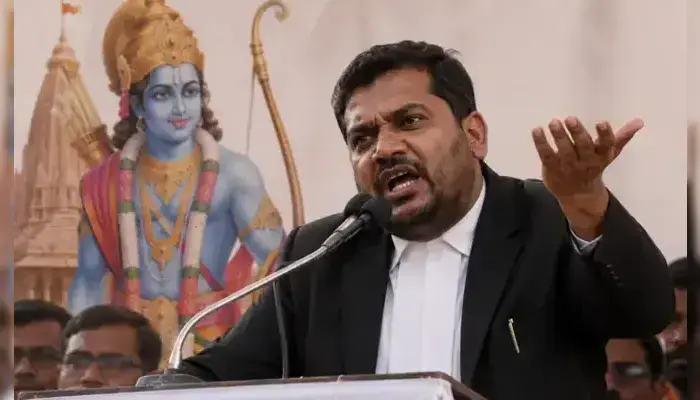
Case Summary
In Delhi, Hindu religious sentiments were hurt during a protest organised by the Cockroach Janata Party (CJP), where advocate Balraj Malik mocked the Hindu religious slogan "Jai Shri Ram" during a public speech. He ridiculed the slogan by questioning its power and significance in relation to the controversy surrounding the Ram Temple in Ayodhya. A video of the incident circulated on social media in which Malik referred to the controversy surrounding the theft of donations at the Ram Temple in Ayodhya and stated, "What was the use of saying 'Jai Shri Ram' here? Raise the slogan where the donation money was stolen. If there had been power in 'Jai Shri Ram', those sitting there would not have stolen money in front of Lord Ram's idol." During the same speech, Malik also criticised Hindu organisations such as the Rashtriya Swayamsevak Sangh and the Bharatiya Janata Party, accusing them of promoting divisions between Hindus and Muslims. He further described sections of the mainstream media as traitors, made remarks against the Supreme Court, and stated that social media had become the primary platform for public discourse. The speech was later circulated on X by political and social activist Manoj Singh, where clips of Malik's remarks drew attention for mocking the Hindu religious slogan "Jai Shri Ram" and hurting the religious sentiments of Hindus. Notably, the Cockroach Janata Party (CJP) emerged in mid-May 2026 as a satirical, youth-led online movement that rapidly transformed into a mass mobilisation platform for students and unemployed graduates through social media engagement. It was founded by Abhijeet Dipke, a member of the Aam Aadmi Party (AAP), who repurposed a controversial public remark comparing unemployed youth to "cockroaches" as a symbol of collective identity and protest. While Dipke initially portrayed the CJP movement as a genuine, non-partisan, and constitutionally aligned initiative demanding educational reforms, accountability for the National Eligibility cum Entrance Test (NEET) examination paper leak, and the resignation of officials, including the Union Education Minister, the movement soon diverged from its stated objectives. Rather than remaining focused on systemic reforms, it evolved into an ideologically driven campaign characterised by anti-Hindu rhetoric. Its co-founders and participants made derogatory remarks about Hindu deities and religious slogans such as "Jai Shri Ram", abused the Hindu community, raised overtly pro-Islamic slogans such as "Naam rahega Allah ka", "Naara-e-Taqbeer, Allahu Akbar", and increasingly directed their hostility towards Hindu organisations, activists, and the government, which they described as a "Hindutva-led government". By the time it culminated in its first major street-level protest at Jantar Mantar on 6 June 2026, the movement had shifted from a purported students' rights campaign into an overtly anti-Hindu platform. On 6 June 2026, Dipke flew in from the United States to lead the movement's first major street-level protest at Jantar Mantar. AAP-aligned figures attended the event under the guise of being neutral, anti-establishment voices. However, contrary to its stated claim of being a student advocacy movement focused on systemic failures, the CJP's conduct at Jantar Mantar told a starkly different story.
Why it is Hate Crime ?
This case has been added to the tracker under the primary category- Hate Speech against Hindus. The subcategory selected is- Anti-Hindu slurs, mocking faith. Anti-Hindu slurs and the deliberate mocking of the Hindu faith owing to religious animosity involve the usage of derogatory terms, stereotypes, or offensive references to religious practices, symbols, or figures. One of the common anti-Hindu slurs used against Hindus is “cow-worshipper” and “cow piss drinker”. The intention of using this term is to demean and mock Hindus as a group and their religious beliefs since Hindus consider the cow holy. Additionally, some symbols and the slurs attached to them have a historical context that exacerbates the insult, hate, stereotyping, dehumanisation and oppression against Hindus. Cow worship has been used for centuries to denigrate Hindus, insult their faith and oppress Hindus specifically as a religious group. There has been overwhelming documentation about how cow slaughter has been used to persecute Hindus with cow meat being thrown in temples and places of worship. There has also been overwhelming documentation where cow meat (beef) has been force-fed to Hindus to either forcefully convert them to Islam or denigrate their faith. Apart from cow worship, the Swastika – which holds deep religious significance for the Hindus – has also been misinterpreted and distorted to use as a slur against Hindus. Similarly, the worship of the Shivling has been used by supremacist ideologies and religions to denigrate Hindus owing to religious animosity. Such slurs and denigration stem out of inherent animosity and hate towards Hindus and their faith, therefore, it is categorised as hate speech targeted at Hindus specifically owing to their religious identity. This incident constituted hate speech against Hindus because it specifically targeted and ridiculed "Jai Shri Ram", one of Hinduism's most revered devotional expressions and a sacred invocation associated with Lord Ram. For millions of Hindus, the chant is not merely a phrase or political slogan but a deeply meaningful expression of devotion, faith, and spiritual identity. It is used in prayers, religious gatherings, festivals, and daily expressions of reverence towards Lord Ram. By mocking such a sacred invocation, the accused directed his remarks at an important symbol of Hindu religious belief. During his remarks, the accused used the controversy surrounding the theft of donations at the Ayodhya Ram Temple to mock the significance of "Jai Shri Ram", stating that if there had been power in the slogan, the theft would not have taken place in front of Lord Ram's idol. Instead of restricting his criticism to individuals involved in the incident or questioning the management of the temple, he directed his remarks towards the sacred religious expression itself. By making a revered Hindu devotional chant the subject of ridicule, he diminished its spiritual significance and attacked a chant deeply associated with the Hindu faith. The accused further discouraged people from chanting "Jai Shri Ram", described it as a slogan associated with royalty and ruling families, and encouraged the audience to adopt alternative slogans. These remarks went beyond a political disagreement or criticism of specific organisations. By questioning the value of a sacred Hindu invocation and urging people to abandon it, the accused targeted a religious expression that carries profound cultural, spiritual, and emotional importance for Hindus. Religious expressions such as "Jai Shri Ram" form an integral part of Hindu identity and are recognised by Hindus worldwide as manifestations of devotion towards Lord Ram. Mocking the chant, questioning its sanctity through ridicule, and discouraging its use amounted to an attack on a core element of Hindu religious expression. The remarks therefore extended beyond ordinary political speech and entered the realm of religiously targeted hostility against Hindu beliefs. The targeted nature of the remarks was further evident from the accused's deliberate contrast between the Hindu devotional slogan "Jai Shri Ram" and slogans such as "Jai Bhim" and "Jai Samvidhan", which are associated with the Ambedkarite movement, an anti-Hindu political movement that denigrates Hinduism, its deities, its followers, temples and scriptures all under the guise of 'fighting casteism'. While the use of these slogans was not objectionable in itself, the accused introduced them after first ridiculing "Jai Shri Ram" and encouraging people to abandon it. By presenting alternative slogans in opposition to a sacred Hindu invocation, he framed the discussion in a manner that diminished Hindu religious identity and reinforced the religiously hostile nature of his remarks. The context in which these remarks were made further demonstrated the targeted nature of the offence. The incident occurred during a Cockroach Janata Party (CJP) protest that was initially presented as a movement concerning students' rights and educational reforms. However, the protest platform became a setting where repeated anti-Hindu remarks, derogatory statements, and attacks on Hindu religious symbols were expressed. This demonstrated that the mocking of "Jai Shri Ram" was not an isolated occurrence or merely an individual remark detached from its surroundings, but part of a broader pattern of hostility directed towards Hindu religious identity. The use of a public protest platform to ridicule a sacred Hindu invocation reflected a recurring pattern of targeting Hindu beliefs and symbols, making the incident a religiously motivated hate crime against Hindus. Overall, since this case meets the parameters of a religiously driven hate crime, it is being added to the hate crime database of the Hinduphobia Tracker. Disclaimer: The Hinduphobia Tracker records incident dates based on when a crime occurs, rather than when it is reported by the media. However, in this case, media reports did not specify the exact date on which the incident occurred. Therefore, 19 July 2026, the date on which the incident first surfaced on social media, has been selected as the indicative incident date for documentation purposes only.


Case Status
Unknown


Perpetrators Details
Perpetrators
Others
Perpetrators Range
One Person
Perpetrators Gender
male
 Sources




