Anti-Hindu hate spewed at Cockroach Janata Party protest; protesters ridicule the Hindu community and mock Hindu temples
 Central Delhi, Delhi, India
  19 July, 2026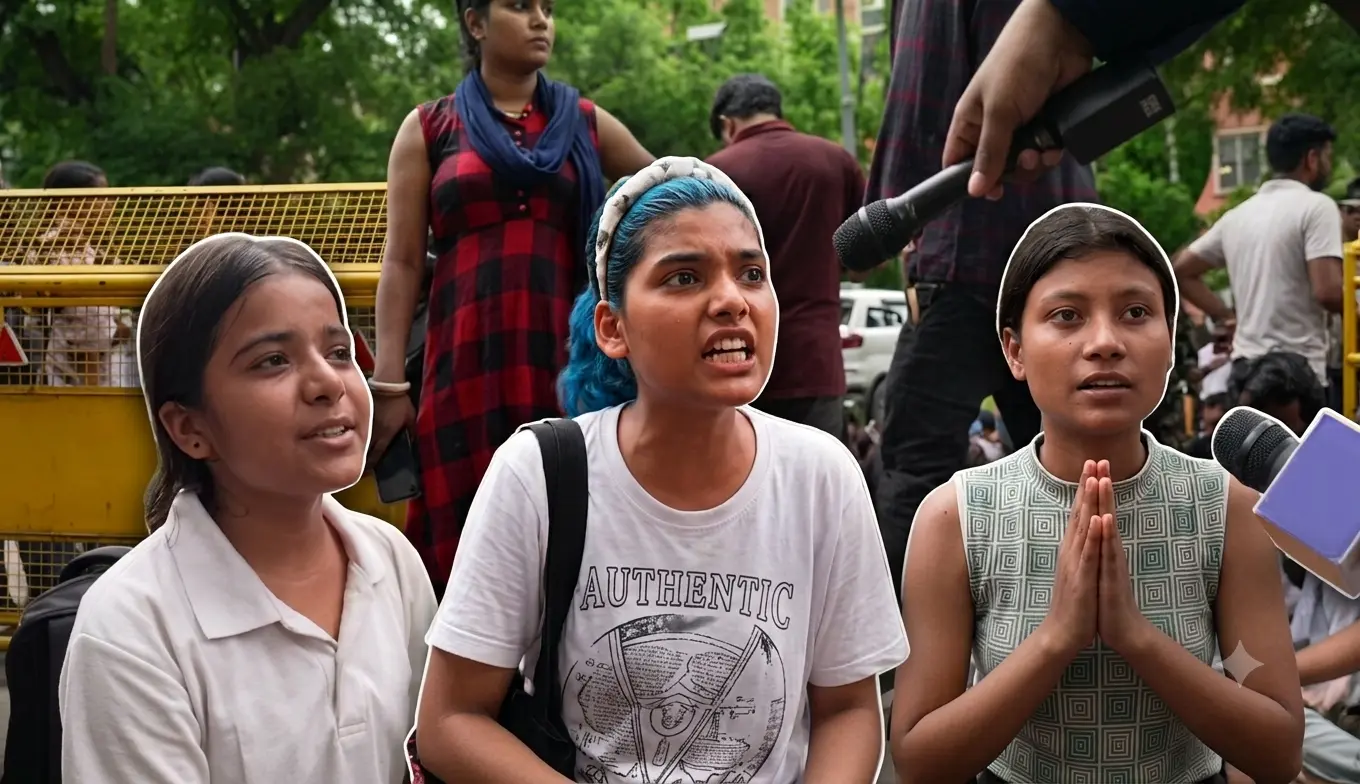
Case Summary
Hindus and their places of worship were openly ridiculed during the Cockroach Janata Party's (CJP) "Chalo Sansad" (Parliament March), a youth protest organised at Jantar Mantar on 20 July 2026. During the demonstration, two female participants made derogatory remarks targeting the Hindu community and Hindu religious beliefs. One of the women claimed that "Muslims are a hundred thousand times better than Hindus", asserting that her Muslim friends had treated her with greater kindness than her Hindu friends. By contrasting the two communities in this manner, she openly demeaned Hindus while glorifying Muslims at their expense. Another female participant mocked Hindu temples, stating that constructing temples would not contribute to the country's development. Her remarks ridiculed Hindu places of worship and dismissed the religious significance temples hold for millions of Hindu devotees. Videos of both women were widely circulated on social media, prompting criticism from members of the Hindu community, who objected to the open denigration of Hindus, the disparagement of Hindu temples and the repeated attempts to portray Hinduism in a negative light. Notably, the Cockroach Janata Party (CJP) emerged in mid-May 2026 as a satirical, youth-led online movement that rapidly transformed into a mass mobilisation platform for students and unemployed graduates through social media engagement. It was founded by Abhijeet Dipke, a member of the Aam Aadmi Party (AAP), who repurposed a controversial public remark comparing unemployed youth to "cockroaches" as a symbol of collective identity and protest. While Dipke initially portrayed the CJP movement as a genuine, non-partisan, and constitutionally aligned initiative demanding educational reforms, accountability for the National Eligibility cum Entrance Test (NEET) examination paper leak, and the resignation of officials, including the Union Education Minister, the movement soon diverged from its stated objectives. Rather than remaining focused on systemic reforms, it evolved into an ideologically driven campaign characterised by anti-Hindu rhetoric. Its co-founders and participants made derogatory remarks about Hindu deities and religious slogans such as "Jai Shri Ram", abused the Hindu community, raised overtly pro-Islamic slogans such as "Naam rahega Allah ka", "Naara-e-Taqbeer, Allahu Akbar", and increasingly directed their hostility towards Hindu organisations, activists, and the government, which they described as a "Hindutva-led government". By the time it culminated in its first major street-level protest at Jantar Mantar on 6 June 2026, the movement had shifted from a purported students' rights campaign into an overtly anti-Hindu platform. On 6 June 2026, Dipke flew in from the United States to lead the movement's first major street-level protest at Jantar Mantar. AAP-aligned figures attended the event under the guise of being neutral, anti-establishment voices. However, contrary to its stated claim of being a student advocacy movement focused on systemic failures, the CJP's conduct at Jantar Mantar told a starkly different story.
Why it is Hate Crime ?
The primary category selected in this case is: Hate speech against Hindus. The subcategory selected is: Anti-Hindu slurs, mocking faith. Anti-Hindu slurs and the deliberate mocking of the Hindu faith owing to religious animosity involve the usage of derogatory terms, stereotypes, or offensive references to religious practices, symbols, or figures. One of the common anti-Hindu slurs used against Hindus is “cow-worshipper” and “cow piss drinker”. The intention of using this term is to demean and mock Hindus as a group and their religious beliefs since Hindus consider the cow holy. Additionally, some symbols and the slurs attached to them have a historical context that exacerbates the insult, hate, stereotyping, dehumanisation and oppression against Hindus. Cow worship has been used for centuries to denigrate Hindus, insult their faith and oppress Hindus specifically as a religious group. There has been overwhelming documentation about how cow slaughter has been used to persecute Hindus with cow meat being thrown in temples and places of worship. There has also been overwhelming documentation where cow meat (beef) has been force-fed to Hindus to either forcefully convert them to Islam or denigrate their faith. Apart from cow worship, the Swastika – which holds deep religious significance for the Hindus – has also been misinterpreted and distorted to use as a slur against Hindus. Similarly, the worship of the Shivling has been used by supremacist ideologies and religions to denigrate Hindus owing to religious animosity. Such slurs and denigration stem out of inherent animosity and hate towards Hindus and their faith, therefore, it is categorised as hate speech targeted at Hindus specifically owing to their religious identity. This case is a clear example of religiously motivated hate speech, as protesters affiliated with the Cockroach Janata Party (CJP) publicly ridiculed the Hindu community, exalted Muslims at the expense of Hindus, and mocked Hindu temples. A protester explicitly declared that "Muslims are a hundred thousand times better than Hindus" while drawing personal comparisons intended to denigrate Hindu friends and elevate Muslim peers. Such rhetoric constitutes a clear instance of religiously motivated hate speech. Hate speech encompasses expressions that vilify, degrade, or incite hostility against individuals or communities on the basis of their protected characteristics, including religion. By portraying Hindus as inherently inferior to another religious group, the statement moves well beyond the expression of a personal opinion and instead promotes collective denigration of an entire religious community. It seeks to demean, marginalise, and foster hostility towards Hindus solely because of their religious identity, demonstrating explicit religious prejudice and anti-Hindu animus. Another protester targeted Hindu temples by asserting that constructing temples contributes nothing to national development. This was not a neutral policy critique but a direct attack on sacred Hindu institutions that hold profound religious, cultural, and historical significance for Hindus. Temples are sacred spaces that serve as centres of worship, spiritual practice, community life, and cultural heritage. Depicting them as obstacles to national progress trivialises and demeans the religious beliefs and practices of the Hindu community. Moreover, national development and the existence of places of worship are not mutually exclusive; infrastructure development and religious life coexist in every pluralistic society. By selectively singling out Hindu temples for ridicule, the remarks cease to be legitimate civic commentary and instead reflect targeted hostility towards Hindu religious symbols and institutions. Although the Cockroach Janata Party's (CJP) protest was initially presented as a movement advocating student grievances and educational reforms, the inclusion of overtly anti-Hindu rhetoric transformed the platform into one that facilitated targeted religious hostility. When an organised public movement permits or amplifies rhetoric that vilifies a particular religious community and disparages its sacred institutions under the guise of student activism, it becomes complicit in the dissemination of hate speech. The fact that these statements were made openly during an organised protest, without any apparent challenge or repudiation, indicates that anti-Hindu rhetoric was allowed to surface unchecked, revealing systemic Hinduphobic undercurrents within the movement. The documented conduct in this case, including the direct denigration of Hindus as a religious community, the targeted mockery of Hindu temples, and the use of a political platform to disseminate religious hostility, meets the analytical criteria for religiously motivated hate speech. Accordingly, this incident has been formally incorporated into the Hinduphobia Tracker's hate crime database.


Case Status
Unknown


Perpetrators Details
Perpetrators
Unknown
Perpetrators Range
From 2 To 5
Perpetrators Gender
female
 Sources




