Revered Hindu deities mocked during Cockroach Janta Party protest in Mumbai, Maharashtra
 Mumbai, Maharashtra, India
  24 July, 2026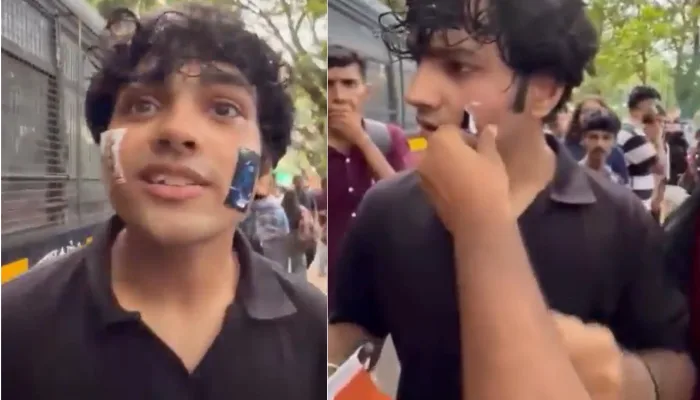
Case Summary
Hindu faith was deliberately mocked and ridiculed during the series of protests organised by the Cockroach Janata Party (CJP), which began at Jantar Mantar in Delhi and spread to several states across India. During one such protest march held in Mumbai, Maharashtra, around 20–21 July 2026, a protester identified as Adarsh Tiwari was seen with stickers depicting the Hindu deities Lord Hanuman and Lord Shiva pasted on both sides of his cheeks. The sacred images of Hindu deities were displayed in a manner that drew the attention of local Hindus present at the protest site. A video of the incident subsequently circulated on social media, bringing the matter to wider public attention. In the viral video, Adarsh Tiwari was confronted by local Hindus, who questioned why he had pasted the images of Lord Hanuman and Lord Shiva on his cheeks. In response, he mocked that the stickers had been applied for "protection" against possible police action during the protest. His explanation was met with objections from local Hindus, who considered using sacred images of revered Hindu deities for such a purpose disrespectful. They objected to the portrayal of Hindu religious symbols as protective props in the context of a political demonstration and demanded that he remove the stickers immediately. Following the confrontation, Adarsh Tiwari removed the stickers depicting Lord Hanuman and Lord Shiva from both sides of his cheeks in the presence of those confronting him. After removing the stickers, local Hindus sent him away from the protest site. No physical violence was reported during the confrontation, and the incident concluded after the stickers were removed and he left the location. The incident reflected the broader ideological trajectory of the Cockroach Janata Party (CJP), whose public campaigns had increasingly shifted from education-related demands towards rhetoric perceived by many as hostile to Hindu symbols, traditions, and religious identity. Critics argued that forcing a man to leave a public protest because he wore saffron bore no relation to the movement's stated demands and instead amounted to intimidation directed at a person displaying a symbol closely associated with the Hindu faith. Notably, the Cockroach Janata Party (CJP) emerged in mid-May 2026 as a satirical, youth-led online movement that rapidly transformed into a mass mobilisation platform for students and unemployed graduates through social media engagement. It was founded by Abhijeet Dipke, a member of the Aam Aadmi Party (AAP), who repurposed a controversial public remark comparing unemployed youth to "cockroaches" as a symbol of collective identity and protest. While Dipke initially portrayed the CJP movement as a genuine, non-partisan, and constitutionally aligned initiative demanding educational reforms, accountability for the National Eligibility cum Entrance Test (NEET) examination paper leak, and the resignation of officials, including the Union Education Minister, the movement soon diverged from its stated objectives. Rather than remaining focused on systemic reforms, it evolved into an ideologically driven campaign characterised by anti-Hindu rhetoric. Its co-founders and participants made derogatory remarks about Hindu deities and religious slogans such as "Jai Shri Ram", abused the Hindu community, raised overtly pro-Islamic slogans such as "Naam rahega Allah ka", "Naara-e-Taqbeer, Allahu Akbar", and increasingly directed their hostility towards Hindu organisations, activists, and the government, which they described as a "Hindutva-led government". By the time it culminated in its first major street-level protest at Jantar Mantar on 6 June 2026, the movement had shifted from a purported students' rights campaign into an overtly anti-Hindu platform. On 6 June 2026, Dipke flew in from the United States to lead the movement's first major street-level protest at Jantar Mantar. AAP-aligned figures attended the event under the guise of being neutral, anti-establishment voices. However, contrary to its stated claim of being a student advocacy movement focused on systemic failures, the CJP's conduct at Jantar Mantar told a starkly different story.
Why it is Hate Crime ?
The primary category for this case is: Attack on Hindu religious representations. The subcategory for this case is: Desecration of a Hindu religious symbol. Icons and symbols or a religious representation of a spiritual ideal are widely revered in Hinduism. Iconography is of vital significance in the Hindu milieu. It helps connect people’s spiritual beliefs with the real world. Iconography within the Hindu faith takes several shapes and forms. Murtis are of most significance to Hindus, to which daily rituals, prayers and offerings are done. Besides the murtis, there are several other symbols which have deep significance in the Hindu faith – the Om and Swastika for example. Since these Hindu religious symbols hold paramount importance in Hinduism, any desecration of symbols, icons, murtis, religious representations and manifestations is driven by animosity towards the faith itself, which manifests itself through these murtis, icons and symbols. Therefore, any desecration of these Hindu religious symbols and representations is considered religiously motivated hate crimes under this category. The other subcategory for this case is: Iconoclastic representation of Hindu Gods/Goddesses. An icon is a symbol of someone or something that is revered, or a religious representation of a spiritual ideal. Iconography is of vital significance in the Hindu milieu. It helps connect people’s spiritual beliefs with the real world. Iconography within the Hindu faith takes several shapes and forms. Murtis are of most significance to Hindus, to which daily rituals, prayers and offerings are done. Besides the murtis, there are several other symbols which have deep significance in the Hindu faith – the Om and Swastika for example. Any iconoclastic representation of these symbols, images and murtis is an affront to the religious beliefs and faith of the Hindu community itself since the symbols and icons are deeply religious in nature. In this sub-category of crime, we would record hate crimes and iconoclastic representations, in words, art, or any other form of representation of symbols that hold religious significance for the Hindu community. Since these symbols, icons and murtis are central to the Hindu faith, any iconoclastic representation of these symbols is born out of animosity towards the faith itself, manifesting itself through these symbols, and therefore, these representations would be considered religiously motivated hate crimes. Lord Hanuman and Lord Shiva are among the most revered deities in Hinduism, and their representations hold profound religious and spiritual significance for Hindu devotees. Images and symbols associated with Hindu deities are not merely artistic or decorative representations but are objects of reverence intrinsically linked with worship, devotion, religious practice, and the expression of Hindu identity. Consequently, the use of such sacred representations in a manner that diminishes their sanctity, trivialises their religious importance, or divorces them from their intended religious purpose constitutes an attack on Hindu religious sentiments and undermines the respect accorded to these revered figures within the Hindu faith. In this incident, images of Lord Hanuman and Lord Shiva were used as stickers placed on the cheeks of a protest participant during the NEET protest march in Mumbai, Maharashtra. According to the participant's own explanation, the stickers were affixed for "protection" against possible police action during the demonstration. By employing sacred representations of revered Hindu deities as protective props in the context of a political protest, the images were removed from their traditional religious context and repurposed for an entirely unrelated purpose, which was, in essence, mocking. By using sacred representations of Lord Hanuman and Lord Shiva as protective props during a political protest, the accused mockingly used revered Hindu religious symbols, thereby ridiculing the faith and devotion of Hindu worshippers. The use of these sacred images in such a manner was a trivialisation of Hindu religious symbols. Hindu religious representations derive their significance from their association with faith, rituals, and devotion, and their use as personal shields or protest-related objects disregarded the religious value attached to them. The act was therefore disrespectful towards the deities represented and an affront to the sentiments of devotees who hold these figures sacred. By appropriating revered Hindu religious symbols for a purpose unrelated to religion and in a manner that diminished their sanctity, the incident amounted to an attack on Hindu religious representations and caused offence to members of the Hindu community. The incident gained wider attention after the video circulated on social media, prompting objections from local Hindus who demanded the immediate removal of the stickers. The public outrage and the subsequent removal of the images demonstrated that the act was extremely disrespectful towards Hindu religious symbols, causing offence to devotees. The reaction underscored the deep religious sensitivity attached to representations of Lord Hanuman and Lord Shiva and highlighted the importance of treating such sacred images with due respect in public spaces. Such incidents highlight the broader concern surrounding the casual or deliberate misuse of Hindu religious representations in public spaces. Sacred symbols and images associated with Hindu deities carry deep spiritual and cultural significance for devotees, and their use in contexts that diminish or ridicule their religious value can cause widespread hurt and distress within the Hindu community. The repeated occurrence of such instances reflects the need for greater sensitivity towards religious symbols and the importance of respecting representations that form an integral part of Hindu faith and identity. The context in which these remarks were made further demonstrated the targeted nature of the offence. The incident occurred during a Cockroach Janata Party (CJP) protest that was presented as a movement concerning students' rights and educational reforms. However, the protest platform became a setting where repeated anti-Hindu remarks, derogatory statements, and attacks on Hindu religious symbols were expressed. This demonstrated that the mocking of Hindu deities in this context not an isolated occurrence or merely an individual remark detached from its surroundings, but part of a broader pattern of hostility directed towards Hindu religious identity. For these reasons, the incident has been documented under the category of Attack on Hindu religious representations, with the subcategory of Desecration of Hindu religious symbol. Disclaimer: The Hinduphobia Tracker records the date on which the incident occurred rather than the date on which it was reported or uploaded on social media. In this case, the exact date on which the incident involving the pasting of stickers depicting Lord Hanuman and Lord Shiva on the cheeks during the NEET protest march in Mumbai, Maharashtra, took place could not be independently verified. The available information indicates that the protest occurred around 20–21 July 2026, while the video of the incident was uploaded and circulated on social media on 25 July 2026. Accordingly, due to the uncertainty regarding the precise date of the incident, the Tracker has recorded 25 July 2026 as the incident date for documentation purposes, based on the date on which the incident came to public attention through social media.


Case Status
Unknown


Perpetrators Details
Perpetrators
Others
Perpetrators Range
One Person
Perpetrators Gender
male
 Sources




