Ancient Hindu Murugan temple targeted again; CPI(M) leaders break gates to occupy Temple land despite Court proceedings
 Tiruppur, Tamil Nadu, India
  27 July, 2026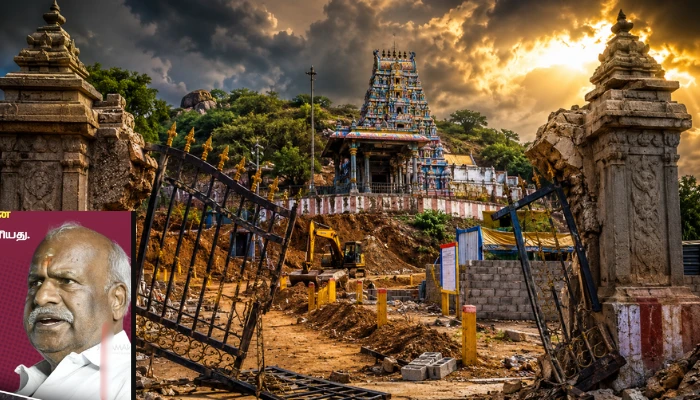
Case Summary
In Tamil Nadu, a 100-year-old Hindu temple's gates were broken by leaders of the Communist Party of India (Marxist) [CPI(M) to occupy the temple land while the ownership dispute was pending before the court. The incident followed an earlier episode in January 2026, when the temple was encroached upon, and the idol of Lord Murugan was removed from the shrine. The incidents sparked protests from Hindu organisations, which demanded legal action against those involved and criticised the police for failing to protect the temple and its property. According to reports, the Kumaran Kundru Murugan Temple, located in Tiruppur district, is a more than 100-year-old Hindu temple situated on Kumarankundru hill. The temple complex includes shrines dedicated to Lord Murugan, Lord Vinayagar, a Sivalingam, and Nandi, making it an important place of Hindu worship for devotees in the region. The temple land later became the subject of a legal dispute, which remained pending before the court. The dispute escalated in January 2026 when CPI(M) members broke the temple's lock and entered the premises. During the incident, they removed a more than 100-year-old idol of Lord Murugan from the temple. The incident triggered widespread concern among local Hindu devotees. Following the demolition, the devotees moved the court to seek legal recourse. The matter remained sub judice, and the court had explicitly issued directions that a decision should be taken only after the court inquiry. Despite these directions, the CPI(M) functionaries, including the party's Tamil Nadu State Secretary K. Shanmugam, again entered the temple premises along with supporters. They broke open the temple's entrance gates and attempted to take possession of the temple land, despite the ownership dispute remaining pending before the judiciary. Following the incident, Hindu Munnani strongly condemned the attempt to occupy the temple land and demanded that the Tamil Nadu government initiate legal proceedings against all those involved, including CPI(M) State Secretary K. Shanmugam. The organisation stated that the actions amounted to a deliberate attempt to encroach upon temple property despite the matter being before the court. It further demanded that the state government ensure the protection of the temple and prevent any further attempts to interfere with its land or places of worship. Hindu Munnani also criticised the Tamil Nadu Police, stating that the department failed to prevent both the January incident, during which the temple lock was broken and the idol of Lord Murugan was removed, and the subsequent incident in which the temple gates were broken during an attempt to occupy the temple land. The organisation described the police's inaction as negligent and called upon the authorities to safeguard the temple premises, protect the rights of Hindu devotees, and ensure that the pending judicial process was respected until the court delivered its final decision.
Why it is Hate Crime ?
In this case, the first primary category selected is Attack on Hindu religious representations. Within this, the subcategory selected is: Attack on temples. In Hinduism, a temple is the abode of the Deity. The Deity in the Temple is consecrated, thereby making it a real, breathing entity. Hindus believe that not just the Deity but the temple premises themselves are sacred to Hindus since Hindus hold the faith that the entire Temple space is an amalgamation of the divine energy of the deity. Given the central significance of Temples in Hindu Dharma, any attack against a Hindu Temple or its peripheral premises is an attack on the faith itself and is born out of animosity towards the faith, of which the Temple is a central tenet. Any manner of attack against a Temple and/or its premises would therefore be considered a religiously motivated hate crime. The other sub-category selected is - Encroachment or illicit takeover of temple land/land near temple. In Hinduism, a temple is the abode of the Deity. The Deity in the Temple is consecrated, thereby making it a real, breathing entity. Hindus believe that not just the Deity but the temple premises themselves are sacred to Hindus since Hindus hold the faith that the entire Temple space is an amalgamation of the divine energy of the deity. Not only the Temple but the Temple premises in their entirety are considered sacred by Hindus. In several cases, the premises of the Temple and/or religious centre are illegally taken over by institutions of other faiths – such as the Waqf board or the Church. Other times, the temple property, land or the property of religious centres are illicitly encroached upon by non-Hindu groups. Any illicit takeover or encroachment is a crime an initio; however, when non-Hindu groups illicitly take over or encroach the sacred land of Hindus, it is an affront to the Hindu community and is therefore classified as a religiously motivated hate crime under this category. This case was included in the Hinduphobia Tracker because the accused deliberately broke the temple lock, forcibly entered and occupied the temple land. In Hinduism, temples are not merely physical structures but sacred abodes of the deity, where consecrated murtis are revered as living manifestations of the Divine. The sanctity extends beyond the shrine to the entire temple premises. Consequently, breaking open the temple gates and attempting to occupy the temple land amounted to a direct intrusion into a revered Hindu place of worship and an attack on the religious beliefs associated with it. Such acts struck at the spiritual identity of the temple and the faith of the devotees who worshipped there. The incident also formed part of a continuing course of conduct directed against the same temple. Earlier actions against the temple had already become the subject of judicial proceedings, yet another attempt was made to forcibly enter the premises and occupy the land while the matter remained sub judice. Rather than respecting the judicial process and the sanctity of the temple, the perpetrators continued to interfere with the Hindu place of worship. The failure of the police personnel present at the spot to prevent the forcible entry further enabled this continuing interference with the temple and its sacred premises. Taken together, the perpetrators' conduct revealed a deliberate attempt to assert control over a Hindu place of worship. The repeated interference with the temple, coupled with the disregard shown towards its sanctity and the legal process, reflected a conscious disregard for the religious rights of Hindu devotees. The objective was not merely to enter disputed land but to interfere with a sacred Hindu religious institution, making the incident a religiously motivated hate crime against Hindus. Disclaimer: The Hinduphobia Tracker records incident dates based on when the victim's ordeal began rather than the date of media reporting. As the available sources do not specify when the encroachment and related acts began, the date the matter was published in the media was recorded as the incident date for documentation purposes.


Case Status
Unknown


Perpetrators Details
Perpetrators
State and Establishment
Perpetrators Range
One Person
Perpetrators Gender
male
 Sources




