Hindu youth forcefully converted, tortured and fed cow meat by Muslim wife and her relatives commits suicide in Delhi
 Delhi, Delhi, India
  26 July, 2026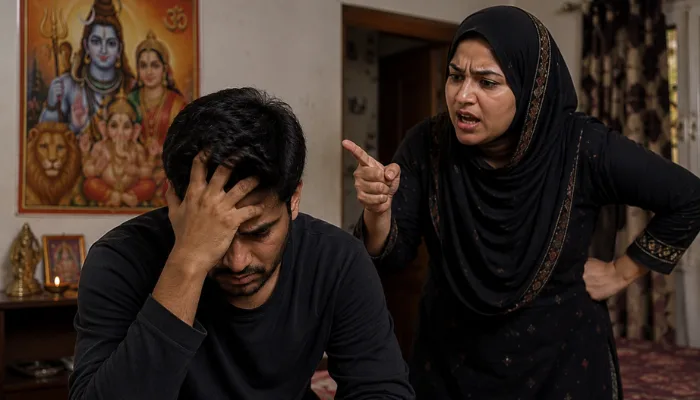
Case Summary
In Delhi, a Hindu youth, Monu, committed suicide after being mentally tortured by his Muslim wife. The deceased was forcefully converted to Islam and pressured into following Islamic principles, such as going to the mosque and doing namaz. He was also force-fed cow meat by his Muslim wife's relatives, who gloated about making him into a 'pakka Musalman' (a devout Muslim). According to his family and neighbours, Monu succumbed to the prolonged religious coercion, harassment, and intimidation that he endured during the two years of his marriage with Aisha Khatun. According to the Hindu victim's neighbours, the Hindu youth had married Aisha Khatun about two years ago in his native village. After the marriage, Aisha's brother took the couple to a mosque, where a 'nikah' ceremony was conducted, and Monu was converted to Islam. The neighbours stated that the Hindu victim remained distressed thereafter and was repeatedly pressured to embrace Islam. They further state that Aisha named their child with a Muslim name, 'Asma ', despite Monu's objections, and that these actions caused him significant mental distress. The neighbours also stated that Monu was forced to consume beef against his wishes, an experience they describe as deeply traumatic for him as a Hindu. On the morning of 27 July, at around 9:00 a.m., the neighbours stated that Aisha's relative, Samir, along with several other men, came to Monu's residence and assaulted him following an altercation. According to those present, after the confrontation ended, Monu told his wife, "You keep calling your relatives to beat me. Now you will see my dead body. Later that day, Monu was found hanging inside the house." According to Monu's family and neighbours, when they attempted to rescue him, Aisha blocked the entrance to the room and warned that anyone who broke open the door would face legal consequences and that she would file false cases against them. Monu's mother was outside the room crying and pleading while efforts were being made to reach him, but Aisha's continuous insistence caused the delay because of which Monu could not be saved. Monu's family and neighbours asserted that the continuous pressure to convert, the circumstances surrounding his marriage, the naming of his child, the assault on the day of his death, and the events immediately before he was found hanging collectively drove him to take his own life. The family maintained that Aisha was aware that Monu would end his life and that she abetted him in suicide. They urged the authorities to investigate the role of Aisha Khatun, Samir, and the others they named in connection with Monu's death. At the time of reporting, the police were treating the case as a simple suicide case. The family, however, demanded that the police investigate the sustained harassment and the events that amounted to abetment of suicide and requested appropriate legal action against Aisha Khatun and her family members.
Why it is Hate Crime ?
The primary category for this case is: Men attacked for being associated with a non-Hindu woman. The first subcategory for this case is: Forced to convert after marriage. The tertiary category for this case is: Forced to follow non-Hindu practices. In such cases, a non-Hindu woman marries a Hindu man, and the force/pressure against the Hindu man to convert to Islam begins after marriage. In such cases, the marriage is consensual in most cases, and often, there is no element of the non-Hindu woman hiding her religious identity. The marriage could be under the Special Marriages Act where neither party is required to convert their religion for the marriage to be considered legitimate. While the victim in such cases enters matrimony assuming that religious identity is not a barrier, the non-Hindu woman starts to pressure the Hindu man to convert to Islam after marriage. In such cases, there is application of force/pressure by the perpetrator, including denial of the man’s religious rights. Some of the means by which the man is forced/pressured to convert include forcing/pressurizing the man to involuntarily consume beef, pressurizing/forcing to read the Kalma, forced circumcision, forced to go to the mosque, etc. There are several instances where, after marriage, the man voluntarily converts to Islam. Such cases are often argued to be a result of religious brainwashing; however, for the purpose of documenting religiously motivated hate crimes, in the absence of the victim complaining of forced conversion, such cases do not form a part of the database. The next subcategory for this case is: Attacked by non-Hindu partner or/and her family. When Hindu men are in a relationship with non-Hindu women, there are cases where the man is forced to convert his religion, and upon his refusal to do so, the partner or/and her family attacks the victim. Such relationships may be consensual, with the religious identity of the non-Hindu woman known to the victim. Somewhere along the relationship, the non-Hindu woman or her family starts forcing/pressurizing the Hindu man to convert. In some of these cases, the association could be non-consensual as well, or the religious identity of the non-Hindu woman could be previously unknown to the Hindu victim. In such cases, the Hindu man is first forced/pressurized to change his religion by the non-Hindu woman or her family. The force/pressure could involve threats. The trigger for directing violence against the Hindu man is, in these cases, his refusal to comply and change his religion under threat and/or force. In other cases that have been documented, it is also seen that the Hindu partner is assaulted by the non-Hindu woman or her family simply for his relationship with the non-Hindu woman and by virtue of him following the Hindu faith and not the religion of the non-Hindu woman. In such cases, the relationship is consensual in most cases, and the religion of both partners is known to the other. Often, in such cases, there is no direct force/pressure to convert either; however, the attack is a result of the Hindu man being in a relationship with the non-Hindu partner and not following her religion/following Hinduism specifically. Such cases are driven by specific religious motivations and against the religious identity of the victim and are therefore qualified as hate crimes. The last subcategory for this case is: Suicide upon being forced to convert. When Hindu men are in a relationship with non-Hindu women, there are cases where the Hindu man faces pressure/threats/violence to convert and change his religious identity by the non-Hindu spouse or her family or/and religious leaders. Such relationships may be consensual, with the religious identity of the non-Hindu spouse known to the victim. Somewhere along the relationship, the non-Hindu spouse starts forcing/pressurizing the Hindu man to convert. In some of these cases, unable to bear the pressure/threat/violence being mounted by the non-Hindu partner or her family to convert, the Hindu man commits suicide. In such cases, often, threats are also given to the family members of the Hindu man. Since such cases are driven by specific religious motivations and against the religious identity of the victim, leading to the Hindu spouse committing suicide, these cases are categorised as hate crimes. This incident has been categorised as a religiously motivated hate crime because the abuse directed at the victim was intrinsically tied to his Hindu religious identity. The facts of the case reveal a sustained pattern of religious coercion aimed not merely at influencing his personal beliefs but at replacing his Hindu identity with an Islamic one. Following his marriage, he was converted to Islam through a nikah ceremony and thereafter pressured to conform to Islamic religious practices by visiting the mosque and offering namaz. Such acts go beyond interpersonal or marital disputes; they represent a systematic attempt to compel a person to abandon his own faith and adopt another religion. The coercion extended beyond religious rituals and into practices that directly violated the victim's Hindu beliefs. He was forced to consume cow meat despite it being strictly against the sacred beliefs of many Hindus, while his wife's relatives boasted that they had turned him into a "pakka Musalman." Forcing a Hindu to consume beef is not merely an act of physical compulsion but one that deliberately targets deeply held religious convictions. Likewise, celebrating his transformation into a "devout Muslim" underscores that the objective was not simply conversion in name but the complete erasure of his previous Hindu identity. The pressure also extended to the victim's family life. Despite his objections, his child was given a Muslim name, reinforcing the broader effort to impose an Islamic identity upon the family. Apart from all this, he was subjected to physical violence and intimidation for refusing to give up his faith. Viewed together, the forced conversion, pressure to practise Islam, compulsion to consume beef, celebration of his religious transformation and physical violence reveal a consistent pattern of targeting the victim because he was Hindu. These were not isolated incidents but interconnected acts directed at dismantling his religious identity and replacing it with another. The incident ultimately culminated in the victim taking his own life after enduring prolonged religious coercion, intimidation, and harassment. The sequence of events demonstrates that the targeting of his faith was not incidental but lay at the heart of the abuse he endured. It is important to mention here that the main motivation to commit such crimes is the indoctrination by Islamic theology, which advocates that all non-Muslims (referred to as kafirs) are inferior and subject to subjugation unless they convert to Islam or live under Islamic rule (dhimmitude). These ideas are not mere abstractions; they manifest in actions where non-Muslims, especially Hindus in India, are seen as targets for religious domination, coercion, or humiliation. This theological framework fosters an "us versus them" mindset, in which any assertion of Hindu identity or religious freedom is seen not only as undesirable but as a threat to Islamic supremacy. As a result, perpetrators who are shaped by such teachings feel justified, even morally obligated, to harass, suppress, or violently attack Hindus, particularly when Hindus assert their religious rights or resist conversion. As a result, Muslim perpetrators invoke such doctrines to justify coercive attempts to convert non-Muslims, particularly Hindus, portraying conversion as a means of abandoning Kufr (a state of disbelief in Islam or disbelief in Islam) and attaining salvation. Such acts, therefore, are not isolated but driven by a broader ideological hostility towards Hindus as non-believers and reflect an attempt to impose religious dominance. Since this case was also not a random isolated incident of conversion of a Hindu but a premeditated attack motivated by bias and hatred against the Hindu community, which is a defining feature of hate crimes, this has been added to the tracker.
Victim Details
Total Victim
1
Deceased
1
Gender
- Male 1
- Female 0
- Third Gender 0
- Unknown 0
Caste
- SC/ST 0
- OBC 0
- General 0
- Unknown 1
Age Group
- Minor 0
- Adult 1
- Senior Citizen 0
- Unknown 0


Case Status
Complaint filed


Perpetrators Details
Perpetrators
Muslim Extremists
Perpetrators Range
From 2 To 5
Perpetrators Gender
both
 Sources




