Hindu woman sexually harassed under guise of infertility treatment; pressured to convert to Islam by Muslim cleric
 Muzaffarnagar, Uttar Pradesh, India
  24 July, 2026
Case Summary
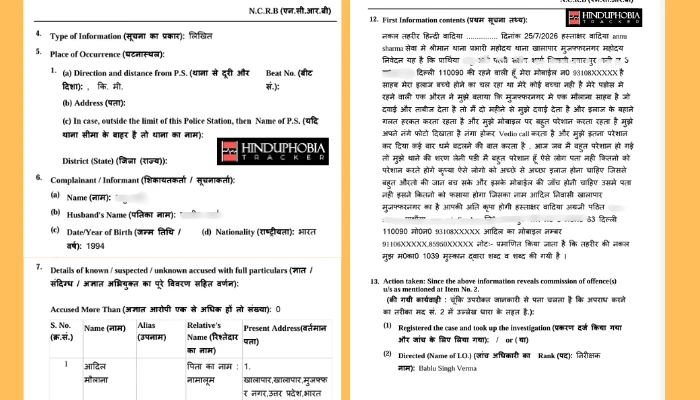
In Uttar Pradesh, Muzaffarnagar, a married Hindu woman from the Dayalpur area of Delhi was sexually harassed and pressured to convert to Islam by a Muslim cleric identified as Maulana Adil. The accused, a resident of Khalapar in Muzaffarnagar district of Uttar Pradesh, lured the victim by claiming that he treated childless couples through indigenous remedies. After the victim approached him for infertility treatment, he sexually harassed her under the pretext of administering treatment, repeatedly contacted her through phone and video calls, sent her objectionable photographs, made immoral demands, gave her a taweez, and pressured her to embrace Islam. Following the victim's complaint, the Khalapar police registered an FIR against the accused. Following the registration of the FIR, the team at Hinduphobia Tracker secured a copy of the First Information Report (FIR), which confirmed the victim’s identity. It also corroborated the victim's complaint that she was sexually harassed and pressured to convert to Islam under the guise of infertility treatment. According to media reports, the victim, a resident of Dayalpur in Delhi, had been undergoing treatment for infertility for a considerable period but had been unable to conceive. During this time, a woman living in her neighbourhood informed her about Maulana Adil, stating that he treated childless couples through traditional indigenous remedies. Trusting this recommendation, the victim travelled to Khalapar in Muzaffarnagar and had been receiving treatment from the accused for the past two months. During the course of the treatment, the accused sexually harassed the victim under the pretext of administering medicine. When she objected to his actions, he told her that his conduct was an essential part of the treatment. Thereafter, he repeatedly contacted her on her mobile phone, sent nude and objectionable pictures and demanded that she too send her pictures. He even gave her a taweez, pressured her to convert to Islam, made video calls while standing in an objectionable condition and subjected her to sustained mental harassment. Based on the victim's complaint, the Khalapar police registered an FIR against Maulana Adil. Station House Officer Bablu Kumar Verma stated that a case had been registered and that police had launched a search to trace the accused. At the time of writing this report, police were searching for the accused, and further investigation into the case remained ongoing.
Case Images
Why it is Hate Crime ?
This case has been added to the tracker under the primary category of Predatory proselytisation. Within it, the sub-category selected is: Harassment, threats, coercion for conversion. Harassment covers a wide range of behaviours of an offensive nature. It is commonly understood as behaviour that demeans, humiliates, and intimidates a person, including threats and coercion. Harassment and threats, in this case, find their root in discriminatory grounds which have the effect of nullifying a person’s rights or infringing upon his freedom to exercise his right specifically owing to the victim’s religious identity. Verbal and physical threats and psychological or physical harassment are often used against Hindu victims because they choose to practice their professed religion. Religious harassment also includes forced and involuntary conversions by harassment, threats or coercion. Coercion includes intimidatory tactics like force-feeding a Hindu victim beef to convert to another religion, forceful circumcision, etc. In several cases documented, non-Hindu perpetrators or those who harbour specific animosity towards Hinduism harass victims simply based on their religious identity. Such cases often also include harassment to ensure the Hindu victim abandons his/her professed religion and adopts the religion of the perpetrator. Such cases where Hindu victims are harassed to convert to the perpetrator’s religion are rooted in animosity towards the victim’s religious identity and are therefore documented as religiously motivated hate crimes. The second sub-category selected is - Proselytisation by grooming, brainwashing, manipulation or subtle indoctrination, with the tertiary category being - Rape and sexual assault/harassment. Religious brainwashing essentially means the often subtle and forcible indoctrination to induce someone to give up their religious beliefs to accept contrasting regimented ideas. Religious grooming or brainwashing also involves propaganda and manipulation. It involves the systematic effort, driven by religious malice and indoctrination, to persuade “non-believers’ to accept allegiance, command, or doctrine to and of a contrasting faith. Cases of such grooming or brainwashing are far more nuanced than direct threats, coercion, inducement and violence. In such cases, it is often seen that there is repeated, subtle and continual manipulation of the victim to induce disaffection towards their own faith and acceptance of the contrasting faith of the perpetrator. While subtle indoctrination is widely acknowledged as predatory, an element which is often understated in such conversions or the attempts of such conversion is the role of loyalty and trust which might develop between the perpetrator and the victim. Fiduciary relationships are often abused to affect such religious conversion. For example, an educator transmitting religious doctrine of a competing faith to a Hindu student. The Hindu student is likely to accept what the teacher is transmitting owing to the existence of the fiduciary relationship. The exploitation of the fiduciary relationship to religiously indoctrinate victims would also be included in this category. Since the underlying animosity towards the victim’s faith forms the basis of predatory proselytisation, such cases are considered religiously motivated hate crimes. This case was classified as a religiously motivated hate crime because a Hindu woman was targeted for religious conversion through deception, sexual exploitation, and sustained psychological pressure. The attempt to replace the victim's Hindu identity with Islam was not incidental to the offence but formed a central element of the accused's conduct. The victim had approached the accused solely for infertility treatment, yet the interaction was converted into an opportunity to pressure her to abandon her professed faith. As such, her Hindu identity became integral to the offence, warranting its inclusion in the Hinduphobia Tracker. The accused initially targeted the victim by exploiting her emotional vulnerability, knowing that she was desperately seeking treatment to conceive a child. By portraying himself as someone capable of curing childless couples through traditional remedies, he carefully cultivated the victim's trust and encouraged her to rely on him. Once he had gained her confidence and lowered her defences, he began pressuring her to convert to Islam while simultaneously abusing the position of trust he had deliberately created. Rather than confining his role to the purpose for which he had been approached, he transformed the relationship into a means of influencing the victim's religious identity. This calculated misuse of a fiduciary relationship demonstrated that the promise of healing was merely a tool to facilitate religious conversion, not an act directed towards the victim's welfare. Furthermore, the persistent pressure to accept a taweez, repeated communication, and continued attempts to influence the victim's religious choices reflected a sustained process of manipulation rather than an isolated act. Religious conversion achieved through exploitation of trust and emotional vulnerability cannot be regarded as an exercise of free and informed choice. Instead, it amounted to a deliberate attempt to weaken the victim's attachment to her Hindu faith and replace it with another religion through psychological influence. Such conduct infringed upon her freedom of conscience and demonstrated a conscious disregard for her right to practise and retain her professed religion. The sexual harassment also formed an integral part of this pattern of exploitation. It was committed within the very relationship that the accused had established by portraying himself as a healer and spiritual guide. The abuse of that position increased the victim's vulnerability and reinforced the broader process of coercion and control. Rather than being an isolated act of sexual misconduct, it became intertwined with the attempt to influence the victim's religious identity, making both forms of exploitation inseparable in the context of the offence. Cases documented by the Hinduphobia Tracker have frequently shown that such conduct follows a recognisable pattern. Once a victim succumbs to sustained pressure, manipulation, or coercion, the perpetrator often proceeds to secure the victim's religious conversion before exerting further pressure to marry. Conversion and marriage frequently operate as the final stages of the process, enabling the perpetrator to consolidate control over the victim while making it more difficult for her to resist, leave the relationship, or report the abuse. Although this sequence had not progressed to those later stages in the present case, the accused's conduct reflected the same pattern of grooming, exploitation, and sustained pressure that has repeatedly preceded such outcomes in similar incidents documented by the Hinduphobia Tracker. The sequence of deception, abuse of trust, sexual exploitation, and sustained pressure to embrace Islam revealed a deliberate course of conduct aimed at exploiting a Hindu woman's vulnerability to secure her religious conversion. The accused's actions demonstrated a conscious disregard for the victim's Hindu identity and her right to practise her faith without coercion or manipulation. For these reasons, the incident constituted a religiously motivated hate crime and has been included in the Hinduphobia Tracker's database. Disclaimer: The available news reports do not specify the exact dates on which the victim first approached the accused for treatment, was subjected to sexual harassment, or faced pressure to convert to Islam. They only establish that the FIR was registered on 25 July 2026 following the victim's complaint. Accordingly, the precise commencement and chronology of the offences could not be determined from the available sources. Hence, 25 July 2026, the date on which the FIR was lodged, was selected as the indicative incident date in the Hinduphobia Tracker.
Victim Details
Total Victim
1
Deceased
0
Gender
- Male 0
- Female 1
- Third Gender 0
- Unknown 0
Caste
- SC/ST 0
- OBC 0
- General 1
- Unknown 0
Age Group
- Minor 0
- Adult 1
- Senior Citizen 0
- Unknown 0


Case Status
Complaint filed


Perpetrators Details
Perpetrators
Muslim Extremists
Perpetrators Range
One Person
Perpetrators Gender
male
 Sources




