Hindu students compelled to study Islamic studies at a public university in Kushtia amidst rising attacks on Hindu minorities in Bangladesh
 Kushtia District, Bangladesh
  25 April, 2025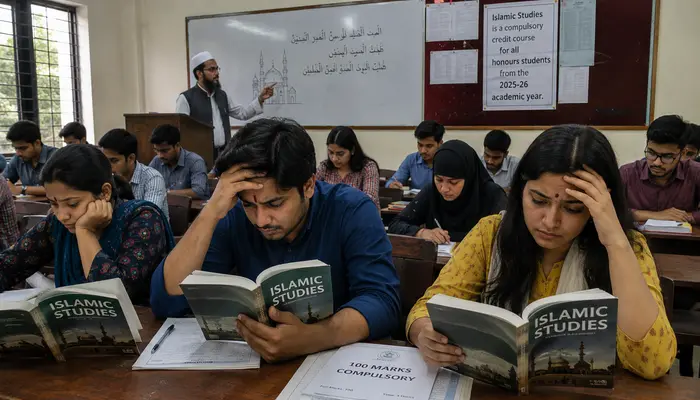
Case Summary
Hindu students at the Islamic University, a public university, in Kushtia, Bangladesh, were compelled to undertake a compulsory Islamic Studies course. This occurred after the university made the subject mandatory for all honours-level students, irrespective of their religious affiliation, from the 2025–26 academic session. The decision required Hindu students to study Islam despite belonging to a different faith, prompting widespread opposition from Hindu students and teachers. They stated that the move infringed upon their religious freedom and equal rights. The decision originated during the 130th meeting of the university's Academic Council held on 26 April 2025, when it approved in principle the introduction of Bangladesh Studies and Islamic Studies as compulsory 100-mark credit courses for all undergraduate departments from the 2025–26 academic year. After no written amendments were submitted to the meeting minutes, the Academic Council formally approved the proposal on 1 November 2025. Although several members voiced objections during the discussions, these concerns were not reflected in the final resolution. The university subsequently prepared separate syllabi for the compulsory courses across all departments. Following the final approval, Hindu students and teachers objected to the decision, stating that it was unjust to compel followers of one religion to study the teachings of another as a mandatory academic requirement. They submitted repeated written objections to the university administration, including the then Vice-Chancellor, Professor Dr Naqib Mohammad Nasrullah, urging the authorities to withdraw the compulsory Islamic Studies course for Hindu and other non-Muslim students. Despite discussions between the Vice-Chancellor, the student adviser and administrative officials, the university refused to reverse its decision and instead instructed departments to proceed with implementing the course. As the university administration maintained that the decision could only be reversed through another meeting of the Academic Council, no immediate changes were made. In response, the university's Puja Udjavan Parishad, along with Hindu and other non-Muslim students, organised a human chain protest. They also submitted a memorandum to the newly appointed Vice-Chancellor, demanding that the compulsory Islamic Studies course be reconsidered. The protesting Hindu students and teachers clarified that they were not opposed to any religion or to the study of religions. However, they argued that compelling Hindu students to undertake a compulsory Islamic Studies course was discriminatory and inconsistent with the principles of religious freedom, equality and mutual respect. They maintained that while Bangladesh Studies, as a national and civic subject, could remain compulsory for all students, Hindu students should not be forced to study Islamic Studies. Instead, alternative arrangements should be made that respected the religious identity and beliefs of non-Muslim students. Despite sustained objections, the university continued preparations to implement the policy. Following the completion of admissions for the 2025–26 academic session, classes were scheduled to commence in August 2026. Since the Academic Council had not withdrawn its earlier decision, all newly admitted students, including Hindu students, were required to register for and undertake the compulsory Islamic Studies course. University officials and students warned that even if the decision were reversed later, compelling students to register first would create avoidable academic and administrative complications. Several university officials and students pointed out that the previous system had not generated any controversy. Earlier, Bangladesh Studies and Islamic Studies had been taught in Bengali as non-credit subjects. Muslim students studied Islamic Studies, while Hindu and other non-Muslim students studied Bangladesh Studies. According to those concerned, the new policy abandoned this arrangement by compelling Hindu students to study Islamic Studies regardless of their religious identity. Hindu students, including Pooja Das, Panchami Dev and Shipan Nath, stated that studying different religions out of personal interest was acceptable and common. However, they stressed that forcing followers of one religion to study the religious history and teachings of another as a compulsory subject was inappropriate. Pankaj Roy, Vice-President of the university's Puja Udjavan Parishad, stated that the decision hurt the sentiments of Hindu and other non-Muslim students because the university admitted students from diverse religious backgrounds, not only Muslims. He said that repeated objections had already been raised and warned that further protests would be organised if the decision was not withdrawn. Teachers within the university also questioned the policy during faculty meetings. According to one faculty member, university authorities justified the compulsory course by arguing that, as a specialised Islamic university, it was appropriate to require all students to study Islam, drawing comparisons with specialised universities that offered courses related to their founding themes. When concerns were raised regarding Hindu students, the administration responded that Islamic beliefs would not be imposed on them, but that Islamic concepts and perspectives would nevertheless form part of the compulsory curriculum. The university later confirmed that the Islamic Studies course would be taught in English, although discussions continued over whether a common syllabus would be adopted across all departments or separate departmental syllabi would be retained. Responding to the controversy, the current Vice-Chancellor, Dr AKM Matinur Rahman, stated that the matter would be placed before the next meeting of the Academic Council for reconsideration. Educationist Dr Manzur Ahmed also said that while an Islamic university could prioritise Islamic education, it should ensure that followers of other religions, including Hindus, were neither neglected nor made to feel marginalised or disrespected. This incident occurred against the backdrop of the continued persecution and insecurity faced by the Hindu minority community in Bangladesh throughout 2025, following the political upheaval triggered by the ouster of Sheikh Hasina's government on 5 August 2024. During 2025, Hindus continued to face targeted attacks on their homes, temples, businesses, and religious institutions, alongside incidents of intimidation, vandalism, physical assaults, land encroachments, forced displacement, and other forms of religiously motivated hostility. The recurring nature of these incidents created an atmosphere of fear and vulnerability within the Hindu community, with many facing discrimination and threats solely because of their religious identity. The Hinduphobia Tracker documented numerous such incidents against the Hindu minority during 2025, underscoring the persistence of anti-Hindu hostility and the continued challenges faced by Bangladesh's Hindu community.
Why it is Hate Crime ?
The primary category selected in this case is: Predatory Proselytisation. The subcategory selected is: Proselytisation by grooming, brainwashing, manipulation or subtle indoctrination. Religious brainwashing essentially means the often subtle and forcible indoctrination to induce someone to give up their religious beliefs to accept contrasting regimented ideas. Religious grooming or brainwashing also involves propaganda and manipulation. It involves the systematic effort, driven by religious malice and indoctrination, to persuade “non-believers’ to accept allegiance, command, or doctrine to and of a contrasting faith. Cases of such grooming or brainwashing are far more nuanced than direct threats, coercion, inducement and violence. In such cases, it is often seen that there is repeated, subtle and continual manipulation of the victim to induce disaffection towards their own faith and acceptance of the contrasting faith of the perpetrator. While subtle indoctrination is widely acknowledged as predatory, an element which is often understated in such conversions or the attempts of such conversion is the role of loyalty and trust which might develop between the perpetrator and the victim. Fiduciary relationships are often abused to affect such religious conversion. For example, an educator transmitting religious doctrine of a competing faith to a Hindu student. The Hindu student is likely to accept what the teacher is transmitting owing to existence of the fiduciary relationship. The exploitation of the fiduciary relationship to religiously indoctrinate victims would also be included in this category. Since the underlying animosity towards the victim’s faith forms the basis of predatory proselytization, such cases are considered religiously motivated hate crimes. This case is a clear example of a religiously motivated incident targeting the religious freedom of Hindu students because they were systematically compelled to study Islamic Studies against their wishes at the Islamic University in Kushtia, Bangladesh. Forcing Hindu and other non-Muslim students to undertake a compulsory, graded course centred on a religion they did not practice or profess violated their freedom of conscience, thought and belief. By making Islamic Studies a mandatory 100-mark credit course required for academic progression, the university used its institutional authority to compel Hindu students to study, attend and be assessed on the teachings of another faith. This went beyond ordinary academic policy and subjected Hindu students to religious coercion by making compliance with a religion-specific curriculum a condition for completing their degree. The discriminatory nature of the policy became even more apparent because Hindu students had previously studied Bangladesh Studies while Muslim students studied Islamic Studies under a separate non-credit arrangement. That longstanding system was abandoned in 2025 when the university resolved to make Islamic Studies a compulsory credit-bearing subject for all honours students. As a result, Hindu students lost the option to study an alternative subject and were required to pass Islamic Studies in order to qualify academically, placing them at a disadvantage solely because of their religious identity. Forcing Hindu students to repeatedly undertake a compulsory course outside their religious beliefs amounts to essential indoctrination and religious proselytisation. Compelling students to continuously engage with and be evaluated on Islamic history, theology, and doctrine under administrative duress is a coercive effort aimed at stripping them of their faith and distinct identity. Placing Hindu students in a captive educational environment where they must absorb foreign religious teachings forces an external theological framework upon them, attempting to systematically erode their religious and spiritual autonomy. The unequal power dynamic in this case further aggravated the impact on Hindu students. As the university exercised complete control over academic progression, degrees and future career prospects, Hindu students had little practical choice but to comply with the compulsory course if they wished to continue their education. By refusing to provide an alternative academic pathway, the university effectively forced Hindu students to choose between adhering to their religious convictions and fulfilling mandatory academic requirements. This case is ultimately a clear case of a religiously driven hate crime because such institutional mandates are designed to inculcate Islamic behaviour onto Hindu students to subtly indoctrinate them over time. By forcing Hindu students to align with Islamic academic requirements, the policy worked to gradually disassociate them from their own heritage, traditions, and faith, turning them into potential prospects for conversion. Weaponising university regulations to impose mandatory religious education on a vulnerable minority reflects a clear intent of systemic hostility and religious coercion aimed at marginalising Hindu students. The fact that this incident occurred during the continued persecution of Hindus in Bangladesh throughout 2025, following the ouster of Sheikh Hasina's government on 5 August 2024, further underscores its seriousness. During this period, Hindus continued to face attacks on their homes, temples, businesses and religious institutions, alongside intimidation and violence because of their religious identity. Viewed against this backdrop, this incident was not an isolated occurrence but formed part of a broader pattern of anti-Hindu hostility and persecution, reinforcing the conclusion that it was motivated by religious bias against the Hindu community. Taken together, these actions demonstrate how institutional authority was used to compel Hindu students to undertake compulsory religious instruction outside their own faith as a condition of their education. The policy disproportionately burdened Hindu students and raised serious concerns regarding religious freedom, equality and non-discrimination within a higher educational institution. Therefore, this case is being added to the hate crime database of the Hinduphobia Tracker. Disclaimer: The Hinduphobia Tracker records incident dates based on when the victim's ordeal or the discriminatory action begins, rather than when it is reported by the media. Although media reports regarding this case came to light on 27 July 2026, the incident has been recorded based on the date the discriminatory policy was first adopted. Since the resolution making Islamic Studies a compulsory subject was passed on 26 April 2025, this date has been selected as the indicative incident date.


Case Status
Complaint not filed


Perpetrators Details
Perpetrators
State and Establishment
Perpetrators Range
Unknown
Perpetrators Gender
unknown
 Sources




