Hindu temple's sanctity desecrated after Muslims perform Islamic rituals inside its premises in Kodagu, Karnataka
 Kodagu, Karnataka, India
  25 July, 2026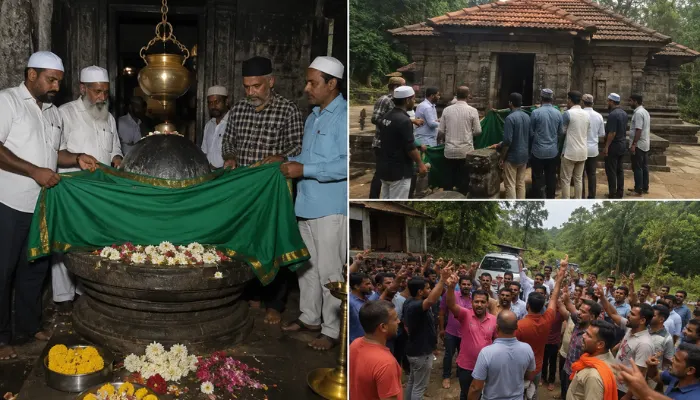
Case Summary
Hindu sentiments were outraged after a group of Muslim men entered the historic Sri Siddeshwara Temple in Kodagu district, Karnataka, on 26th July 2026. Inside the temple premises, they performed the 'Chadar Chadhana' ceremony, an Islamic ritual. The Hindu devotees stated that the act was contrary to the temple's established religious traditions and practices. The incident sparked concern among the local Hindu community and led to protests demanding action against those involved. The incident took place at the historic Sri Siddeshwara Temple situated at Gaddi Betta, in the forested area near Maldare-Mathur in Virajpet taluk of Kodagu district, Karnataka. The temple holds significant religious and cultural importance for devotees from Kodagu and neighbouring districts. Since the shrine is located within a protected forest area, access to the temple was regulated by the Forest Department. On the day of the incident, a group of Muslim men arrived at the temple in a car and entered the temple premises. Inside the temple complex, they performed the 'Chadar Chadhana' ritual by placing a ceremonial chadar, offering flowers, and reciting Islamic prayers within the temple premises. Photographs and videos of the ritual were widely circulated on social media, triggering strong reactions from devotees and local residents. Following the circulation of the visuals, residents and devotees gathered near the temple to protest the incident. Several Hindu organisations also joined the protests, demanding strict action against those responsible. During the protests, demonstrators questioned the Forest Department over access to the protected forest area. They pointed out that ordinary devotees and visitors were required to undergo security checks and obtain permission before entering the forest zone, whereas the Muslim group involved in the ritual was able to drive into the temple premises and perform the ceremony without any intervention. Protesters also highlighted objectionable writing found on Forest Department signboards near the temple and demanded an investigation into whether it was connected to the incident. Following the incident, the police initiated an inquiry to verify the authenticity and timeline of the viral photographs and videos. Investigators began identifying the individuals seen in the visuals, tracing the vehicle used to reach the temple, and recording statements from temple authorities and eyewitnesses. At the time of writing this report, the investigation remained ongoing. Meanwhile, Hindu organisations and local residents demanded the arrest of those involved, legal action for hurting Hindu religious sentiments, and enhanced security measures at the Sri Siddeshwara Temple, including permanent security arrangements and surveillance to safeguard the temple and preserve its established religious traditions.
Why it is Hate Crime ?
The primary category for this case is: Attack on Hindu religious representations. The subcategory for this case is: Breaking rules of a place of worship. Sanatan Dharma is not a religion of one book, which is to say that while it has religious scriptures that form the central tenets of the faith, there are several traditions followed through thousands of years, mostly passed from generation to generation orally. One of these oral traditions or written traditions is the rules of specific temples. Certain temples have rules which are traditional, dependent on the worship of the presiding deities. These rules and traditions have been followed for thousands of years, whether they find scriptural mention or not. Such traditions are based on the nature and rules of worship of the presiding deity of that temple. Any non-compliance with these traditions owing to animosity towards the faith or for the sake of activism stems not only from the lack of faith in the presiding deity but also from disregard for the faith of the devotees of that deity/temple and implicit bias against the faith, the tradition and the deity itself. Since these specific traditions are central to the faith of the devotees of that specific temple and presiding deity, any non-compliance with these traditional rules would be considered a religiously motivated hate crime. The other subcategory selected is: Defiling religious customs. In Hinduism, a temple is the abode of the Deity. The Deity in the Temple is consecrated, thereby, making it a real, breathing entity. Hindus believe that not just the Deity but the temple premises itself are sacred to Hindus since Hindus hold the faith that the entire Temple space is an amalgamation of the divine energy of the deity. Similarly, religious activities hold deep significance for Hindus, as they are intricately connected to their spiritual, cultural, and social lives. These practices encompass rituals, festivals, prayers, and pilgrimages that celebrate and honour various deities, fostering a sense of spiritual connection, community, and cultural continuity. Given the central significance of Temples and religious activities in Hindu Dharma, any aggressive Abrahamic chanting outside Temples or during religious activities negates the divinity of the religious space because the chanting itself negates the existence of any other God other than the God of the Abrahamic faith. Such chanting is specifically done to negate the faith of Hindus, establish religious supremacy, intimidate the devotees and mock the faith. Besides temples, such Abrahamic chanting outside any Hindu place of worship or religious structure or during any religious activity has the same effect. Since such acts are rooted in an inherent religious supremacist mentality driven by religious animosity, such crimes would be considered religiously motivated hate crimes under this category. The act in this case constitutes a religiously motivated hate incident because it involved the performance of an Islamic ritual inside the Sri Siddeshwara Temple in disregard of the temple's established Hindu traditions, customs, and rules of worship. Hindu temples are not merely physical structures but sacred institutions that occupy a central place in Hindu religious life. Every temple is consecrated according to Hindu scriptures and follows a distinct system of worship based on the presiding deity, Agama Shastra (sacred texts), local traditions, and long-established religious customs that have been preserved over generations. These traditions regulate who may conduct rituals, what forms of worship are permissible, and how the sanctity of the temple is to be maintained. For Hindu devotees, a temple represents the abode of the deity and is revered as a sacred space where worship is conducted exclusively according to Hindu religious practices. Performing an Islamic ritual that is foreign to these established traditions inside a Hindu temple violates the sanctity of the shrine, disregards centuries-old religious customs, and interferes with the temple's established mode of worship. The incident had a direct impact on Hindu devotees because it hurt their religious sentiments and disturbed the sanctity they associate with the temple. For devotees, the sanctity of a Hindu temple is preserved through strict adherence to its prescribed rituals and customs. The performance of an Islamic ritual inside the temple premises not only violated the temple's established rules of worship but also desecrated and defiled the sanctity of the sacred space by introducing a religious practice entirely outside the Hindu tradition into a place dedicated exclusively to Hindu worship. Devotees viewed this as a serious violation of the temple's religious character, causing anguish among the local Hindu community. The widespread protests that followed reflected the depth of this hurt and the community's determination to preserve the temple's established traditions and sanctity. Notably, in Islamic theology, idol worship and polytheistic forms of worship are regarded as impermissible, making the deliberate performance of Islamic prayers inside a Hindu temple, where consecrated idols are the focal point of worship, particularly significant. By reciting Islamic verses and conducting an Islamic religious ceremony within a sacred Hindu space, the individuals disregarded the religious character of the temple and asserted an external religious practice over an established Hindu place of worship. Such conduct demonstrated hostility towards the temple's governing traditions, desecrated its sanctity, and undermined devotees' ability to practise their faith with dignity and security. Such acts are a result of indoctrination in Islamic theology that regards non-Muslims (referred to as kafirs) as inferior and encourages the supremacy of Islam over other faiths. These beliefs are reflected in conduct that seeks to assert religious dominance over non-Muslim communities, particularly Hindus, by disregarding or violating the sanctity of their places of worship and religious practices. This ideological framework fosters an "us versus them" mindset in which the religious identity and practices of Hindus are viewed as inferior or unacceptable. Consequently, individuals influenced by such beliefs perceive acts that undermine Hindu religious traditions or symbols as justified expressions of religious superiority. Performing Islamic rituals inside a Hindu temple, despite the temple's own established mode of worship, reflects such an assertion of religious dominance over a sacred Hindu space and conveys disrespect towards the beliefs of Hindu devotees. Such acts are therefore not merely isolated violations of temple customs but reflect a broader pattern of hostility towards Hindu religious identity and sacred institutions. Since this incident involved the deliberate desecration of a Hindu temple's sanctity by introducing religious practices wholly foreign to its established traditions, it satisfies the parameters of a religiously motivated hate incident and has accordingly been added to the hate crime database of the Hinduphobia Tracker.


Case Status
Unknown


Perpetrators Details
Perpetrators
Muslim Extremists
Perpetrators Range
Unknown
Perpetrators Gender
male
 Sources




