Anti-Hindu Hate Speech: Muslim youth posts provocative remarks targeting Kanwar Yatra, threatens roadside Namaz in Raebareli
 Raebareli, Uttar Pradesh, India
  19 July, 2026
Case Summary
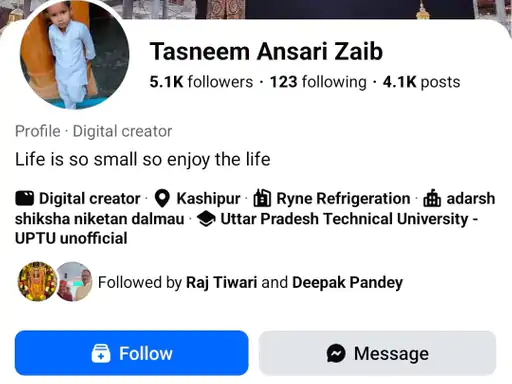
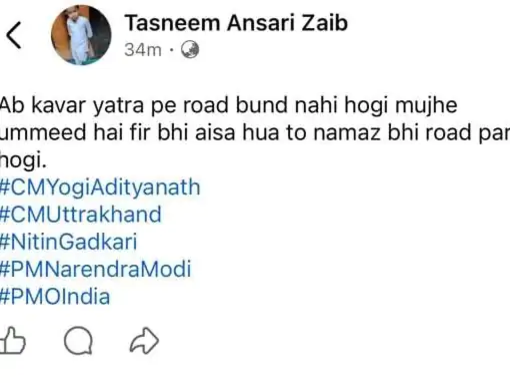
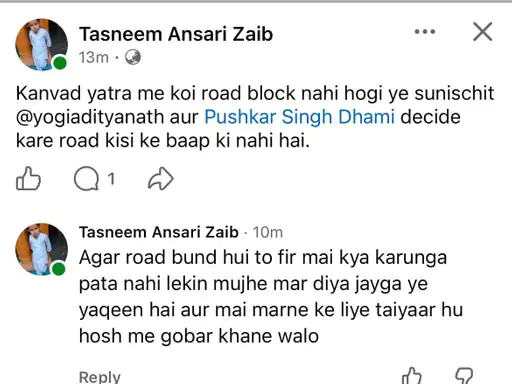
In Raebareli, Uttar Pradesh, Hindu sentiments were outraged after a Muslim youth named Tasneem Ansari Zaib made derogatory remarks about the Kanwar Yatra during the holy month of Sawan. According to reports, the accused, Tasneem Ansari Zaib, a resident of Kashipur village under the jurisdiction of Dalmau Police Station, made a series of posts on Facebook. These posts were directed at the Chief Ministers of Uttar Pradesh and Uttarakhand. The remarks quickly circulated on social media, drawing widespread criticism from residents and Hindu organisations due to their reference to the Kanwar Yatra and the proposal to offer Namaz on public roads if roads were blocked for the pilgrimage. In one of his posts, Tasneem Ansari Zaib tagged Uttar Pradesh Chief Minister Yogi Adityanath and Uttarakhand Chief Minister Pushkar Singh Dhami, writing that no roads should be blocked for the Kanwar Yatra and declaring that "the road doesn't belong to anyone's father." He further wrote that if roads were blocked during the yatra, Namaz would be offered on the road. In another post, while tagging Prime Minister Narendra Modi and Union Minister Nitin Gadkari, he reiterated that roads should not be closed for the Kanwar Yatra and again stated that if road closures occurred, Namaz would be offered on the road. The posts also contained a statement indicating that he was prepared to die, referring to a threat to his life. Following the circulation of these posts, the matter sparked significant outrage among local Hindu residents and Hindu organisations, who demanded the registration of an FIR and strict legal action against the accused. The objections centred on the timing of the posts during the sacred Hindu month of Sawan and the Kanwar Yatra, as well as the nature of the statements concerning public religious practices and the tagging of constitutional authorities. Given that the posts directly tagged the Chief Ministers of Uttar Pradesh and Uttarakhand and concerned a sensitive religious occasion, the matter came to the attention of law enforcement agencies. The Dalmau Police and the Local Intelligence Unit (LIU) initiated an investigation into the viral posts and began monitoring the activities of the accused. According to Additional Superintendent of Police Alok Singh, an inquiry into the objectionable social media posts is underway; dedicated police teams have been constituted to identify and locate Tasneem Ansari Zaib, and further legal action will be taken based on the findings of the investigation. Sawan is considered the holiest month in the Hindu calendar, dedicated to the worship of Lord Shiva through fasting, prayers, and rituals for spiritual cleansing. During this month, millions of devotees undertake the Kanwar Yatra, walking barefoot long distances to fetch holy water (Ganga Jal) from sacred rivers like the Ganges. They carry this water on decorated bamboo poles (kanwars) to offer it at Shiva temples, symbolising complete surrender, penance, and gratitude to the deity.
Case Images
Why it is Hate Crime ?
The primary category for this case is: Hate speech against Hindus. The subcategory for this case is: Anti-Hindu slurs, mocking faith. Anti-Hindu slurs and the deliberate mocking of the Hindu faith owing to religious animosity involve the usage of derogatory terms, stereotypes, or offensive references to religious practices, symbols, or figures. One of the common anti-Hindu slurs used against Hindus is “cow-worshipper” and “cow piss drinker”. The intention of using this term is to demean and mock Hindus as a group and their religious beliefs since Hindus consider the cow holy. Additionally, some symbols and the slurs attached to them have a historical context that exacerbates the insult, hate, stereotyping, dehumanisation and oppression against Hindus. Cow worship has been used for centuries to denigrate Hindus, insult their faith and oppress Hindus specifically as a religious group. There has been overwhelming documentation about how cow slaughter has been used to persecute Hindus, with cow meat being thrown in temples and places of worship. There has also been overwhelming documentation where cow meat (beef) has been force-fed to Hindus to either forcefully convert them to Islam or denigrate their faith. Apart from cow worship, the Swastika – which holds deep religious significance for Hindus has also been misinterpreted and distorted to be used as a slur against Hindus. Similarly, the worship of the Shivling has been used by supremacist ideologies and religions to denigrate Hindus owing to religious animosity. Such slurs and denigration stem from inherent animosity and hate towards Hindus and their faith; therefore, it is categorised as hate speech targeted at Hindus specifically owing to their religious identity. This case constitutes a clear instance of hate speech directed against Hindus and their festivals because the accused's statements specifically targeted the Kanwar Yatra, a religious pilgrimage that is sacred to Hindus. By repeatedly stating that Namaz would be offered on public roads if roads were blocked for the Kanwar Yatra, the accused did not simply comment on traffic arrangements. Instead, he used a major Hindu religious event to make provocative statements that turned the pilgrimage into a religious confrontation. By choosing the Kanwar Yatra as the focus of his remarks, the accused targeted a core Hindu religious practice and sought to provoke and insult the religious sentiments of Hindu devotees. Such ideology working against the Hindu faith fails to qualify as solidarity of the society but creates an obvious view of the animosity and prolonging hatred of Muslims against Hinduism and Hindu practices at large by spreading hate and feelings of superiority of their religion to Hinduism, which they demean. To understand the seriousness of this incident, it is necessary to recognise the religious significance of the Kanwar Yatra in Hinduism. The Kanwar Yatra is one of the largest and most sacred annual pilgrimages dedicated to Lord Shiva, observed during the holy month of Sawan. Millions of Hindu devotees, known as Kanwariyas, undertake arduous journeys on foot while carrying holy water from the River Ganga in Kanwars, which is ceremonially offered at Shiva temples as an act of devotion, penance, and spiritual discipline. The pilgrimage represents faith, sacrifice, religious austerity, and unwavering devotion to Lord Shiva. Temporary traffic diversions and administrative arrangements are routinely made to facilitate the safe movement of millions of devotees participating in this religious observance. The accused sought to draw a false equivalence between the Kanwar Yatra and the offering of Namaz on public roads. This comparison is fundamentally misleading because the Kanwar Yatra is an annual religious pilgrimage undertaken by millions of Hindu devotees during the holy month of Sawan, whereas Namaz is a routine act of Islamic worship performed several times daily throughout the year. The temporary traffic diversions and administrative arrangements made during the Kanwar Yatra are intended to facilitate the safe movement of an exceptionally large number of pilgrims participating in a time-bound religious festival. Equating these extraordinary arrangements with the routine offering of Namaz misrepresents the nature and scale of the two religious practices and creates a false narrative of unequal treatment. In a pluralistic society, the State has a constitutional obligation to ensure that all religious communities are able to practise their faith peacefully and safely. Consequently, governments routinely make temporary administrative and traffic arrangements for major religious gatherings across communities whenever public safety or crowd management so requires. Similar arrangements are made during large Eid congregations, Muharram processions, Christmas celebrations, Sikh Nagar Kirtans, Jain processions, and other significant religious events. Such measures are administrative responses to the scale and logistical requirements of public gatherings rather than expressions of religious preference or discrimination. By portraying the temporary arrangements made for the Kanwar Yatra as a justification for offering Namaz on public roads, the accused attempted to create an artificial religious confrontation instead of engaging in a genuine discussion on public administration. The repeated invocation of Namaz in direct response to the Kanwar Yatra framed a sacred Hindu pilgrimage as being in competition with an Islamic religious practice, thereby fostering resentment against the pilgrimage itself. Rather than raising a neutral concern about traffic management, the posts used a revered Hindu religious observance as the basis for a provocative comparison that had the potential to inflame communal tensions and generate hostility towards Hindu religious practices. The repeated declaration that Namaz would be offered on the roads if routes were blocked for the Kanwar Yatra was directed specifically at this Hindu pilgrimage. The statements were not confined to expressing disagreement over traffic arrangements but instead used the occasion of a major Hindu religious event to issue a religiously charged response. By repeatedly associating Namaz with the Kanwar Yatra in a confrontational manner and publicly tagging the Chief Ministers of Uttar Pradesh and Uttarakhand, as well as the Prime Minister and the Union Minister for Road Transport and Highways, the accused amplified the message during an ongoing Hindu religious observance. Such comments by the Muslim perpetrator were rooted in religious animosity against Hindus. These ideas are not mere abstractions; they manifest in actions where non-Muslims, especially Hindus in India, are seen as targets for religious domination, coercion, or humiliation. This theological framework fosters an "us versus them" mindset, in which any assertion of Hindu identity or religious freedom is seen not only as undesirable but as a threat to Islamic supremacy. Such acts, therefore, are not isolated but driven by a broader ideological hostility towards Hindus as non-believers and reflect an attempt to impose religious dominance. The posts generated widespread outrage among Hindu residents and Hindu organisations, who viewed them as an affront to the sanctity of the Kanwar Yatra and demanded legal action. The timing of the statements, during the sacred month of Sawan, further intensified their impact because they directly concerned one of Hinduism's most revered religious pilgrimages. By choosing the Kanwar Yatra as the subject of repeated provocative statements, the accused targeted a central Hindu religious practice and offended the religious sentiments of Hindu devotees. Disclaimer: The Hinduphobia Tracker records the incident date based on when the incident occurred rather than when it was covered by the media or gained attention on social media. In this case, the exact date on which the Facebook posts were published is not specified in the available sources. The media coverage of the incident first appeared on 20 July 2026. Accordingly, 20 July 2026 has been adopted as the indicative incident date for documentation purposes only, as it is the earliest verifiable date currently available.


Case Status
Unknown


Perpetrators Details
Perpetrators
Muslim Extremists
Perpetrators Range
One Person
Perpetrators Gender
male
 Sources




