Minor Hindu girl raped, impregnated, forced to convert to Islam and do nikah by Muslim man in Nagpur, Maharashtra
 Nagpur, Maharashtra, India
  12 August, 2020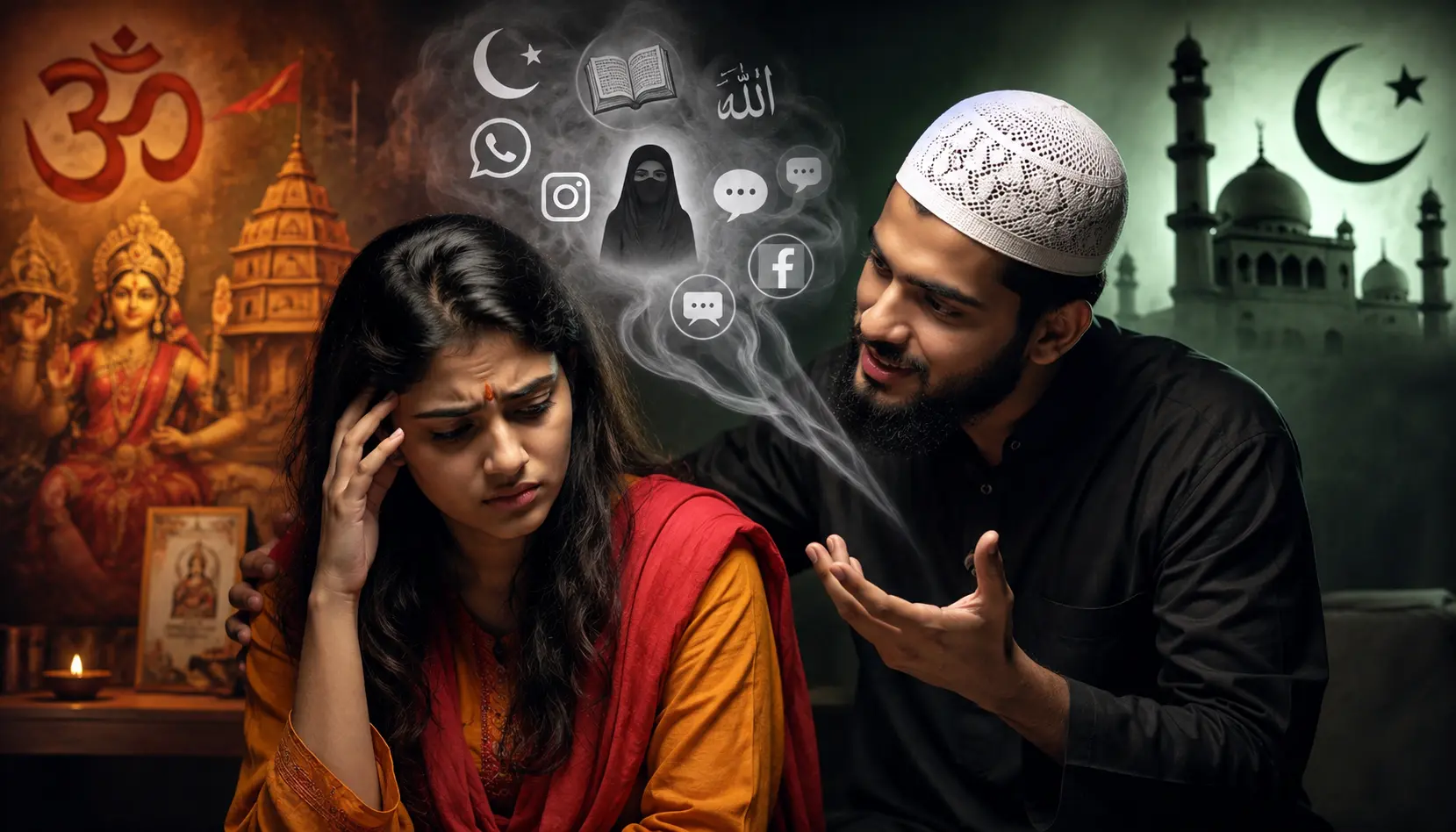
Case Summary
In Nagpur, Maharashtra, a 15-year-old Hindu girl was lured, abducted, raped, impregnated, and forced to convert and undergo a nikah (Islamic marriage) by a Muslim man named Sameer Ali. The victim's ordeal began around 13 August 2020 in the Mankapur–Zingabai Takli area of Nagpur. At the time, the victim was 15 years old, whilst the accused, Sameer Ali, was around 21 to 24 years old and worked at a paan kiosk near Mankapur Chowk. The accused first lured the minor Hindu girl into a relationship before abducting and sexually assaulting her. He raped and impregnated the victim whilst she was still a minor and had turned 16. In 2021, after impregnating the victim, Sameer Ali forcibly converted her to Islam and made her undergo a nikah at an Islamic shrine near Awasthi Chowk. The nikah ceremony was conducted by Maulana Anwar in the presence of Sameer's family members, Aziza Munir Ali, aged 45, and Munir Ali, aged 50. The Hindu girl revealed that Sameer, Aziza, and Munir had conspired to deceive her, facilitate her religious conversion, and exploit her. She further stated that a forged identity document carrying her altered name and age was used to secure her admission to a government maternity hospital, where she later delivered a child. On 24 July 2026, the case came to light after the Hindu victim approached the police with the assistance of a Vishwa Hindu Parishad activist and narrated the physical and mental abuse she had endured over the previous several years. Police found that her name and age had been altered in a forged identity document. Based on her complaint, the police registered a case under multiple provisions of the Bharatiya Nyaya Sanhita, the Protection of Children from Sexual Offences Act, and the Prohibition of Child Marriage Act. Provisions relating to the forgery of documents and criminal conspiracy were also invoked. Senior police officers stated that investigation teams were verifying the sequence of events, examining the forged identity document, recording the statements of witnesses, including the person who arranged the marriage, and collecting medical and forensic evidence. They confirmed that the victim had been a minor at the time of the abduction and sexual assault. The investigation was also examining all aspects of the case, including the relationship between the accused and the victim. Senior Inspector Harsh Kalsekar of Mankapur Police Station stated that the main accused had been arrested.
Why it is Hate Crime ?
The primary category selected is: Predatory Proselytisation. The subcategory selected is: Proselytisation by grooming, brainwashing, manipulation or subtle indoctrination. The tertiary categories selected are: Rape and sexual assault/harassment, Conversion of Minor, Victim says was brainwashed/groomed. Religious brainwashing essentially means the often subtle and forcible indoctrination to induce someone to give up their religious beliefs to accept contrasting regimented ideas. Religious grooming or brainwashing also involves propaganda and manipulation. It involves the systematic effort, driven by religious malice and indoctrination, to persuade “non-believers’ to accept allegiance, command, or doctrine to and of a contrasting faith. Cases of such grooming or brainwashing are far more nuanced than direct threats, coercion, inducement and violence. In such cases, it is often seen that there is repeated, subtle and continual manipulation of the victim to induce disaffection towards their own faith and acceptance of the contrasting faith of the perpetrator. While subtle indoctrination is widely acknowledged as predatory, an element which is often understated in such conversions or the attempts of such conversion is the role of loyalty and trust which might develop between the perpetrator and the victim. Fiduciary relationships are often abused to affect such religious conversion. For example, an educator transmitting religious doctrine of a competing faith to a Hindu student. The Hindu student is likely to accept what the teacher is transmitting owing to existence of the fiduciary relationship. The exploitation of the fiduciary relationship to religiously indoctrinate victims would also be included in this category. Since the underlying animosity towards the victim’s faith forms the basis of predatory proselytization, such cases are considered religiously motivated hate crimes. The other subcategory selected is: Harassment, threats, coercion for conversion. Harassment covers a wide range of behaviours of an offensive nature. It is commonly understood as behaviour that demeans, humiliates, and intimidates a person, including threats and coercion. Harassment and threats, in this case, find their root on discriminatory grounds which has the effect of nullifying a person’s rights or infringing upon his freedom to exercise his right specifically owing to the victim’s religious identity. Verbal and physical threats and psychological or physical harassment are often used against Hindu victims because they choose to practice their professed religion. Religious harassment also includes forced and involuntary conversions by harassment, threats or coercion. Coercion includes intimidatory tactics like force-feeding a Hindu victim beef to convert to another religion, forceful circumcision etc. In several cases documented, non-Hindu perpetrators or those who harbour specific animosity towards Hinduism, harass victims simply based on their religious identity. Such cases often also include harassment to ensure the Hindu victim abandons his/her professed religion and adopts the religion of the perpetrator. Such cases where Hindu victims are harassed to convert to the perpetrator’s religion are rooted in animosity towards the victim’s religious identity and are therefore documented as religiously motivated hate crimes. The other primary category selected is: Crimes against women in relationships and other sexual crimes. The subcategory selected is: Brainwashed and/or Groomed. The tertiary categories selected are: Rape and sexual assault/harassment, Conversion of Minor, Victim says was brainwashed/groomed. In our database, we have not added incidents where women have converted to another religion of their free will and no allegations of forced/involuntary conversion have been made. However, there are certain cases of conversion where the consent itself is a result of the brainwashing or grooming of a minor by the non-Hindu perpetrator trying to victimise a woman for her Hindu religious identity. The phenomenon of grooming points to non-Hindu perpetrators identifying their Hindu victims’ vulnerabilities and exploiting them over months and sometimes years, to extract the supposed ‘consent’ in order to convert their religion. In most cases of grooming, the victims are minors or the grooming started when the victim was a minor. In other cases of grooming, the non-Hindu perpetrator brainwashes and grooms a minor victim to extract their trust and then proceeds to rape them repeatedly with the intent of converting them to their faith. It is pertinent to understand here that when the victim is a minor, the ‘consent’ to convert or enter into a romantic relationship with an adult itself is redundant – addressed by POCSO. While every case of conversion of a minor and incidents of establishing a physical relationship with a minor by an adult is a crime, for the purpose of this database, a case would be considered a hate crime only if there is a distinct religious angle to the grooming. For example, in the UK, if a Hindu minor is targeted by Pakistani grooming gangs, it would be considered a hate crime because the victims are specifically targeted owing to their non-Muslim religious identity with the perpetrators being Muslim. In other cases, if a Hindu minor is brainwashed into entering a physical relationship with the non-Hindu adult perpetrator and the family alleges grooming/brainwashing of the minor to convert her religion, it would form a part of this database. If the victim is a Hindu adult, the case would form a part of this database only if the victim herself says that she was brainwashed/groomed to convert her religion. However, if the victim is deceased (murdered or otherwise), the case would form a part of this database if her family/friends provided testimony that the victim was brainwashed/groomed to convert her religion. Since these crimes have a distinct religious angle where the victim is being targeted owing to her Hindu religious identity, these cases are considered a hate crime. The other subcategory selected is: Forced conversion before marriage. The tertiary category selected is: Forced to do nikah. In such cases, a non-Hindu man is in a relationship with a Hindu woman when the pressure to convert her religion begins to manifest. In such cases, typically, two patterns emerge. First, when the relationship is consensual, and the religious identity of the perpetrator is known to the Hindu woman in the relationship, however, at some point during the relationship, the non-Hindu man starts to force the victim to convert her religion and give up her Hindu religious identity. The second is when the woman gets into a marriage with the man pretending to share her faith. Later, when the truth is revealed, the man starts pressuring the woman to convert her religion and give up her religious identity. In both the situations, the methods used to force the victim to convert her religion often revolve around force-feeding beef, forcing her to wear hijab, forcing her to read the Kalma or even pressurizing the victim to do ‘Nikah’, which is marriage under Islamic law, with a prerequisite being conversion to Islam. Cases where a Hindu woman consensually converts to Islam in a relationship will be left out of the hate crime database, even though it could be argued in several cases that the conversion was a result of religious brainwashing. This case from Nagpur, Maharashtra, represents an explicit instance of a religiously motivated hate crime. A minor Hindu girl was systematically lured, abducted, sexually assaulted, impregnated, forcibly converted to Islam, and subjected to a nikah (Islamic marriage) by an adult Muslim man. The sequence of events demonstrates a targeted pattern of behaviour where the victim's religious background and extreme vulnerability were exploited to execute forced religious conversion and prolonged abuse. Central to this case is the victim's status as a minor throughout the initial years of the abuse. Legal and moral standards establish that a minor cannot grant informed consent regarding sexual relationships or life-altering decisions such as religious conversion. Due to their stage of development, minors are uniquely susceptible to manipulation, grooming, and coercion by adults. The Muslim perpetrator exploited this inherent power imbalance, targeting a minor Hindu girl for her religious identity. Because the minor lacked the cognitive capacity to consent, any assertion of a voluntary relationship or voluntary religious conversion is invalid ab initio. The deliberate targeting of a vulnerable minor girl for the purpose of sexual assault and forced conversion underlines the hostile motivation behind the act. The trajectory of the offence highlights a calculated approach from its inception. The perpetrator initially used deceptive emotional manipulation, commonly referred to as "love bombing", to establish control over the minor. This strategy served as a gateway to sever her connections with her family and community, culminating in her abduction from her familiar environment. Removing a minor from her protective social network to an isolated setting enabled subsequent physical and sexual control. The progression from emotional manipulation to physical abduction and ongoing sexual assault reveals a premeditated strategy designed to achieve complete dominance over the victim. The sexual violence and subsequent pregnancy in this case must be analysed within the context of the forced conversion that followed. The assault was not an isolated act of physical abuse, but part of a systematic effort to break the victim's autonomy and enforce a fundamental identity change. In hate crime analyses, sexual violence directed at members of a targeted group functions as a mechanism of subjugation and control. By subjecting a minor Hindu girl to continuous sexual assault and forcing her into pregnancy, the perpetrator asserted power over her physical and religious identity, making the sexual violence inherently connected to her faith background. The act of forcing the victim to renounce her Hindu faith and convert to Islam represents a fundamental violation of individual freedom and religious autonomy. Forcible conversion is designed to erase a person's self-determined identity and substitute it with another under duress. The perpetrator's insistence on converting the girl demonstrates an underlying hostility toward her original faith, treating her personal beliefs as something to be forcibly eradicated. This coercive stripping of identity is a defining characteristic of religiously motivated bias offences. Following the coerced conversion, the victim was subjected to a nikah (Islamic marriage). Under traditional Islamic jurisprudence, a polytheist or idol-worshipping woman (such as a Hindu woman) cannot contract a valid marriage with a Muslim man unless she converts to Islam. In this case, the forced conversion was engineered specifically to fulfil this jurisprudence requirement, allowing the ceremony to proceed. Beyond satisfying a procedural rule, the religious ceremony served to formalise and legalise the preceding unlawful acts of abduction, sexual assault, and religious coercion. By enveloping the abuse within the formal framework of a religious marriage, the perpetrator sought to legitimise the exploitation in the eyes of his family and community, creating a structural barrier that severely hindered the victim from seeking immediate escape, reporting the crime, or accessing legal recourse. Furthermore, forcing the victim into a nikah served as a calculated mechanism to assert complete dominance, authority, and ongoing control over her. In this setting, the victim's status was reduced from an autonomous individual to a legally bound dependent, systematically stripping away her agency, isolating her from her natal support systems, and ensuring her continued physical, psychological, and religious subjugation under the perpetrator's authority. The presence and participation of the perpetrator's family members, specifically his parents, indicate that the offence was not an isolated act committed by a single individual. The involvement of relatives in witnessing and facilitating the ceremony points to a collective effort to validate the forced conversion and marriage. Their participation provided a support structure for the perpetrator, reinforcing the coercive environment and ensuring the minor remained trapped within the family unit under her altered identity. The performance of the nikah by a maulana (religious cleric) at a religious shrine demonstrates the utilisation of formal religious structures to complete the process. Performing a forced conversion and marriage within a religious institution provides an overlay of legitimacy to an unlawful act. The willingness of a cleric to officiate a ceremony involving a minor under coercive circumstances highlights how religious authority was leveraged to formalise forced conversions. This institutional element transformed the individual act of abuse into a structured, formal process. Because this case contains verified elements of targeted grooming, physical abduction, sexual assault of a minor, forced religious conversion, and institutional coercion directed against an individual based on her faith, it meets the established criteria for a bias-motivated offence. Consequently, this incident is recorded in the Hinduphobia Tracker's hate crime database as a documented religiously driven hate crime. Disclaimer: In this case, the perpetrator count has been recorded as four, as the crime involved not only the principal accused but also his parents and a Maulana. Accordingly, all four individuals have been counted as the perpetrators for documentation purposes.
Victim Details
Total Victim
1
Deceased
0
Gender
- Male 0
- Female 1
- Third Gender 0
- Unknown 0
Caste
- SC/ST 0
- OBC 0
- General 0
- Unknown 1
Age Group
- Minor 1
- Adult 0
- Senior Citizen 0
- Unknown 0


Case Status
Case sub-judice


Perpetrators Details
Perpetrators
Muslim Extremists
Perpetrators Range
From 2 To 5
Perpetrators Gender
both
 Sources




