Sanctity of Hindu religious symbols desecrated by Muslim man who attempted to marry a Hindu woman in Uttar Pradesh's Mirzapur
 Mirzapur, Uttar Pradesh, India
  25 July, 2026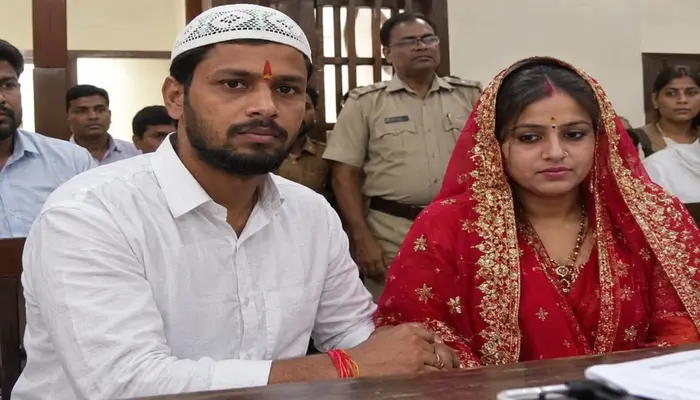
Case Summary
In Mirzapur, Uttar Pradesh, the sanctity of Hindu sacred symbols was desecrated when a Muslim man wore a kalava (sacred Hindu thread) and applied a tilak on his forehead in an attempt to marry a Hindu woman at the Mirzapur district court on 25 July 2026. The perpetrator, Afzal, a Muslim resident of Ghazipur, arrived at the Mirzapur district court with a Hindu woman to solemnise a court marriage. He was accompanied by his parents and was wearing a kalava on his wrist and a tilak on his forehead, adopting visible Hindu religious symbols while concealing his Muslim identity. Lawyers present at the court noticed the group and became suspicious. They questioned Afzal, during which he disclosed that he was a Muslim. His use of Hindu religious symbols while concealing his religious identity sparked outrage among the lawyers and members of the public present at the court, who viewed it as a desecration of symbols held sacred in Hinduism. They also accused Afzal of trapping the Hindu girl by hiding his religious identity. During the confrontation, Afzal's mother stated before those gathered that Sub-Inspector Manoj Mishra, posted at Jamuniya in Ghazipur, had assured the family that they could contact him if they faced any difficulty. Following the incident, the lawyers and members of the public handed Afzal and his parents over to the Nyayalaya Chowki Police, who took all three into custody. The police summoned the Hindu woman's parents to Mirzapur to verify the circumstances of the case and determine whether she was an adult or a minor.At the time of writing this report, the police investigation was ongoing.
Why it is Hate Crime ?
The primary category selected is: Attack on Hindu religious representations. The subcategory selected is: Desecration of Hindu religious symbol. Icons and symbols or a religious representation of a spiritual ideal are widely revered in Hinduism. Iconography is of vital significance in the Hindu milieu. It helps connect people’s spiritual beliefs with the real world. Iconography within the Hindu faith takes several shapes and forms. Murtis are of most significance to Hindus, to which daily rituals, prayers and offerings are done. Besides the murtis, there are several other symbols which have deep significance in the Hindu faith – the Om and Swastika for example. Since these Hindu religious symbols hold paramount importance in Hinduism, any desecration of symbols, icons, murtis, religious representations and manifestations, is driven by animosity towards the faith itself which manifests itself through these murtis, icons and symbols. Therefore, any desecration of these Hindu religious symbols and representations is considered religiously motivated hate crimes under this category. This case is a clear example of a religiously motivated hate crime because Hindu religious symbols, which hold deep spiritual and cultural significance, were used merely as tools to facilitate a marriage to a Hindu woman. These symbols were not used as expressions of faith or religious practice but as a means to project a Hindu identity. Their use in this manner undermined their sanctity and reduced objects of profound religious reverence to instruments of convenience. Such conduct reflects a disregard for the sacredness of Hindu religious symbols and transforms them into tools for achieving a personal objective, thereby making this a clear instance of a religiously driven hate crime. In Hinduism, the tilak is far more than a mark on the forehead. It is a sacred religious symbol that signifies devotion, spiritual discipline, and one's connection with the divine. Depending on the tradition, it represents the blessings of a deity, participation in a religious ceremony, or adherence to a particular Hindu sampradaya (sect). Likewise, the kalava, also known as the mauli or sacred thread, is tied during Hindu religious rituals and ceremonies as a symbol of divine protection, purity, commitment, and blessings. It is worn with reverence after prayers and rituals and carries deep religious meaning for practising Hindus. Both the tilak and the kalava are visible expressions of Hindu faith and are treated with respect by devotees because of the spiritual significance attached to them. Against this background, the conduct described in this case assumes greater significance. A person who is not a practitioner of Hinduism chose to wear these sacred symbols solely while attempting to marry a Hindu woman in court. The available reports indicate that these symbols were used to project a Hindu identity rather than as an expression of genuine religious belief. This reduced sacred Hindu symbols to instruments of deception and convenience. The act demonstrates a disregard for the reverence with which practising Hindus regard the tilak and the kalava. Rather than respecting their religious significance, the symbols were used as tools to create a false impression before the woman, the lawyers present at the court, and the legal authorities. Such conduct undermines the sanctity attached to these symbols in Hinduism and therefore constitutes a religiously motivated hate crime. It is important to clarify the categorisation of this case. At first glance, the incident appears similar to several other cases in which Muslim men have concealed their religious identity to initiate relationships or marriages with Hindu women. In many such instances, Hinduphobia Tracker has categorised the incidents under "Crimes against women in relationships and other sexual crimes", as the available evidence established that the Hindu victim had been deceived about the perpetrator's identity, manipulated into the relationship, or subjected to sexual exploitation, forced marriage, or religious conversion. However, the facts presently available in this case do not justify placing it under that category. The reports do not clearly state whether the woman was a minor or an adult, nor do they establish whether she was unaware of the man's religious identity at any stage of the relationship. There is also no statement from the woman indicating that she had been deceived, coerced, or induced into marrying him. In the absence of these crucial facts, it would be speculative to conclude that she was lured into the relationship through concealment of identity. Consequently, based on the information currently available in the public domain, this incident is not being classified under "Crimes against women in relationships and other sexual crimes". Should further verified information emerge demonstrating that the woman was deceived about the accused's identity or subjected to coercion or exploitation, the categorisation of the case will be updated accordingly. At the same time, this incident cannot be viewed in complete isolation. Hinduphobia Tracker has documented 1,317 cases in which Hindu women were targeted by Muslim men because of their religious identity. Of these, 823 cases involved the accused concealing their religious identity from the Hindu victim by adopting Hindu names, identities, or outwardly displaying Hindu religious symbols such as the tilak, kalava or kada, to present themselves as Hindus. In many of these documented cases, the concealment of religious identity formed part of a broader pattern that culminated in the Hindu victim being deceived into a relationship, sexually exploited, pressured into marriage, or forced to convert to Islam. While every case must be assessed independently on the basis of its own facts and evidence, the documented data demonstrates that concerns surrounding the concealment of religious identity in relationships are neither isolated nor sporadic. Rather, they reflect a recurring pattern observed across hundreds of documented cases. It is against this broader factual backdrop that incidents involving the concealment of religious identity and the misuse of Hindu religious symbols continue to attract public attention and scrutiny. Therefore, although the available evidence in the present case does not establish that the Hindu woman was deceived about the accused's identity, the accused's act of wearing the tilak and kalava to project a false Hindu identity cannot be viewed in complete isolation from this wider documented pattern. Nevertheless, irrespective of the unanswered questions regarding the woman's age, her knowledge of the accused's religious identity, or the nature of their relationship, one aspect of this incident remains clear from the available reports. A Muslim man appeared before a court wearing Hindu religious symbols despite not being a practising Hindu, and these symbols were used only to project a Hindu identity while attempting to marry a Hindu woman. This conduct diminished the sanctity of the tilak and the kalava, treating objects of deep religious reverence as instruments of convenience rather than symbols of faith. It is this deliberate misuse of sacred Hindu religious symbols, and the resulting disrespect shown towards their religious significance, that forms the basis for including this incident in the Hinduphobia Tracker's hate crime database.


Case Status
Complaint filed


Perpetrators Details
Perpetrators
Muslim Extremists
Perpetrators Range
One Person
Perpetrators Gender
male
 Sources




