Hindu community targeted; anti-Hindu casteist slogans raised at CJP protest in Delhi
 Delhi, Delhi, India
  22 July, 2026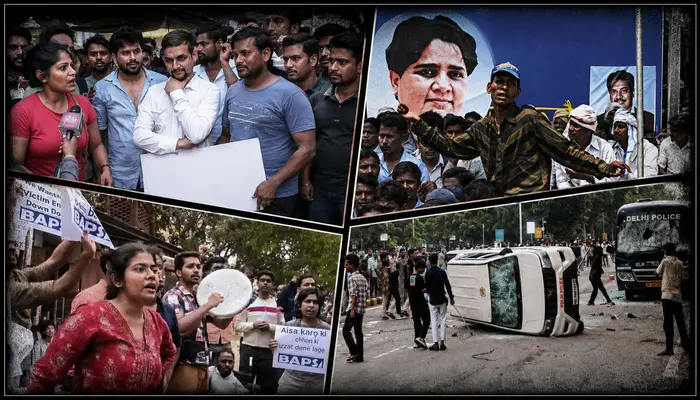
Case Summary
At a protest organised by the Cockroach Janata Party (CJP) at Jantar Mantar in Delhi, anti-Hindu casteist slogans of "Tilak, Tarazu aur Talwar... inko maaro joote chaar" were raised in the presence of protesters. The slogan has historically been directed against communities identified by these symbols. "Tilak" refers to the sacred forehead mark associated with Hindu religious identity and, in this slogan, represents Brahmins. "Tarazu" (weighing scale) symbolically refers to the Vaishya community, traditionally associated with trade and commerce. "Talwar" (sword) symbolically represents the Kshatriya community, historically associated with warrior traditions. A video of the slogans being raised at the protest subsequently went viral on social media. In the viral video, protesters were heard raising the slogan "Tilak, Tarazu aur Talwar... inko maaro joote chaar"(Brahmin, Vaishya and Kshatriya, thrash them with shoes), a slogan that has long been associated with hostility towards the communities represented by these symbols. The slogan has also been raised during several other protests involving sections of JNU students and members of organisations such as DS-4, BSP, AISF, AISA, SFI, ASA, SOI, AIMSF and BAPSA. The footage circulated widely across social media platforms. Critics argued that the use of such a slogan went beyond the stated objective of the protest and instead targeted communities identified through symbols closely associated with Hindu religious and cultural identity. The video spread rapidly on social media, with many users expressing concern over the public use of a slogan historically regarded as derogatory towards the communities represented by Tilak, Tarazu, and Talwar. The incident reflected the broader ideological trajectory of the Cockroach Janata Party (CJP), whose public campaigns had increasingly shifted from education-related demands towards rhetoric perceived by many as hostile to Hindu symbols, traditions, and religious identity. Critics argued that forcing a man to leave a public protest because he wore saffron bore no relation to the movement's stated demands and instead amounted to intimidation directed at a person displaying a symbol closely associated with the Hindu faith. Notably, the Cockroach Janata Party (CJP) emerged in mid-May 2026 as a satirical, youth-led online movement that rapidly transformed into a mass mobilisation platform for students and unemployed graduates through social media engagement. It was founded by Abhijeet Dipke, a member of the Aam Aadmi Party (AAP), who repurposed a controversial public remark comparing unemployed youth to "cockroaches" as a symbol of collective identity and protest. While Dipke initially portrayed the CJP movement as a genuine, non-partisan, and constitutionally aligned initiative demanding educational reforms, accountability for the National Eligibility cum Entrance Test (NEET) examination paper leak, and the resignation of officials, including the Union Education Minister, the movement soon diverged from its stated objectives. Rather than remaining focused on systemic reforms, it evolved into an ideologically driven campaign characterised by anti-Hindu rhetoric. Its co-founders and participants made derogatory remarks about Hindu deities and religious slogans such as "Jai Shri Ram", abused the Hindu community, raised overtly pro-Islamic slogans such as "Naam rahega Allah ka", "Naara-e-Taqbeer, Allahu Akbar", and increasingly directed their hostility towards Hindu organisations, activists, and the government, which they described as a "Hindutva-led government". By the time it culminated in its first major street-level protest at Jantar Mantar on 6 June 2026, the movement had shifted from a purported students' rights campaign into an overtly anti-Hindu platform. On 6 June 2026, Dipke flew in from the United States to lead the movement's first major street-level protest at Jantar Mantar. AAP-aligned figures attended the event under the guise of being neutral, anti-establishment voices. However, contrary to its stated claim of being a student advocacy movement focused on systemic failures, the CJP's conduct at Jantar Mantar told a starkly different story.
Why it is Hate Crime ?
The primary category for this case is: Hate speech against Hindus. The subcategory for this case is: Anti-Hindu slurs, mocking faith. Anti-Hindu slurs and the deliberate mocking of the Hindu faith owing to religious animosity involve the usage of derogatory terms, stereotypes, or offensive references to religious practices, symbols, or figures. One of the common anti-Hindu slurs used against Hindus is “cow-worshipper” and “cow piss drinker”. The intention of using this term is to demean and mock Hindus as a group and their religious beliefs since Hindus consider the cow holy. Additionally, some symbols and the slurs attached to them have a historical context that exacerbates the insult, hate, stereotyping, dehumanisation and oppression against Hindus. Cow worship has been used for centuries to denigrate Hindus, insult their faith and oppress Hindus specifically as a religious group. There has been overwhelming documentation about how cow slaughter has been used to persecute Hindus, with cow meat being thrown in temples and places of worship. There has also been overwhelming documentation where cow meat (beef) has been force-fed to Hindus to either forcefully convert them to Islam or denigrate their faith. Apart from cow worship, the Swastika – which holds deep religious significance for the Hindus – has also been misinterpreted and distorted to use as a slur against Hindus. Similarly, the worship of the Shivling has been used by supremacist ideologies and religions to denigrate Hindus owing to religious animosity. Such slurs and denigration stem from inherent animosity and hate towards Hindus and their faith; therefore, it is categorised as hate speech targeted at Hindus specifically owing to their religious identity. The slogan "Tilak, Tarazu aur Talwar..." has historically been associated with hostility towards communities represented by these symbols. In the slogan, Tilak refers to the sacred forehead mark that symbolises Hindu religious identity and traditionally represents Brahmins, Tarazu (weighing scale) symbolically represents the Vaishya community, and Talwar (sword) symbolically represents the Kshatriya community. Raising this slogan in a public demonstration targets communities that have historically formed part of the Hindu social and religious order and reduces symbols closely associated with Hindu identity into objects of hostility and ridicule. Savarna is a social term used in India to refer to communities traditionally associated with the Brahmin, Kshatriya, and Vaishya varnas of the Hindu social order. In contemporary political discourse, the term is often used as a collective identifier for these communities. In some contexts, it is also employed in political rhetoric to target or stereotype these groups, contributing to caste-based polarisation within Hindu society. The slogan seeks to divide Hindus along caste lines by portraying communities traditionally represented by the symbols of the Tilak, Tarazu, and Talwar as adversaries rather than as integral parts of the broader Hindu social and religious tradition. By singling out these communities for public ridicule and hostility, such rhetoric encourages internal divisions within Hindu society instead of fostering social cohesion. In this context, the slogan does not merely express opposition towards particular caste groups but also exploits caste identities to fragment the Hindu community, thereby reinforcing hostility towards communities identified through symbols closely associated with Hindu religious and cultural identity. This same anti-Hindu propaganda is also promoted by groups such as Ambedkarites, Phuleites, and Periyarites, who claim that Dalits and tribals are not Hindus. The same playbook is used to create and deepen caste divisions within Hindu society by portraying different Hindu communities like Brahmin, Kshatriya and Vaishya as adversaries instead of members of a shared civilisational and religious tradition. Slogans targeting communities identified with symbols such as the Tilak, Tarazu, and Talwar reflect this broader attempt to pit one section of Hindu society against another, thereby weakening Hindu unity and reinforcing hostility towards Hindu identity. The incident is significant because the slogan was raised during a public protest despite having no connection with the stated objective of the demonstration. Instead of remaining confined to the issues around which the protest was organised, participants resorted to slogans historically associated with hostility towards sections of Hindu society. Such rhetoric transforms a political gathering into a platform where expressions associated with Hindu identity become the subject of public abuse and derision. Social media users also criticised the slogan as an attempt to deepen caste divisions within Hindu society by encouraging hostility between different Hindu communities rather than promoting social harmony. The slogan is not new and has appeared on several occasions in India's political discourse. It has historically been associated with sections of the DS-4 (Dalit Shoshit Samaj Sangharsh Samiti) movement during the 1980s and has resurfaced at various protests and demonstrations over the years. More recently, videos from some university demonstrations, including protests involving sections of student activists, have shown the slogan being raised again. The repeated acts during the Cockroach Janata Party (CJP) protest that targeted Hindu religious symbols and hurt Hindu sentiments have drawn widespread criticism and intensified concerns over the hostility displayed towards Hinduism. By introducing anti-Hindu rhetoric into a protest ostensibly centred on the NEET paper leak, the organisers and participants responsible for such conduct shifted the focus from educational accountability to religious provocation. Such actions not only deeply offend the religious sentiments of millions of Hindus but also undermine communal harmony by turning a public protest into a platform for vilifying a particular faith. They raise serious concerns about the growing normalisation of hostility towards Hindu beliefs and practices in the guise of political activism. For these reasons, the incident has been documented as a hate crime. The public raising of the slogan "Tilak, Tarazu aur Talwar...", which has historically been associated with hostility towards communities represented by symbols closely linked to Hindu religious and cultural identity, amounted to the public denigration of those communities. The use of the slogan at a political protest that was unrelated to such issues demonstrated that the expression was directed not towards any legitimate grievance but towards communities identified with these Hindu symbols. Its deployment in a public gathering, coupled with its historical association with anti-Hindu rhetoric and its potential to foster caste divisions within Hindu society, reflects hostility towards Hindu identity and therefore warrants its documentation as a hate crime. Disclaimer: The Hinduphobia Tracker records the date on which the incident occurred rather than the date on which it was reported. In this case, the exact date on which the slogan "Tilak, Tarazu aur Talwar..." was raised during the Cockroach Janata Party (CJP) protest could not be independently verified from publicly available sources. The incident was reported in the media on 23 July 2026. Accordingly, in the absence of a verifiable incident date, the Tracker has recorded 23 July 2026 as the incident date for documentation purposes.


Case Status
Unknown


Perpetrators Details
Perpetrators
Others
Perpetrators Range
One Person
Perpetrators Gender
female
 Sources




