Hindu family defrauded as Muslim man poses as Hindu ascetic to steal gold ornaments in Chattogram, Bangladesh
 Chittagong District, Bangladesh
  21 July, 2026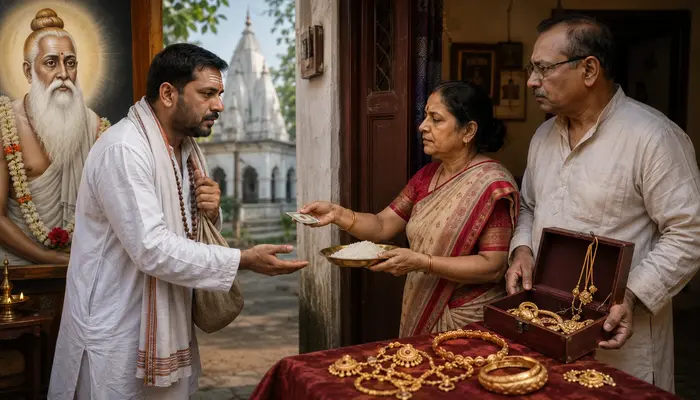
Case Summary
In Khulshi, Chattogram, Bangladesh, a Hindu family of Ajit Ghosh and his wife was deceived by a Muslim man who posed as a devotee of Baba Lokenath and claimed to have come from the Bardi Lokenath Temple in Narayanganj. By impersonating a Hindu ascetic (Baba) and invoking the name of the revered Hindu saint (Baba Lokenath), he gained the trust of the Hindu family and fraudulently obtained approximately 2 bhori and 1 ana of gold ornaments before fleeing. He was introduced to the family by the wife of Ajit Ghosh. Police later arrested the accused and recovered a portion of the stolen property. The incident occurred at the ground-floor residence of Ajit Ghosh, located near Ambagan Nagar Swasthya Clinic under Khulshi Police Station. The accused, Sarowar Sardar (42), son of the late Hamid Sardar and a resident of Krishnakathi Sutalori Bede Palli in Jhalakathi Sadar, arrived at the house disguised as a Hindu sadhu. Folding his hands, he chanted "Joy Baba Lokenath" and introduced himself as a devotee from the Bardi Lokenath Temple in Narayanganj. The accused requested an offering (pranami) of 11 Taka from the Hindu homeowner's wife. Trusting his identity and representation, she brought the money from inside the house. He then asked for rice to be offered as prasad, which the family also provided. Using a series of deceptive tactics while maintaining his false identity as a Hindu devotee, he induced the couple to hand over approximately 2 bhori and 1 ana of gold ornaments, after which he fled the scene. Following the incident, a case was registered at the local police station. Acting on the complaint, police launched an operation and arrested Sarowar Sardar on the night of 22 July 2026 from the Hazarigali area under Kotwali Police Station. During the arrest, police recovered three pairs of gold earrings, five parts of a Sita necklace, one stone-set gold pendant, five ana of melted gold, two smartphones, and BDT 14,000 in cash from the accused's possession. Police identified Sarowar Sardar as an active member of a fraud ring. Khulshi Police Station Officer-in-Charge (OC) Mozammel Hoque stated that the accused had been produced before the court in connection with fraud charges. The incident occurred against the backdrop of escalating hostility towards Hindus in Bangladesh. This escalation of violence against Hindus in Bangladesh has unfolded in three distinct phases: first, following the ouster of Sheikh Hasina's government in August 2024; second, after the death of Sharif Osman Bin Hadi in December 2025; and third, in the immediate aftermath of the 13th National Parliamentary Election in 2026. Following the ouster of Sheikh Hasina, multiple reports documented attacks on Hindu homes, temples, and religious institutions, alongside intimidation campaigns, arson, and mob assaults targeting minority neighbourhoods. The Hinduphobia Tracker recorded 336 such incidents against the Hindu minority, underscoring the scale and persistence of anti-Hindu violence during this period. A further escalation occurred following the death of Sharif Osman Bin Hadi, a Muslim political activist and student leader known for his anti-Hindu and anti-India rhetoric. Hadi had been involved in political unrest after the fall of the Hasina government and was killed in Dhaka on 18th December 2025 during clashes. In the aftermath of his death, Hindu communities were blamed and subsequently targeted in retaliatory violence. Hindu homes were selectively set ablaze in multiple localities, forcing families to flee and leaving many displaced. The attacks appeared patterned rather than sporadic, with Muslim mobs focusing on Hindu neighbourhoods, properties, and religious symbols. Among the victims was Dipu Chandra Das, who was lynched to death and his body was set ablaze by a Muslim mob over false blasphemy allegations. The Hinduphobia Tracker documented 51 incidents of anti-Hindu violence in the period following Hadi's death alone. Reports further indicated that posters and written materials calling for the extermination of Hindus were displayed in public spaces. Alongside incidents of arson, vandalism, assault, intimidation, and organised anti-Hindu mobilisation, these developments contributed to a climate of increasing insecurity for the Hindu minority. The third phase of violence emerged after the 13th National Parliamentary Election in 2026. Within days of the announcement of results, Hindu families in districts including Noakhali, Rangpur, Nilphamari, Sylhet, Thakurgaon, and Dinajpur reported attacks involving arson, looting, assault, and vandalism of temples and homes. In several instances, Hindu homes were selectively targeted, looted, and families were threatened with displacement.
Why it is Hate Crime ?
The primary category for this case is: Attack on Hindu religious representation. The subcategory for this case is: Defiling religious customs. Sanatan Dharma is not a religion of one book, which is to say that while it has religious scriptures that form the central tenets of the faith, there are several traditions followed through thousands of years, mostly passed from generation to generation orally. There are several such customs and traditions that are followed by various Hindus and Hindu sects. Defiling of these traditions and customs is a breach of an individual or group’s religious practices. Such practices can range from dietary restrictions like not eating non-vegetarian food for a certain period of the year, not eating non-vegetarian food at all, not eating beef since the cow is considered holy in Hinduism, the sanctity of religious customs followed in the house (like many ISCKON devotees), etc. Any malicious action leading to the breach of such traditions or defilement of these traditions owing to animosity towards the faith or for the sake of activism stems not only from the lack of faith in the religion itself but also from disregard for the faith of the devotees who follow the customs/traditions and implicit bias against the faith and the tradition itself. Since these specific traditions are central to the faith of the devotees of that specific sect of Hindus, any non-compliance with these traditional rules would be considered a religiously motivated hate crime. This case has been included in the Hinduphobia Tracker because it involved a Muslim man posing as a Hindu devotee of Baba Lokenath, falsely claiming to have come from the Bardi Lokenath Temple in Narayanganj. Introducing himself as a Hindu ascetic, he folded his hands, chanted "Joy Baba Lokenath," and requested pranami and rice for prasad from a Hindu family. These were not genuine acts of devotion but formed part of a calculated deception to gain the family's confidence before fraudulently looting them. The sacred customs of offering pranami and prasad were thereby reduced from acts of religious devotion to instruments of deception. By pretending to be a Hindu ascetic, the accused insulted and disrespected religious practices that occupy an important place in Hindu tradition. Hindu families commonly welcome saints, ascetics, and devotees into their homes and offer them pranami, food, or prasad as acts of religious merit and service. By falsely assuming the identity of a devotee of Baba Lokenath and exploiting these devotional customs, the accused abused the trust that naturally accompanies such religious practices. The deception therefore extended beyond an ordinary act of fraud, as it relied upon the misuse of customs that Hindus observe with sincerity and reverence. In Islamic theology, shirk (associating partners with Allah) is regarded as the gravest sin. Since Hindu traditions involve the worship of multiple deities and the use of murtis (idols), mainstream Islamic theology generally classifies such practices as forms of shirk. Classical Islamic jurisprudence and theology have historically regarded shirk as a serious theological error and have distinguished between monotheistic belief (tawhid) and practices considered polytheistic. The misuse of Hindu religious customs in this manner has wider implications for the Hindu community. Religious traditions such as offering pranami and prasad are founded upon trust, devotion, and respect for the sacred. When these customs are deliberately exploited to facilitate criminal conduct, their sanctity is compromised, and the confidence with which devotees practise these traditions is undermined. The reported conduct therefore constitutes a defilement of Hindu religious customs and has been documented under this category. Disclaimer: The Hinduphobia Tracker has recorded 23 July 2026 as the date of this incident because the exact date on which the accused, posing as a devotee of Baba Lokenath, defrauded the Hindu family is not available in the public domain. Although the accused was arrested on 22 July 2026, the available reports do not specify when the fraud itself took place. Accordingly, the date of the first media report has been used for documentation purposes.
Victim Details
Total Victim
2
Deceased
0
Gender
- Male 1
- Female 1
- Third Gender 0
- Unknown 0
Caste
- SC/ST 0
- OBC 0
- General 0
- Unknown 2
Age Group
- Minor 0
- Adult 1
- Senior Citizen 0
- Unknown 1


Case Status
Complaint registered


Perpetrators Details
Perpetrators
Muslim Extremists
Perpetrators Range
One Person
Perpetrators Gender
male
 Sources




