CJP protest turns sinister; mob invokes lynching of Hindu police officer Ratan Lal by Muslims to threaten officer at Jantar Mantar
 Delhi, Delhi, India
  22 July, 2026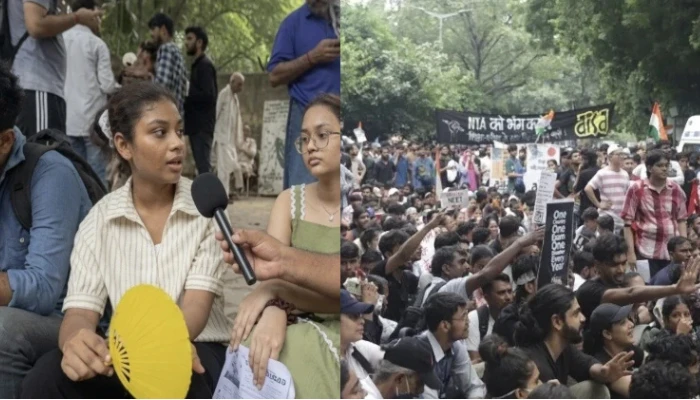
Case Summary
During the protest organised by the Cockroach Janata Party (CJP) at Jantar Mantar in Delhi, a Delhi Police officer was threatened with violence by a group of men who shouted, "Tujhe bhi Ratan Lal banayenge" ("We will make you another Ratan Lal"), invoking the name of Head Constable Ratan Lal, who was killed by a Muslim mob, while performing his official duties during the 2020 Delhi anti-Hindu pogroms. The incident was brought to light by a 17-year-old Hindu student, Rushi Mehra, who announced that she was leaving the protest after revealing that genuine students were being intimidated by groups of "goons" and expressing fears for her safety and future. According to Rushi, the police officer was assaulted by a group of around 10 to 15 individuals while he was merely asking people to move aside. Rushi Mehra shared her account in a video that circulated widely on social media. In the viral video, the student, identified as Rushi Mehra, stated that she was returning home because she could no longer continue participating in the protest. She stated that "there are literally five goons around every genuine student" and further stated that she and her siblings had previously become acquainted with a Delhi Police officer. He was deployed at the protest site. After offering him toffees, the officer told them they could approach him if they needed help. According to her, the officer was merely asking people to move aside when a group of around 10 to 15 individuals suddenly attacked him while shouting, "Tujhe bhi Ratan Lal banayenge." (We will make you another Ratan Lal) Rushi stated that she initially did not understand the meaning of the slogan. However, after searching online, she learnt that Head Constable Ratan Lal of the Delhi Police was killed during the 2020 Delhi anti-Hindu pogroms. From 24 to 26 February 2020, Delhi witnessed large-scale communal violence against Hindus in which Islamist mobs targeted Hindu homes, businesses, and places of worship. Head Constable Ratan Lal, a Hindu man, was among the first victims of the violence and was lynched by an Islamist mob on Wazirabad Road near Chand Bagh while performing his official duties. Rushi said she was shocked after learning the reference and stated that those leading the protest were aware of the presence of disruptive elements but had failed to take any action against them. The student further stated that she had decided to leave the protest because she wanted to protect her future and did not want to become involved in violence or legal complications. She urged other students to leave the "facade", warning that remaining at the protest could jeopardise their careers by associating them with violent elements. Her statements prompted widespread discussion on social media regarding the atmosphere at the protest and the presence of disruptive groups among the demonstrators. The statements made by the student reflected the broader trajectory of the Cockroach Janata Party (CJP), whose public campaigns had increasingly become associated with incidents extending beyond its stated objective of seeking educational reforms. Few social media users argued that intimidation, violence against police personnel, and the invocation of the name of a police officer who was killed during the 2020 Delhi riots bore no connection to the movement's stated demands and instead raised serious concerns about the conduct of those participating in the protest. Notably, the Cockroach Janata Party (CJP) emerged in mid-May 2026 as a satirical, youth-led online movement that rapidly transformed into a mass mobilisation platform for students and unemployed graduates through social media engagement. It was founded by Abhijeet Dipke, a member of the Aam Aadmi Party (AAP), who repurposed a controversial public remark comparing unemployed youth to "cockroaches" as a symbol of collective identity and protest. While Dipke initially portrayed the CJP movement as a genuine, non-partisan, and constitutionally aligned initiative demanding educational reforms, accountability for the National Eligibility cum Entrance Test (NEET) examination paper leak, and the resignation of officials, including the Union Education Minister, the movement soon diverged from its stated objectives. Rather than remaining focused on systemic reforms, it evolved into an ideologically driven campaign characterised by anti-Hindu rhetoric. Its co-founders and participants made derogatory remarks about Hindu deities and religious slogans such as "Jai Shri Ram", abused the Hindu community, raised overtly pro-Islamic slogans such as "Naam rahega Allah ka", "Naara-e-Taqbeer, Allahu Akbar", and increasingly directed their hostility towards Hindu organisations, activists, and the government, which they described as a "Hindutva-led government". By the time it culminated in its first major street-level protest at Jantar Mantar on 6 June 2026, the movement had shifted from a purported students' rights campaign into an overtly anti-Hindu platform. On 6 June 2026, Dipke flew in from the United States to lead the movement's first major street-level protest at Jantar Mantar. AAP-aligned figures attended the event under the guise of being neutral, anti-establishment voices. However, contrary to its stated claim of being a student advocacy movement focused on systemic failures, the CJP's conduct at Jantar Mantar told a starkly different story.
Why it is Hate Crime ?
This case has been added to the tracker under the primary category of Hate Speech against Hindus. The subcategory selected is: Violent threats. Violent threats, explicit, implicit or implied, are the most dangerous form of hate speech since it goes beyond discriminatory and prejudicial language to express the intent of causing harm to an individual or a group of people based on their religious identity and faith. There could be several different kinds of threats that are issued to Hindus based on religious animosity. An explicit threat would mean the direct threat of violence towards an individual Hindu, a group of Hindus or Hindus at large. Physical violence, death threats, threats of destruction of property belonging to Hindus and threats of genocide would mean explicit threats against Hindus for their religious identity. Implicit threats may not be a direct threat but implied through the use of symbols of actions – for example – in the Nupur Sharma case, other than explicit threats, there were also implicit threats when Islamists took to the streets to burn and beat her effigies. It implies that they want to do the same to Nupur Sharma – thereby it is considered an implicit threat. Violent threats can be delivered in person, through letters, phone calls, graffiti, or increasingly through social media and other online platforms. It would be important to understand that a threat – explicit or implicit, online or offline – to an individual who happens to be a Hindu does not qualify as a religiously motivated threat. Such a threat, while vile and dangerous, could be owing to non-religious reasons and/or personal animosity. To qualify as a religiously motivated threat, it would need to exhibit an indication that the individual is being targeted for religious reasons and/or owing to his/her religious identity as a Hindu. This case was included in the Hinduphobia Tracker because it involved a violent threat that invoked the killing of Head Constable Ratan Lal, a Hindu police officer who was lynched during the 2020 Delhi riots while performing his official duty. The threat drew upon a well-known episode of communal violence against a Hindu officer and used it to intimidate another police officer, thereby invoking a past act of religiously charged violence as a warning. The threat assumed greater significance when viewed against the backdrop of the 2020 Delhi riots. Between 24 and 26 February 2020, large-scale communal violence engulfed parts of Delhi, during which Hindu homes, businesses, and places of worship were targeted in several localities. Among the earliest casualties was Head Constable Ratan Lal, who was brutally lynched by an Islamist mob while attempting to restore law and order on Wazirabad Road near Chand Bagh. He lost his life while discharging his official duties, making his killing one of the defining incidents of the communal violence. Against this background, invoking Ratan Lal's killing to threaten a police officer at the Cockroach Janata Party (CJP) protest carried a clear and specific meaning. The reference was not a random expression of violence but recalled the murder of a Hindu police officer during communal riots. By warning that another officer would be made "another Ratan Lal", the perpetrators relied on the memory of that communal killing to instil fear and intimidate a person performing a similar law enforcement role. The threat therefore derived its force from the religious and communal context in which Ratan Lal was killed. Furthermore, the slogan normalised and glorified an act of communal violence by presenting it as a precedent to intimidate another police officer. Rather than treating the lynching of Ratan Lal as a tragic crime, it invoked his killing as a model to be repeated against someone carrying out his lawful duties. Such conduct reflected hostility towards the victim of that communal violence and trivialised the gravity of his murder by converting it into a tool of intimidation. Taken together, the circumstances showed that the threat was deliberate and calculated rather than spontaneous. The perpetrators consciously chose a slogan rooted in a notorious incident of communal violence and used it to terrorise a serving police officer. By invoking the murder of a Hindu officer to threaten another officer, they sought to create fear through the memory of a religiously charged killing. The conduct therefore reflected hostility rooted in that communal context and amounted to a clear instance of violent intimidation directed through the invocation of anti-Hindu communal violence. Disclaimer: The Hinduphobia Tracker has recorded 23 July 2026 as the date of the victim's ordeal because the exact date on which the victim was threatened is not available in the public domain. Accordingly, the date of the first media report has been used. The Hinduphobia Tracker has recorded one victim(1) in this case because, based on the available media reports, one Delhi Police officer was specifically identified as the recipient of the threat. Although other individuals were present at the protest, the reported act of intimidation was directed at a single police officer. The Hinduphobia Tracker has recorded the perpetrator(s) as unknown. Although media reports stated that a group of approximately 10–15 individuals threatened the police officer, no participant was specifically identified or named. Accordingly, the perpetrators were documented as unknown for the tracker.
Victim Details
Total Victim
1
Deceased
0
Gender
- Male 1
- Female 0
- Third Gender 0
- Unknown 0
Caste
- SC/ST 0
- OBC 0
- General 0
- Unknown 1
Age Group
- Minor 0
- Adult 1
- Senior Citizen 0
- Unknown 0


Case Status
Unknown


Perpetrators Details
Perpetrators
Others
Perpetrators Range
From 10 to 100
Perpetrators Gender
unknown
 Sources




