Hindu youth publicly humiliated and forced to wear garland of shoes by Muslim mob over false allegation of blasphemy in Bangladesh
 Barisal, Barisal District, Bangladesh
  22 July, 2026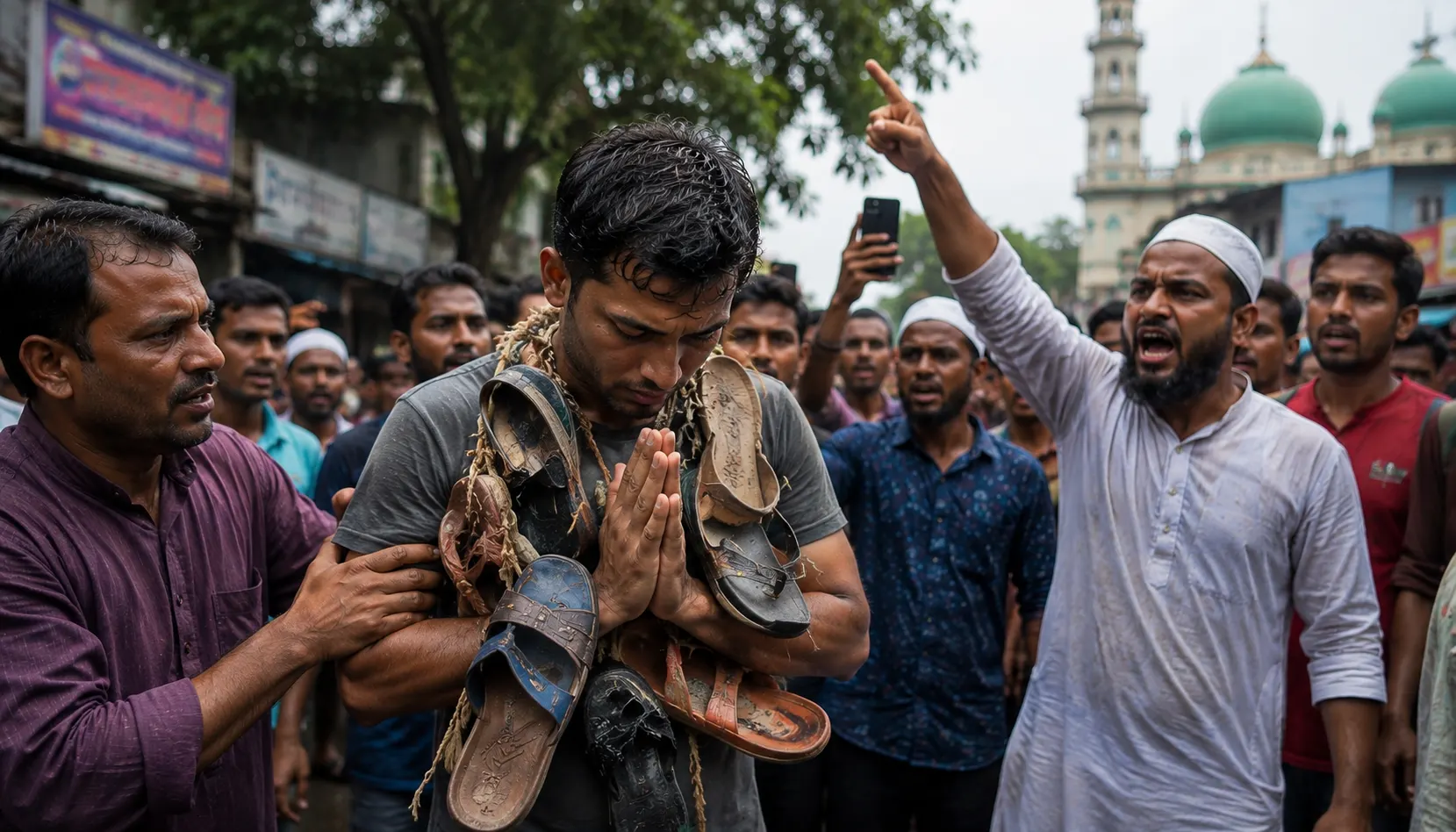
Case Summary
In Banaripara Upazila of Barishal, Bangladesh, a 27-year-old Hindu man, Sanjib Roy, was publicly humiliated by a local Muslim mob following false allegations that he had made derogatory remarks about Prophet Muhammad. Instead of being produced before law enforcement for due legal process, the Hindu youth was detained by members of the crowd, forced to wear a garland of shoes, and paraded through a local market before being compelled to issue a public apology. The incident has drawn attention due to the use of extrajudicial public humiliation in response to an unverified allegation of religious insult. According to local news reports, the incident occurred in the Gopal Market area of Ektarhat under Syedkathi Union in Banaripara Upazila, Barishal. The victim was identified as Sanjib Roy (27), son of Sharat Roy. Local residents accused him of making offensive remarks concerning Prophet Muhammad. As news of the alleged remarks spread throughout the locality, a crowd gathered, detained the Hindu youth, and subjected him to public humiliation. Eyewitness accounts state that members of the crowd forced Sanjib Roy to wear a garland made of shoes and paraded him through the market in full public view. During the incident, he was also compelled to fold his hands, apologise publicly, admit to the alleged remarks attributed to him, and assure those present that he would not make such comments again. The public humiliation reportedly took place before a large gathering of residents. Following the public apology, residents released the Hindu youth into the custody of his father rather than handing him over to the police. At the time of reporting, there was no publicly available confirmation that any formal criminal complaint or police case had been registered against Sanjib Roy in connection with the allegations. Likewise, there was no official indication that any legal action had been initiated against those involved in detaining and publicly humiliating him. The incident generated widespread discussion within the locality, with public attention focusing both on the allegation of religious insult and on the extrajudicial punishment inflicted upon the Hindu youth by the assembled crowd. The events occurred against the backdrop of escalating hostility towards Hindus in Bangladesh. This escalation of violence against Hindus in Bangladesh has unfolded in three distinct phases: first, following the ouster of Sheikh Hasina's government in August 2024; second, after the death of Sharif Osman Bin Hadi in December 2025; and third, in the immediate aftermath of the 13th National Parliamentary Election in 2026. Following the ouster of Sheikh Hasina, multiple reports documented attacks on Hindu homes, temples, and religious institutions, alongside intimidation campaigns, arson, and mob assaults targeting minority neighbourhoods. The Hinduphobia Tracker recorded 336 such incidents against the Hindu minority, underscoring the scale and persistence of anti-Hindu violence during this period. A further escalation occurred following the death of Sharif Osman Bin Hadi, a Muslim political activist and student leader known for his anti-Hindu and anti-India rhetoric. Hadi had been involved in political unrest after the fall of the Hasina government and was killed in Dhaka on 18th December 2025 during clashes. In the aftermath of his death, Hindu communities were blamed and subsequently targeted in retaliatory violence. Hindu homes were selectively set ablaze in multiple localities, forcing families to flee and leaving many displaced. The attacks appeared patterned rather than sporadic, with Muslim mobs focusing on Hindu neighbourhoods, properties, and religious symbols. Among the victims was Dipu Chandra Das, who was lynched to death and his body was set ablaze by a Muslim mob over false blasphemy allegations. The Hinduphobia Tracker documented 51 incidents of anti-Hindu violence in the period following Hadi's death alone. Reports further indicated that posters and written materials calling for the extermination of Hindus were displayed in public spaces. Alongside incidents of arson, vandalism, assault, intimidation, and organised anti-Hindu mobilisation, these developments contributed to a climate of increasing insecurity for the Hindu minority. The third phase of violence emerged after the 13th National Parliamentary Election in 2026. Within days of the announcement of results, Hindu families in districts including Noakhali, Rangpur, Nilphamari, Sylhet, Thakurgaon, and Dinajpur reported attacks involving arson, looting, assault, and vandalism of temples and homes. In several instances, Hindu homes were selectively targeted, looted, and families were threatened with displacement.
Why it is Hate Crime ?
The primary category for this case is: Attack not resulting in death. The subcategory for this case is: Attacked over 'Blasphemy' Blasphemy essentially refers to the desecration of anything which is held sacred/holy to a group of people. However, for religious supremacist groups, the elements of ‘blasphemy’ are ever-changing, shifting and expanding – leading to infringement on the rights of other religious groups, freedom of speech and expression, threats and even physical violence. There are instances where blasphemy is also used as a dog whistle to target Hindus owing to intrinsic animosity towards Hinduism. There are several instances where stating truths as mentioned in the non-Hindu doctrine itself has led to unmitigated violence against Hindus. There have also been instances where non-Hindus have themselves created a ‘blasphemous’ situation, like placing a Quran in a temple, to use it as an excuse to attack Hindus. Essentially, Blasphemy charges are often made up and/or are used to shut down any form of criticism of non-Hindu faiths and as a tool to target Hindus. Any physical violence over Blasphemy charges against Hindus is foundationally based on animosity for Hindus and their faith owing to religious supremacist ideologies; therefore, such attacks would be documented as religiously motivated hate crimes under this category. The next subcategory for this case is: Attacked for Hindu identity. In several cases, Hindus are attacked merely for their Hindu identity without any perceived provocation. A classic example of this category of religiously motivated hate crime is a murder in 2016. 7 ISIS terrorists were convicted for shooting a school principal in Kanpur because they got ‘triggered’ seeing the Kalava on his wrist and the tilak that he had put. In this, the Hindu victim had offered no provocation except for his Hindu religious identity. The motivation for the murder was purely religious, driven by religious supremacy. Such cases where Hindus are targeted merely for their religious identity would be documented as hate crimes under this category. This case is a clear example of a religiously motivated hate crime, where a Hindu man was subjected to extrajudicial public humiliation following unverified allegations that he had made derogatory remarks about Prophet Muhammad. Regardless of whether the allegations were true, the victim was denied the presumption of innocence and was instead punished by a local Muslim mob without any judicial determination of guilt. Rather than allowing the matter to be addressed through lawful procedures, members of the crowd detained the Hindu youth, forced him to wear a garland of shoes, paraded him publicly, and compelled him to apologise. The allegation of blasphemy thus became the immediate trigger for collective punishment, making this a clear case of an attack over alleged blasphemy. Without any verification of whether any blasphemous act had actually occurred, the Hindu youth was humiliated by the Muslim community through protests, public pressure, and coordinated mobilisation. This escalation occurred purely based on circulating claims, yet it rapidly created a situation where even law enforcement did not intervene against the accused. The public arbitrary act took place in an environment shaped by intense communal pressure rather than by a completed evidentiary assessment, demonstrating how accusation alone becomes sufficient to initiate coercive action against Hindus. This reflects a serious distortion of due process, where perception replaces proof, and the Hindu accused is treated as guilty by the Muslim community by default in cases involving alleged insult to Islam. Blasphemy allegations in Muslim-majority societies such as Bangladesh have repeatedly been used as a catalyst for mob violence and vigilantism against religious minorities, particularly Hindus. In many instances, the mere accusation of insulting Islam or Prophet Muhammad is sufficient to provoke public outrage and extrajudicial punishment, irrespective of whether the allegation is ever substantiated through due process. Such accusations frequently result in intimidation, social ostracisation, physical assault, destruction of property, forced apologies, arbitrary detention, or even killings. This pattern creates an environment where Hindus remain especially vulnerable, as an allegation alone is often enough to expose them to violence and humiliation before any impartial investigation takes place. Muslim extremist groups have historically exploited blasphemy accusations to intimidate religious minorities, particularly Hindus, silence dissent, and reinforce social control. Hindus in Bangladesh remain especially vulnerable because allegations involving Islam frequently trigger collective outrage and public vigilantism regardless of whether the accusations have been independently verified. Such allegations have repeatedly preceded Muslim mob attacks, destruction of Hindu homes and temples, forced displacement, arrests, and other forms of persecution across Bangladesh. Consequently, accusations of blasphemy against Hindus cannot be viewed in isolation from the broader environment of anti-Hindu hostility in which they occur. The mob's actions in this case further demonstrate that the objective extended beyond merely expressing outrage at the alleged remarks. By forcing the Hindu victim to wear a garland of shoes, a symbol widely associated with public disgrace and degradation in South Asia and parading him through a public marketplace, the perpetrators sought to humiliate and dishonour him before the wider community. Such acts are intended not merely to punish the individual but also to send a message of intimidation to the broader Hindu community that perceived offences against Islamic sentiments will invite collective retribution outside the framework of law. The coercive public apology extracted from the victim further reinforces that the punishment was imposed through mob pressure rather than any legal process. The victim's Hindu identity is also central to understanding the religiously motivated nature of the incident. As a member of the Hindu minority in Bangladesh, he was singled out for collective humiliation by members of the Muslim community over an allegation relating to Islam. The fact that a public spectacle was created around his humiliation, instead of pursuing established legal mechanisms, reflects a broader pattern in which Hindu minorities are disproportionately vulnerable to mob justice in cases involving alleged religious offences. The attack therefore cannot be viewed solely as a response to an alleged act of blasphemy; it also illustrates how a Hindu individual was publicly degraded in a religiously charged environment because he belonged to a minority community with limited social protection. The incident also demonstrates the failure of the rule of law, as the crowd assumed the role of judge and executioner by punishing any legal determination of guilt. Even if an allegation of religious insult had been made, the appropriate course of action would have been to report the matter to the competent authorities and allow an impartial investigation. Instead, the victim was subjected to public humiliation through mob coercion, highlighting how accusations relating to Islam are capable of bypassing due process and enabling collective punishment. Such incidents contribute to a broader climate of fear and insecurity among Hindus in Bangladesh, reinforcing the perception that allegations involving Islamic religious sentiments can rapidly translate into extrajudicial violence and intimidation against members of the Hindu minority. Overall, since this case extends to the parameters of a religiously driven hate crime, it has been added to the hate crime database of the Hinduphobia Tracker. Disclaimer: Hinduphobia Tracker records incident dates based on when the alleged offence occurred rather than when it was reported by the media. However, in this case, the reports do not specify the exact date of the incident. Therefore, 23 July 2026, the date on which the incident was reported in the media, has been recorded as the indicative incident date for documentation purposes only.
Victim Details
Total Victim
1
Deceased
0
Gender
- Male 1
- Female 0
- Third Gender 0
- Unknown 0
Caste
- SC/ST 0
- OBC 0
- General 0
- Unknown 1
Age Group
- Minor 0
- Adult 1
- Senior Citizen 0
- Unknown 0


Case Status
Unknown


Perpetrators Details
Perpetrators
Muslim Extremists
Perpetrators Range
Unknown
Perpetrators Gender
unknown
 Sources




