Hindu man targeted and threatened for chanting Lord Ram's name while pro-Islamic slogans openly raised at CJP protest in Delhi
 Delhi, Delhi, India
  17 July, 2026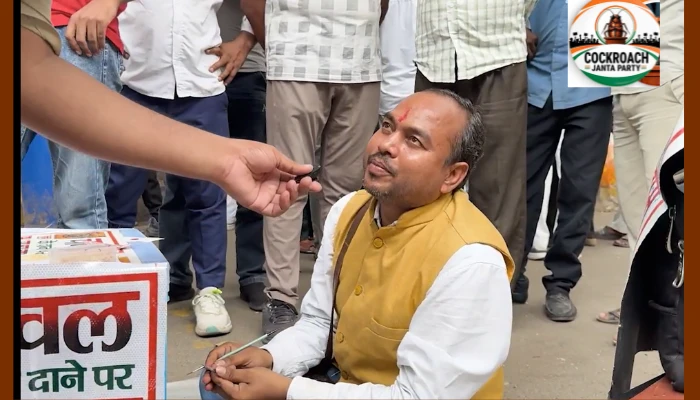
Case Summary
At the protest organised by the Cockroach Janata Party (CJP) at Jantar Mantar in Delhi, a Hindu devotee was threatened for chanting the name of Lord Ram by the protestors. Meanwhile, slogans such as "Sirf Allah ka Naam Rahega" were being raised openly at the protest venue. The incident came to light after a video of the interaction went viral on social media. In the viral video, the Hindu devotee, identified as Manish Pal, told the media that he had come to the protest to spread the message and power of Lord Ram. He explained that chanting the name of Lord Ram purified the mind, removed evil thoughts, and inspired people not to harm others. Seated on the ground beside a box stating that he would inscribe the name of Lord Ram on grains of rice, and that anyone who approached him would receive a grain of rice with "Ram" written on it free of cost. Manish Pal further told the media that while he was peacefully chanting the name of Lord Ram and distributing the inscribed grains of rice, some CJP supporters approached him and objected to his religious activity. He stated that they told him that the name of Lord Ram would not be allowed there and threatened him for publicly chanting "Ram-Ram". During the same interaction, the reporter also revealed that slogans such as "Sirf Allah ka Naam Rahega" (Only Allah's name will remain) were being raised openly at the protest venue, yet a Hindu devotee was being threatened merely for chanting the name of Lord Ram. The contrast highlighted the differing treatment accorded to religious expressions at the same gathering. The incident reflected the broader ideological trajectory of the Cockroach Janata Party (CJP), whose public campaigns had increasingly shifted from education-related demands towards rhetoric perceived by many as hostile to Hindu symbols, traditions, and religious identity. Critics argued that objecting to the peaceful chanting of Lord Ram's name and threatening a Hindu devotee for distributing religious tokens had no connection with the movement's stated objective of seeking educational reforms and instead amounted to hostility towards Hindu religious expression. Notably, the Cockroach Janata Party (CJP) emerged in mid-May 2026 as a satirical, youth-led online movement that rapidly transformed into a mass mobilisation platform for students and unemployed graduates through social media engagement. It was founded by Abhijeet Dipke, a member of the Aam Aadmi Party (AAP), who repurposed a controversial public remark comparing unemployed youth to "cockroaches" as a symbol of collective identity and protest. While Dipke initially portrayed the CJP movement as a genuine, non-partisan, and constitutionally aligned initiative demanding educational reforms, accountability for the National Eligibility cum Entrance Test (NEET) examination paper leak, and the resignation of officials, including the Union Education Minister, the movement soon diverged from its stated objectives. Rather than remaining focused on systemic reforms, it evolved into an ideologically driven campaign characterised by anti-Hindu rhetoric. Its co-founders and participants made derogatory remarks about Hindu deities and religious slogans such as "Jai Shri Ram", abused the Hindu community, raised overtly pro-Islamic slogans such as "Naam rahega Allah ka", "Naara-e-Taqbeer, Allahu Akbar", and increasingly directed their hostility towards Hindu organisations, activists, and the government, which they described as a "Hindutva-led government". By the time it culminated in its first major street-level protest at Jantar Mantar on 6 June 2026, the movement had shifted from a purported students' rights campaign into an overtly anti-Hindu platform. On 6 June 2026, Dipke flew in from the United States to lead the movement's first major street-level protest at Jantar Mantar. AAP-aligned figures attended the event under the guise of being neutral, anti-establishment voices. However, contrary to its stated claim of being a student advocacy movement focused on systemic failures, the CJP's conduct at Jantar Mantar told a starkly different story.
Why it is Hate Crime ?
This case has been added to the tracker under the primary category: Attack not resulting in death. Within this, the subcategory selected is Attacked for Hindu identity. In several cases, Hindus are attacked merely for their Hindu identity without any perceived provocation. A classic example of this category of religiously motivated hate crime is a murder in 2016. 7 ISIS terrorists were convicted for shooting a school principal in Kanpur because they got ‘triggered’ seeing the Kalava on his wrist and the tilak that he had put. In this, the Hindu victim had offered no provocation except for his Hindu religious identity. The motivation for the murder was purely religious, driven by religious supremacy. Such cases where Hindus are targeted merely for their religious identity would be documented as a hate crime under this category. This case was included in the Hinduphobia Tracker because the Hindu devotee was targeted solely for publicly expressing his faith through chanting the name of Lord Ram and distributing grains of rice inscribed with "Ram". The hostility arose not from any unlawful or provocative conduct, but from a peaceful act of Hindu religious expression, making the devotee's religious identity the central reason for the confrontation. For Hindus, chanting the name of Lord Ram is a deeply revered spiritual practice believed to purify the mind, strengthen devotion, and cultivate righteous conduct. Similarly, writing and distributing the name of the deity as a sacred token is an accepted form of religious devotion. Consequently, objecting to and threatening a person for engaging in these peaceful religious practices amounted to interference with the free expression of Hindu faith rather than an ordinary disagreement. The conduct directly targeted a visible manifestation of Hindu religious identity. Furthermore, the surrounding circumstances reinforced the religious nature of the incident. While other religious slogans were openly raised at the same venue without objection, a Hindu devotee was confronted and threatened for invoking the name of Lord Ram. This selective hostility demonstrated that the objection was directed specifically at the public expression of Hindu beliefs rather than at religious expression in general. Such unequal treatment reflected prejudice against Hindu religious practices and denied a Hindu devotee the freedom to peacefully practise and express his faith. Moreover, the Hindu devotee had been sitting peacefully at the protest site and was neither interfering with nor compelling anyone to participate in his religious activity. He merely continued his devotional practice and engaged only with those who voluntarily approached him to receive a grain of rice inscribed with the name of Lord Ram. Despite this peaceful and non-intrusive conduct, he was threatened solely because he was openly worshipping a Hindu deity and expressing his Hindu faith. This demonstrated that the hostility was directed not at his conduct, but at the Hindu religious practice itself. Such conduct revealed contempt towards Hindu religious identity. Their actions were aimed at preventing the devotee from continuing a peaceful act of worship and discouraging the open invocation of Lord Ram in a public space. The motive, as reflected in their conduct and the surrounding circumstances, was to suppress a visible expression of Hindu faith because it was Hindu in nature. The incident therefore constituted a targeted act against a Hindu devotee's religious identity and his right to freely profess and practise his religion. Disclaimer: The Hinduphobia Tracker has recorded 19 July 2026 as the date of the victim's ordeal because the exact date on which the victim was threatened is not available in the public domain. Accordingly, the date of the first media report has been used.
Victim Details
Total Victim
1
Deceased
0
Gender
- Male 1
- Female 0
- Third Gender 0
- Unknown 0
Caste
- SC/ST 0
- OBC 0
- General 0
- Unknown 1
Age Group
- Minor 0
- Adult 1
- Senior Citizen 0
- Unknown 0


Case Status
Unknown


Perpetrators Details
Perpetrators
Others
Perpetrators Range
Unknown
Perpetrators Gender
unknown
 Sources




