Hindu temple's sanctity defiled; Muslim man spat, urinated, kicked and broke the Shivalinga in Hamirpur, Uttar Pradesh
 Hamirpur, Uttar Pradesh, India
  18 July, 2026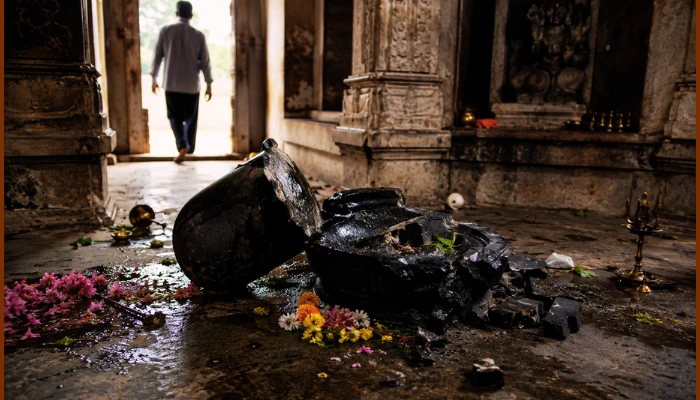
Case Summary
In Nauranga village, Hamirpur district, Uttar Pradesh, the sanctity of a Hindu temple was defiled, and the sacred Shivalinga was desecrated when a Muslim man named Hateem spat on a sacred Shivalinga, urinated on it, and kicked it, causing the Shivalinga to break. According to media reports, the incident took place at a temple in Nauranga village. As per a video about the incident, a local was seen stating that the accused entered the temple premises, spat on the sacred Shivalinga, urinated on it, and then kicked it, causing the Shivalinga to become dislodged from its place and break. The villager stated that the accused was under the influence of alcohol when he committed the act. The incident sparked outrage among the villagers, who caught the accused at the scene before he could flee and handed him over to the police. Deputy Superintendent of Police Rajeev Pratap Singh stated that Majhgawan police received information from villagers regarding the desecration of the Shivalinga inside the temple. A police team immediately reached the spot. During the preliminary investigation, it was found that the accused had removed the Shivalinga from its place while under the influence of alcohol. The police took the accused into custody without delay. Based on a complaint filed by the temple committee, the Majhgawan police registered a case against the accused under the relevant legal provisions and initiated further legal proceedings. Police stated that the law-and-order situation in the village remained peaceful. As a precautionary measure, additional police personnel were deployed in the area while further investigation and other necessary legal action continued.
Why it is Hate Crime ?
The primary category selected in this case is: Attack on Hindu religious representations. The subcategory selected is: Desecration of Hindu religious symbols. Icons and symbols or a religious representation of a spiritual ideal are widely revered in Hinduism. Iconography is of vital significance in the Hindu milieu. It helps connect people’s spiritual beliefs with the real world. Iconography within the Hindu faith takes several shapes and forms. Murtis are of most significance to Hindus, to which daily rituals, prayers and offerings are done. Besides the murtis, there are several other symbols which have deep significance in the Hindu faith – the Om and Swastika for example. Since these Hindu religious symbols hold paramount importance in Hinduism, any desecration of symbols, icons, murtis, religious representations and manifestations is driven by animosity towards the faith itself, which manifests itself through these murtis, icons and symbols. Therefore, any desecration of these Hindu religious symbols and representations is considered religiously motivated hate crimes under this category. The other subcategory selected is: Breaking rules of place of worship. Sanatan Dharma is not a religion of one book, which is to say that while it has religious scriptures that form the central tenets of the faith, there are several traditions followed through thousands of years, mostly passed from generation to generation orally. One of these oral traditions or written traditions is the rules of specific temples. Certain temples have rules that are traditional, dependent on the worship of the presiding deities. These rules and traditions have been followed for thousands of years, whether they find scriptural mention or not. Such traditions are based on the nature and rules of worship of the presiding deity of that temple. Any non-compliance with these traditions owing to animosity towards the faith or for the sake of activism stems not only from the lack of faith in the presiding deity but also from disregard for the faith of the devotees of that deity/temple and implicit bias against the faith, the tradition and the deity itself. Since these specific traditions are central to the faith of the devotees of that specific temple and presiding deity, any non-compliance with these traditional rules would be considered a religiously motivated hate crime. The other subcategory selected is: Defiling religious customs. Sanatan Dharma is not a religion of one book, which is to say that while it has religious scriptures that form the central tenets of the faith, there are several traditions followed through thousands of years, mostly passed from generation to generation orally. There are several such customs and traditions that are followed by various Hindus and Hindu sects. Defiling of these traditions and customs is a breach of an individual or group’s religious practices. Such practices can range from dietary restrictions like not eating non-vegetarian food for a certain period of the year, not eating non-vegetarian food at all, not eating beef since the cow is considered holy in Hinduism, the sanctity of religious customs followed in the house (like many ISCKON devotees), etc. Any malicious action leading to the breach of such traditions or defilement of these traditions owing to animosity towards the faith or for the sake of activism stems not only from the lack of faith in the religion itself but also from disregard for the faith of the devotees who follow the customs/traditions and implicit bias against the faith and the tradition itself. Since these specific traditions are central to the faith of the devotees of that specific sect of Hindus, any non-compliance with these traditional rules would be considered a religiously motivated hate crime. The other subcategory selected is - Attack on temples. In Hinduism, a temple is the abode of the Deity. The Deity in the Temple is consecrated, thereby making it a real, breathing entity. Hindus believe that not just the Deity but the temple premises themselves are sacred to Hindus since Hindus hold the faith that the entire Temple space is an amalgamation of the divine energy of the deity. Given the central significance of Temples in Hindu Dharma, any attack against a Hindu Temple or its peripheral premises is an attack on the faith itself and is born out of animosity towards the faith, of which the Temple is a central tenet. Any manner of attack against a Temple and/or its premises would therefore be considered a religiously motivated hate crime. The case was included in the Hinduphobia Tracker because a sacred Hindu temple and one of the holiest symbols of Hindu worship, the Shivalinga, were deliberately desecrated through acts that were inherently insulting and sacrilegious. The conduct was not limited to causing physical damage but involved acts that are universally regarded as a grave defilement of a sacred object of worship, thereby directly attacking the religious beliefs and dignity of Hindu devotees. The Shivalinga is one of the most revered representations of Lord Shiva and is worshipped daily through prayers, rituals, and offerings. In Hindu belief, it is not a mere stone or religious object but a consecrated manifestation of the deity. The conduct of the accused constituted an intentional desecration of a sacred Hindu religious symbol. Such acts went far beyond ordinary vandalism because they specifically targeted an object that holds profound spiritual significance for Hindus, making the religious identity of the symbol central to the offence. Furthermore, the desecration occurred inside a functioning Hindu temple, a consecrated place governed by established religious customs and standards of ritual purity. By entering the temple solely to subject the Shivalinga to repeated acts of defilement, the perpetrator violated the sanctity of the place of worship itself and displayed complete disregard for the religious rights and beliefs of Hindu devotees. Here it is important to mention that an eyewitness revealed that the accused was under the influence of alcohol at the time of the incident. However, this does not dilute the religious nature of the offence. While intoxication may impair judgment, it often brings to the surface impulses and prejudices that a person might otherwise restrain. Even in that state of intoxication, his decision to defile the Shivalinga reflects the deep-seated hostility he harboured towards the Hindu faith, which manifested in directing his actions against one of its holiest religious symbols. Rather than engaging in random or indiscriminate misconduct, he carried out a sustained sequence of degrading acts by spitting on the Shivalinga, urinating on it, repeatedly kicking it, and ultimately breaking it. Even if it is argued that the accused was not fully in his senses, the selective nature of his actions cannot be ignored. The accused did not wander into a random public place or engage in indiscriminate vandalism. He did not target a place of worship belonging to another faith, such as a mosque or a church. Rather, he specifically entered a Hindu temple and targeted the sacred Shivalinga. This demonstrated that he remained aware of the nature of the place and the object he chose to attack. Taken together, the surrounding circumstances revealed a conscious contempt for Hindu religious beliefs rather than a spontaneous act of disorder. The repeated acts of desecration, carried out against one of Hinduism's most sacred symbols within a consecrated temple, demonstrated a deliberate disregard for the sanctity of Hindu places of worship and the faith of their devotees. Consequently, the incident constituted a religiously motivated act targeting Hinduism and its followers, warranting its inclusion in the Hinduphobia Tracker as a hate crime. Disclaimer: The Hinduphobia Tracker has recorded 19 July 2026 as the date when the act was carried out because the exact date on which the defilement occurred is not available in the public domain. Accordingly, the date of the first media report has been used for documentation purposes.


Case Status
Complaint filed


Perpetrators Details
Perpetrators
Muslim Extremists
Perpetrators Range
One Person
Perpetrators Gender
male
 Sources




