Hindu woman duped into temple marriage by married Muslim man impersonating a Hindu; coerced into converting to Islam and solemnising nikah after his true identity emerged
 Rudraprayag, Uttarakhand, India
  20 July, 2026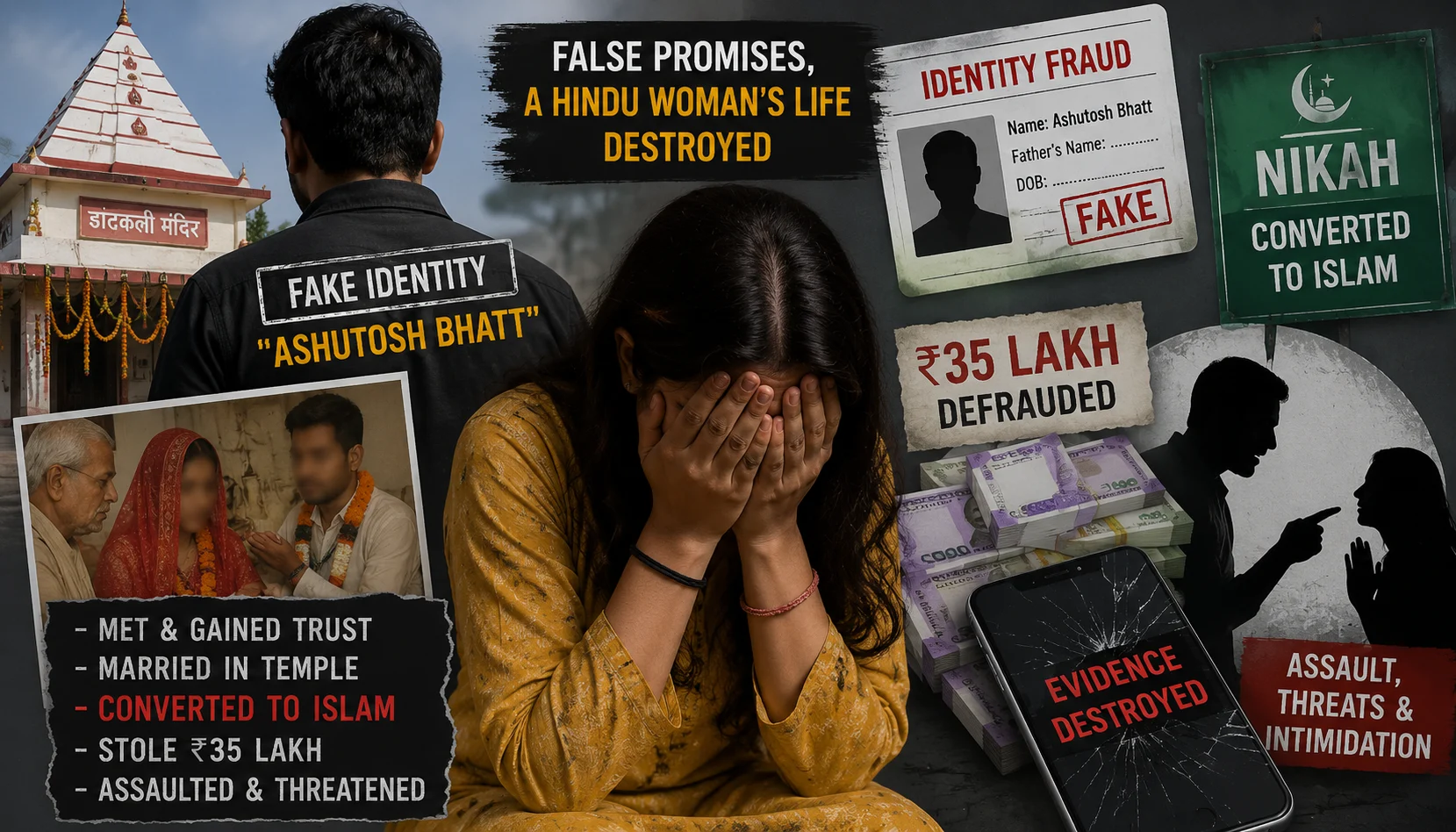
Case Summary
In Rudraprayag, Dehradun, Uttarakhand, a Hindu woman, Aarti, a resident of Shimla Enclave, was deceived into a relationship by a Muslim man identified as Shamshad Ali, who converted the victim and performed Nikah, and introduced himself to her under the concealed Hindu identity of Ashutosh Bhatt. According to the victim, the accused, who is originally from Rudraprayag, communicated with her in "Garhwali", as both belonged to the Garhwal region. By posing as a Garhwali Hindu and concealing his actual identity, he gained the trust of the Hindu woman. The two subsequently got married at Datkali Temple, where Aarti, her mother, and the accused were present. During the ceremony, Aarti submitted her genuine Aadhaar card, whereas the accused produced a forged Aadhaar card identifying himself as "Ashutosh Bhatt", thereby concealing his true identity. After the victim tied the knot with the accused as per Hindu rituals, she discovered the accused's real identity. When she confronted him regarding the deception, the accused convinced her that he would remarry her, but this time as per Islamic rites (Nikah). He subsequently called a Maulvi who converted Aarti and solemnised their Nikah. The accused assured the victim that he would remain with her permanently. It later emerged that Shamshad Ali was already married and was the father of three children, a fact that had not been disclosed to the Hindu woman until now. The accused was residing in Harbhajwala, Mehuwala, near Anna Hazare Chowk, Dehradun. According to the victim, he induced the Hindu woman and her family to sell their only plot of land, valued at approximately ₹35 lakh, by helping them secure a buyer. After facilitating the transaction, he misappropriated the entire ₹35 lakh, depriving the Hindu family of what they described as their only financial asset and savings. On the night of 21 July, the accused forced his way into Aarti's parents' house, where he assaulted Aarti's mother and engaged in a physical altercation with her. When the victim and her family warned him with a police complaint and threatened to tell others about the incident, the accused broke the mobile phone that contained evidence relating to the case. He also threatened Aarti with death if she disclosed the incident or approached the authorities. A police complaint has been filed by the victim and the people from the community against the Muslim perpetrator.
Why it is Hate Crime ?
The primary category for this case is: Crime against women in relationships and other sexual crimes. Within this, the selected subcategory is: Man pretends to be Hindu. The tertiary category for this case is: Name Changed. The next tertiary category for this case is: Marries as per Hindu rituals. When a non-Hindu man pretends to be a Hindu to deceive a Hindu woman into a relationship, the act is seen as triggered by mala fide intentions. In some cases, the woman eventually accepts the man’s original religious identity and converts after the man’s identity is revealed. These cases could be argued as cases of religious brainwashing and a result of the pressure a woman feels after getting into a relationship with a man. The woman, it can be argued, also changed her religious identity because of the stigma she believes she might face if she chooses to walk out of a deceptive relationship. However, for the purpose of documenting hate crimes, the cases in this subcategory are limited to those where there is explicit violence aimed at religious conversion against the wishes of the victim (force-feeding beef, blackmailing with intimate videos, rape on refusal to convert, etc), or if the woman herself complains of the man’s religious deception. In such cases, it is established that the deception of the non-Hindu man had a specific aim of religious conversion or targeting of the victim due to her Hindu religious identity, therefore making it a religiously motivated hate crime. The other subcategory for this case is: Forced conversion after marriage. The tertiary category for this case is: Forced to do Nikah. In such cases, a non-Hindu man is in a relationship with a Hindu woman when the pressure to convert her religion begins to manifest. In such cases, typically, two patterns emerge. First, when the relationship is consensual and the religious identity of the perpetrator is known to the Hindu woman in the relationship, however, at some point during the relationship, the non-Hindu man starts to force the victim to convert her religion and give up her Hindu religious identity. The second is when the woman marries the man, pretending to share her faith. Later, when the truth is revealed, the man starts pressuring the woman to convert her religion and give up her religious identity. In both situations, the methods used to force the victim to convert her religion often revolve around force-feeding beef, forcing her to wear hijab, forcing her to read the Kalma or even pressurising the victim to do ‘Nikah’, which is marriage under Islamic law, with a prerequisite being conversion to Islam. Cases where a Hindu woman consensually converts to Islam in a relationship will be left out of the hate crime database, even though it could be argued in several cases that the conversion was a result of religious brainwashing. This case qualifies as a religiously motivated hate crime because the victim states that the accused deliberately concealed his religious identity by assuming a Hindu name, "Ashutosh Bhatt," and presenting forged identity documents to facilitate a marriage according to Hindu rituals. The deception was not incidental but was directly connected to the victim's religious identity as a Hindu woman. According to the victim, once the temple marriage had taken place and the accused's real identity was revealed, he insisted that she abandon her Hindu religious identity, undergo conversion to Islam, and participate in a Nikah ceremony. The sequence of acts religious deception, temple marriage under a false Hindu identity, followed by conversion and Nikah after disclosure of the accused's identity supports the conclusion that religion was central to the offence rather than merely incidental to the relationship. The victim's account indicates that her consent to the relationship and temple marriage was based on the belief that she was marrying a fellow Hindu. She only became aware of his true identity after the marriage had already taken place. This concealment deprived the Hindu woman of the opportunity to make an informed decision regarding marriage and her religious identity. The subsequent demand that she convert to Islam and participate in a Nikah fundamentally altered the nature of the relationship from the one to which she believed she had consented. The sequence of deception followed by religious conversion and solemnisation of a nikah suggests that the temple marriage was never intended to be treated as valid by the accused and that acceptance of an Islamic marriage became the ultimate objective. This incident, viewed in its entirety, acquired the characteristics of a religiously targeted offence because the conduct was directed at changing the religious identity of a Hindu individual by exploiting his vulnerable circumstances and dependence on spiritual intervention. Such actions stem from inherent hostility towards the victim's professed faith, as Abrahamic faiths believe that any non-adherent to the faith is subject to being dehumanised until they convert. Such acts were not merely personal crimes; they were rooted in a desire to dominate and erase the religious identity of the victim. Since such predatory actions stem from doctrinal animosity towards the Hindu faith and its followers, this case is being documented as a religiously motivated hate crime.
Victim Details
Total Victim
1
Deceased
0
Gender
- Male 0
- Female 1
- Third Gender 0
- Unknown 0
Caste
- SC/ST 0
- OBC 0
- General 0
- Unknown 1
Age Group
- Minor 0
- Adult 1
- Senior Citizen 0
- Unknown 0


Case Status
Complaint filed


Perpetrators Details
Perpetrators
Muslim Extremists
Perpetrators Range
One Person
Perpetrators Gender
male
 Sources




