Hindus targeted by Bangladeshi Muslim politician; calls for removal of Hindus from state institutions and banning Hindu organisation
 Dhaka District, Bangladesh
  10 July, 2026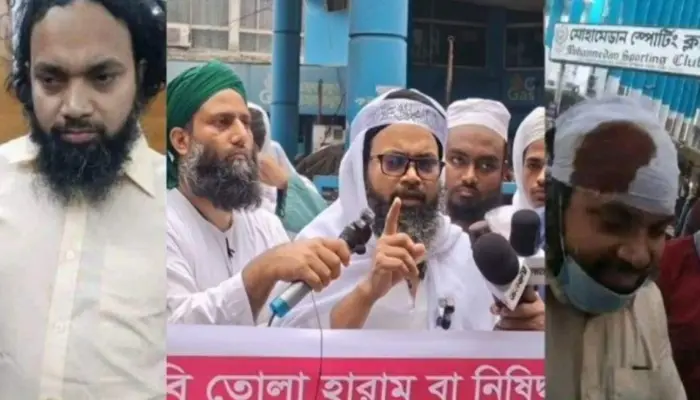
Case Summary
Hindus were targeted by Arif Al Khabir, the convener of the platform Students-Workers-People Establishing Justice, delivering a speech in Dhaka calling for the removal of Hindus from Bangladesh's state institutions and urging the government to ban organisations he associated with the Hindu community. Addressing a rally on 11 July 2025, he demanded that Hindus be expelled from the secretariat, police, administration, Border Guard Bangladesh (BGB), and the armed forces, asserting that such measures were necessary to protect the country's sovereignty and national security. He also called for a ban on India's intelligence agency RAW, ISKCON, the Hindu Mahajote, and the Sanatan Vidyarthi Sangathan, portraying them as threats to Bangladesh. During the speech, Arif Al Khabir described Hindus as agents of India and argued that whenever members of the Hindu community encountered difficulties, they sought India's intervention. Referring to an earlier incident involving the cutting of a banana tree near a temple in Mirpur, he claimed that the subsequent arrests were made under pressure from India and used the episode to reinforce his assertion that Hindus acted in India's interests. He further alleged that Bangladesh had suffered because of Hindus and called for them to be overthrown, reiterating his demand that Hindu organisations and ISKCON be prohibited from operating in the country. The speech drew widespread attention after videos of his remarks circulated on social media, prompting calls for action against him. Arif Al Khabir had previously come under public scrutiny in January 2025 following an attack on indigenous student protesters outside the National Curriculum and Textbook (NCTB) building in Dhaka. He and another individual, Md. Abbas, were arrested in connection with the attack after appearing with bandages that were later reported to have been staged, as police stated that neither had sustained injuries. Later, photographs showing them applying fake bandages were published in the media, further fuelling controversy surrounding the incident.
Why it is Hate Crime ?
In this case, the primary category selected is: Hate Speech against Hindus. Within this, the subcategory selected is: Anti-Hindu subversion and prejudice. Hate speech is defined as any speech, gesture, conduct, writing, or display that is prejudicial against a specific individual and/or group of people, which is leading to or may lead to violence, prejudicial action or hate against that individual and/or group. Media plays a specific and overarching reach in perpetuating prejudicial attitudes towards a community owing to unfair, untrue coverage and/or misrepresentation/misinterpretation, selective coverage and/or omission of facts of/pertaining to issues affecting a specific religious group. This type of bias can dehumanise the victim group, making it easier for others to justify harmful actions against them, which aligns with the objectives of hate speech laws aimed at preventing such harm. It is often observed that the media takes a prejudicial stand against the Hindu community driven by their need to shield the aggressor community which happens to be a numeric minority, however, is the one perpetrating violence against Hindus. For example, the media is often quick to contextualise religiously motivated crimes against Hindus, omit or misrepresent facts that point towards religiously motivated hate crimes, justify and/or downplay religiously motivated hate crimes or simply present fake news to stereotype Hindus. Such media bias leads to the denial of persecution and is often used to dehumanise Hindus, leading to justification for violence against them. For example, the media covered several fake allegations of Hindus targeting Muslims and forcing them to chant Jai Shree Ram. Most of these cases were proved false and fabricated after police investigation. These fake news reports were subsequently never retracted or clarified. Such fake news led to the justification of violence and dehumanisation of Hindus based on the argument that since Hindus targeted Muslims and forced them to chant Jai Shree Ram, the dehumanisation of Hindus and violence against them was par for the course and merely a retaliation. Such media bias leads to prejudicial portrayal of Hindus and offers a justification for violence against them and therefore, is considered hate speech under this category. The incident constituted a targeted instance of hate speech against the Hindu community, as the Muslim man singled out Hindus as a religious group and portrayed them as a threat to Bangladesh's sovereignty and national security. Rather than criticising the actions of specific individuals, Arif Al Khabir attributed disloyalty and anti-national motives to Hindus as a whole, repeatedly referring to them as "agents of India". By treating an entire religious community as inherently suspect because of its faith, the speech promoted collective guilt and encouraged prejudice against Hindus solely on the basis of their religious identity. A particularly serious aspect of the speech was the demand that Hindus be expelled from Bangladesh's state institutions, including the secretariat, police, administration, Border Guard Bangladesh (BGB), and the armed forces. These calls advocated the exclusion of citizens from public employment and state service purely because they were Hindus, thereby denying them equal participation in civic and national life. Such rhetoric sought to institutionalise religious discrimination by presenting the continued presence of Hindus in positions of public responsibility as a danger to the country. Calls for the removal of an entire religious community from government institutions because of their religion showcases religious animosity. The speech also demanded that organisations associated with the Hindu community, including ISKCON, Hindu Mahajote, and the Sanatan Vidyarthi Sangathan, be banned from operating in Bangladesh. These organisations were grouped together with India's intelligence agency, RAW, and characterised as threats to the country's sovereignty. By equating Hindu religious and socio-cultural organisations with foreign intelligence activities, the speech reinforced the narrative that Hindu religious identity itself was incompatible with national interests. Such framing further stigmatised the community and sought to legitimise restrictions on its religious and organisational freedoms. Furthermore, Arif Al Khabir attempted to justify his remarks by citing an earlier incident involving the cutting of a banana tree near a temple in Mirpur, asserting that India's response demonstrated that Hindus functioned as proxies for India. This argument reinforced the portrayal of Hindus as a fifth column working against Bangladesh, despite applying this characterisation indiscriminately to the entire community. By repeatedly invoking themes of national betrayal and foreign allegiance, the speech encouraged public distrust and hostility towards Hindus while portraying discrimination against them as a measure necessary to protect the nation. Taken together, the speech dehumanised and marginalised Hindus by questioning their loyalty, advocating their exclusion from state institutions, seeking the prohibition of Hindu organisations, and portraying them as enemies of the state because of their religion. The repeated calls for the removal and suppression of the Hindu community were directed at Hindus collectively rather than at specific individuals for any identifiable conduct. Since the speech promoted hostility, discrimination, and exclusion against a protected religious community on the basis of its faith, it constitutes a clear instance of anti-Hindu hate speech and qualifies as a hate crime targeting the Hindu minority in Bangladesh.


Case Status
Unknown


Perpetrators Details
Perpetrators
Muslim Extremists
Perpetrators Range
One Person
Perpetrators Gender
male
 Sources




